

On this page
Watch a jet land and you often see a small puff of blue-grey smoke at the moment the main wheels touch the runway. Nothing is braking yet. The smoke comes from the wheels being dragged from rest up to full rolling speed in a fraction of a second, with the tread sliding on the concrete while it happens. This post works out how fast the wheel must spin, how long the slide lasts, and why the heat made in it does not depend on how hard the wheel hits the ground.
Why does a landing wheel slide at touchdown?
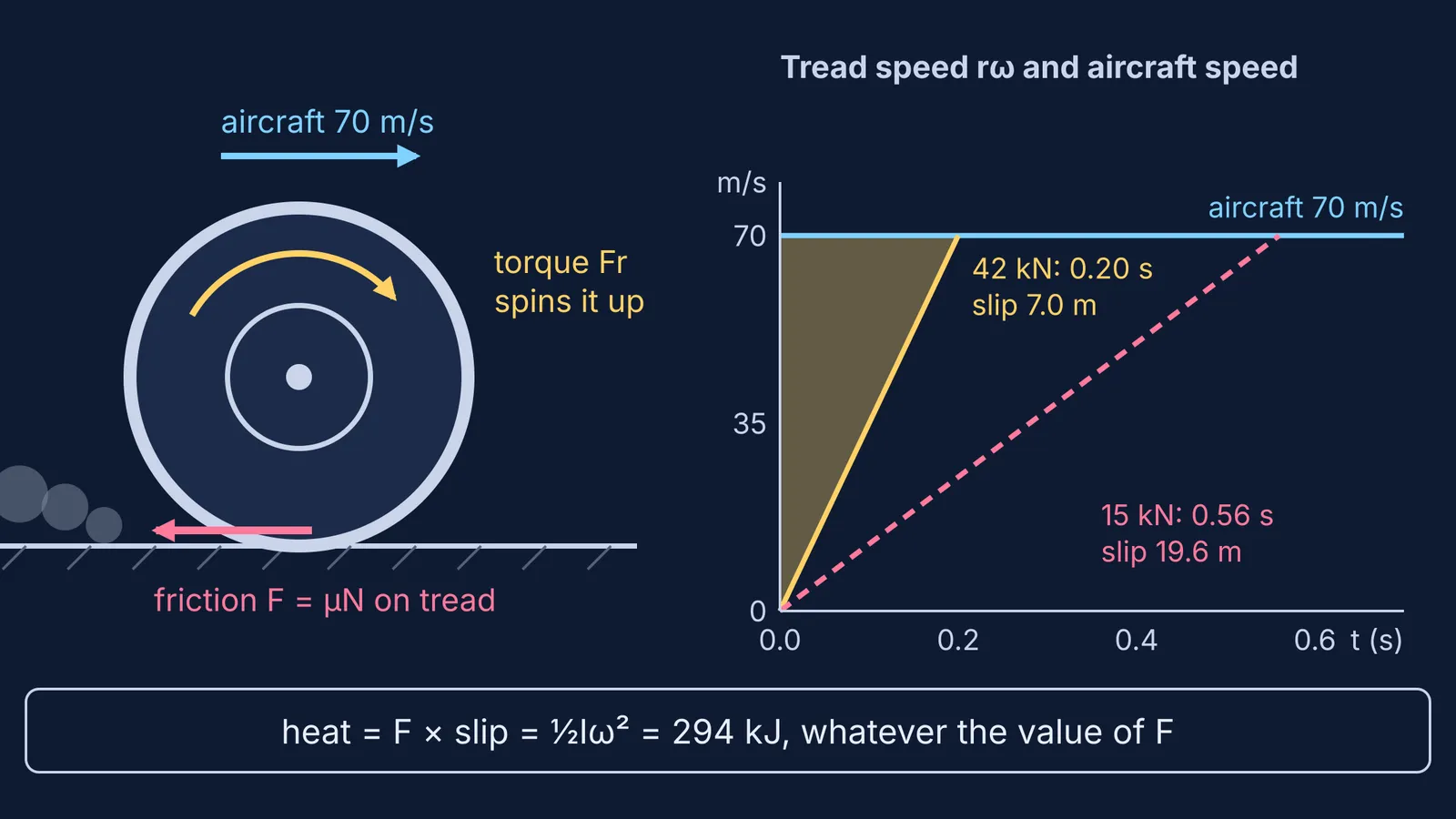
In the air the wheels are not turning. The aircraft is moving at, say, 70 m/s, but the bottom of each tyre is moving at 70 m/s too, because it is carried along with the axle and not rotating backwards. Rolling without slipping needs the bottom of the tyre to be at rest on the ground, which means v = rω. At the moment of contact ω = 0, so the tread skids along the runway at the full 70 m/s.
Engineers call the short skid that follows the spin-up period. A review by Mahjouri, Shabani and Skote in Aircraft Engineering and Aerospace Technology (2022) describes it in just these terms: the wheels are static at touchdown, they skid on the runway, and the skid lasts a fraction of a second but can burn and wear the tyre.
This is the same physics as a ball that is thrown sliding along the floor and then starts to roll, covered in when a sliding ball starts pure rolling. The difference here is that the wheel starts with no spin at all, and the aircraft's speed hardly changes.
How does friction spin the wheel up?
While the tread slides forward over the runway, kinetic friction F = μN acts on the tread pointing backwards, opposite to the sliding. N is the part of the aircraft's weight pressing that wheel down, and μ is the coefficient of kinetic friction between rubber and concrete.
That backward force acts at the bottom of the wheel, a distance r below the axle, so it gives a torque Fr. The torque spins the wheel in the forward rolling direction:
Fr = Iα, so α = Fr/I
The wheel's spin rises steadily until the tread speed rω catches up with the aircraft speed v. Then the sliding stops, kinetic friction disappears and the wheel just rolls. The spin-up time is
t = Iω/(Fr), with ω = v/r
Why is the heat the same whatever the friction force?
Heat from kinetic friction is the friction force times the distance the surfaces slide over each other. That sliding distance is not how far the aircraft travels. It is the difference between the distance the axle moves and the distance the tread moves by turning.
Axle distance: vt, since the aircraft's speed is nearly constant.
Tread distance: the tread speed rises steadily from 0 to v, so on average it is v/2, and the distance is vt/2.
Slip distance: vt − vt/2 = vt/2.
Now put in t = Iω/(Fr):
Heat = F × vt/2 = F × v × Iω/(2Fr) = ½Iω²
because v/r = ω. The force F cancels. A larger friction force spins the wheel up faster, but over a shorter slip, and the product is the same. The heat made always equals the wheel's final rotational kinetic energy.
The friction also slows the aircraft a little. It takes F × vt = Iω² of the aircraft's kinetic energy: half goes into the wheel's spin and half into heat. The same half-and-half split appears in a box placed on a moving conveyor belt, where the heat equals the kinetic energy the box gains.
Worked example: one main wheel at 70 m/s
Take an illustrative main wheel and tyre of mass 200 kg and rolling radius 0.60 m. Treat it as I = 0.6mr² (between a solid disc, 0.5mr², and a ring, mr², since much of the mass is in the tyre and rim). Real values depend on the aircraft type.
Moment of inertia. I = 0.6 × 200 × 0.60² = 43.2 kg m².
Final spin. ω = v/r = 70/0.60 ≈ 116.7 rad/s. In rpm: 116.7 × 60/(2π) ≈ 1,114 rpm.
Final rotational energy. ½Iω² = ½ × 43.2 × 116.7² ≈ 294,000 J = 294 kJ.
Firm touchdown. N = 60 kN, μ = 0.7, so F = 42 kN. t = Iω/(Fr) = 43.2 × 116.7 / (42,000 × 0.60) = 0.20 s. Slip = vt/2 = 70 × 0.20/2 = 7.0 m. Heat = 42,000 × 7.0 = 294 kJ.
Light touchdown. N = 30 kN, μ = 0.5, so F = 15 kN. t = 43.2 × 116.7 / (15,000 × 0.60) = 0.56 s. Slip = 70 × 0.56/2 = 19.6 m. Heat = 15,000 × 19.6 = 294 kJ.
Check units. I × ω has units kg m² × s⁻¹, and F × r has units N m = kg m² s⁻². Their ratio is in seconds, as a time should be.
The firm touchdown makes heat at an average rate of 294 kJ / 0.20 s ≈ 1.5 MW, the light one at about 0.5 MW, but both make the same total. Compare the aircraft's own energy: an illustrative 60-tonne aircraft at 70 m/s has ½mv² ≈ 147 MJ, so the 588 kJ each wheel takes from it is tiny. That is why treating v as constant during spin-up is fair.
Where does the heat go, and can it be avoided?
The heat is made right at the contact patch, so much of it goes into a thin surface layer of rubber, which gets hot enough to break down. That is the puff of smoke. Models of the tread temperature by Li and Wang (2023) find that this frictional heating raises the tread temperature and wears it away, and that a softer landing has little or no benefit, which matches the result above that the heat does not depend on F.
Engineers have proposed spinning the wheels up before touchdown, called pre-rotation, so that rω is already close to v. A second study by Li and Wang in the CEAS Aeronautical Journal (2023) models how pre-rotation reduces the friction heating. In energy terms, if the wheel already spins at ω₀, the heat is ½I(ω − ω₀)², which falls quickly as ω₀ approaches ω.
For a different side of landing, where the whole aircraft must stop rather than just its wheels spin up, see how jets take off and land on an aircraft carrier.
To check your own rolling-with-slipping answers step by step, try the Fermi Problem Library, which has a step-by-step solver that explains the reasoning.
Quick checklist
At touchdown ω = 0, so the tread slides at the full aircraft speed.
Friction F = μN on the tread gives torque Fr and spins the wheel up: t = Iω/(Fr).
Slip distance is vt/2, not vt.
Heat = F × slip = ½Iω², independent of F and μ.
The aircraft loses Iω²: half to spin, half to heat.
With a pre-spun wheel the heat is ½I(ω − ω₀)².


