

On this page
India's first home-built aircraft carrier, INS Vikrant, was commissioned in 2022 and flies MiG-29K fighters, as The Week explains. Its whole flight deck covers 1,34,000 sq ft, about two football grounds, according to The Tribune. A fast jet has to get airborne, and later come to a dead stop, inside that space. Two pieces of Class 11 kinematics explain how.
How do jets take off from an aircraft carrier?
Some carriers fling jets off with catapults. INS Vikrant uses a different scheme called STOBAR, short take-off but arrested recovery: the jet takes off on its own engine power up a curved ramp at the bow and lands by hooking a wire at the stern.
Vikrant's ramp is inclined at 14 degrees, and a MiG-29K takes about 3 seconds to be airborne from the deck, The Tribune reported.
The ship helps too. STOBAR carriers must keep up a speed of 20 to 30 knots (37 to 56 km/h) to generate the wind needed over the deck, according to the STOBAR entry on Wikipedia. Wings care about airspeed, not ground speed, which is the same reason planes take off into the wind.
What does the ski-jump actually do?
A flat deck would drop the jet towards the sea the moment it ran out of runway. The ramp instead turns part of the jet's forward motion into a climb, so it leaves the deck rising, like a projectile, while the engines keep adding speed.
The payoff is large: a MiG-29 launching over the ski-jump of a Russian Kuznetsov-class carrier can take off at about 70 knots (130 km/h) instead of the usual 140 knots (260 km/h), according to the Wikipedia article on aviation ski-jumps), which notes the figure depends on factors such as weight.
Here is a rough sketch of why. Borrow that exit speed of 130 km/h, about 36 m/s, and use Vikrant's 14 degrees. The vertical part is 36 × sin 14° ≈ 8.7 m/s. Ignoring lift and thrust, gravity needs 8.7 ÷ 9.8 ≈ 0.9 s to cancel that upward speed. Meanwhile it keeps speeding up until its wings can carry it.
How do jets stop in under 100 metres?
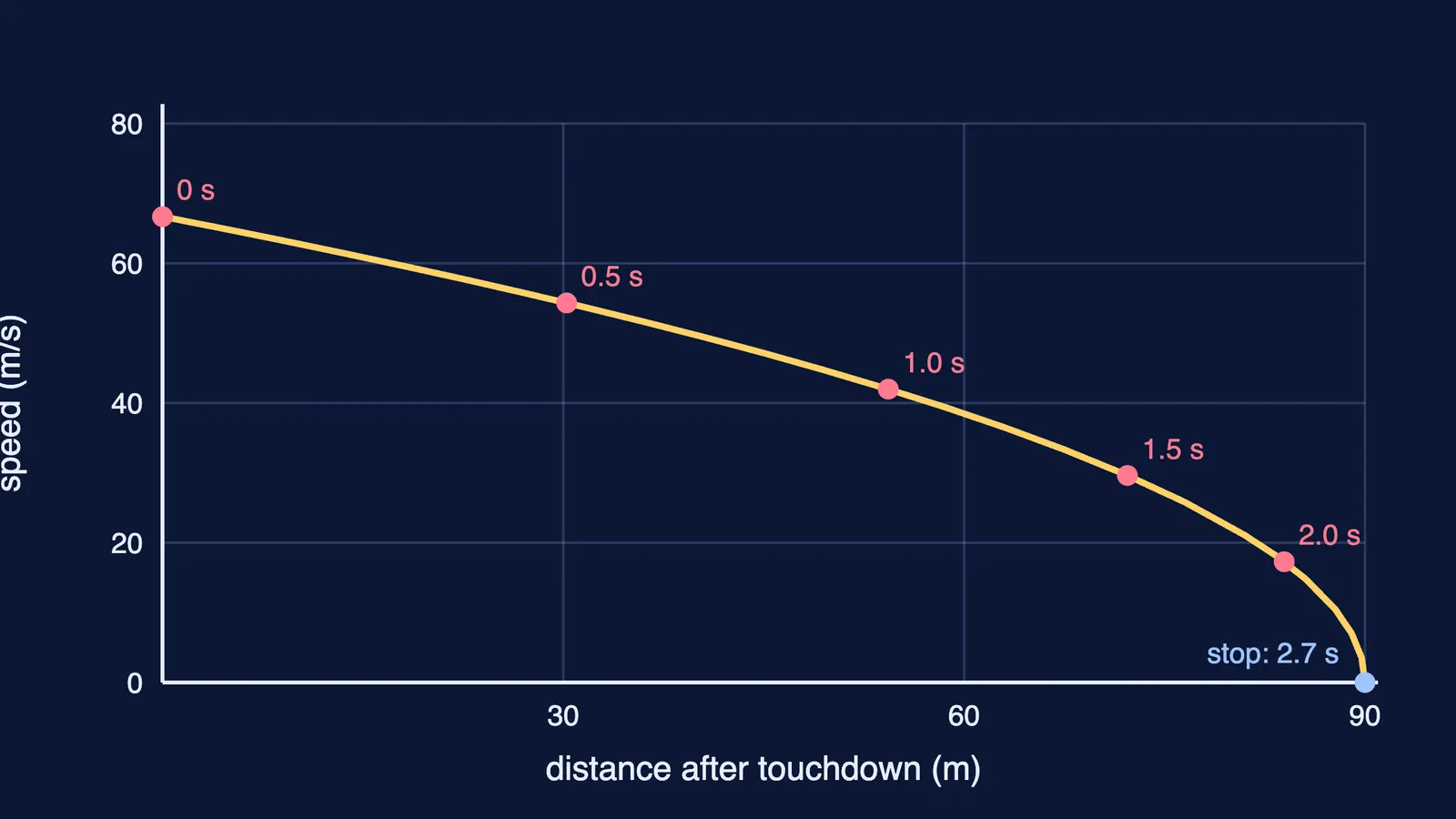
On Vikrant, three ribbed steel arrestor wires, each 1 inch thick, stretch across the 60-metre-wide deck, and a hook under the jet's tail catches one of them, The Tribune reported. The same report says a jet approaches the deck at 240 km/h and is brought to a stop within 90 metres of touchdown.
Below the deck, the wire runs to hydraulic damping systems that absorb the jet's kinetic energy, says the Wikipedia article on arresting gear. It describes a US Navy Mark 7 Mod 3 design rated to recover a 23-tonne aircraft at 130 knots (240 km/h) in 105 m, absorbing at most 64.4 MJ.
Worked example: the kinematics of an arrested landing
Use the Vikrant numbers from The Tribune: 240 km/h, stopped in 90 m. Treat the reported approach speed as the speed at touchdown, and assume constant deceleration.
Convert units: 240 ÷ 3.6 = 66.7 m/s.
Pick the equation without time in it: v² = u² − 2as, with v = 0.
Solve for a: a = u² ÷ 2s = 66.7² ÷ 180 ≈ 24.7 m/s².
Express it in g: 24.7 ÷ 9.8 ≈ 2.5 g, so the straps push the pilot back with about 2.5 times their weight.
Find the time: t = u ÷ a = 66.7 ÷ 24.7 ≈ 2.7 s.
Now check the energy, using the US design case from the arresting gear article: a 23,000 kg jet at 66.7 m/s carries ½mv² ≈ 51 MJ, inside the 64.4 MJ the system is designed to absorb. Over 105 m, the average braking force is about 51 MJ ÷ 105 m ≈ 490 kN.
The same article says the gear is designed to stop every aircraft in the same run-out, whatever its mass and speed, so a heavier aircraft gets more braking force, not a longer deck. Compare our explainer on how mass affects a vehicle's stopping distance.
How can you practise problems like this?
Use this five-step check on any stopping or launch problem:
Convert every speed to m/s before you start.
Choose the equation that leaves out the quantity you don't know and don't need.
Decide the direction of positive, then give a its sign.
Sanity-check the answer in g: if a landing comes out at hundreds of g, look for a unit slip.
Cross-check with energy, ½mv² = Fs, when a mass is given.
For ideas easier to see than to read, like the ski-jump arc, the Fermi Simulation Lab has interactive simulations. If you get stuck on a step, the Fermi Problem Library has a step-by-step solver that explains the reasoning, and Fermi's AI tutor can work out what you already know and build a plan for the session.


