

On this page
When a box is gently placed on a horizontal conveyor belt moving at constant speed, it does not match belt speed immediately. Instead, it skids forward, leaving a brief friction mark before matching the belt. While introductory students often assume friction only retards motion, a moving belt acts as the driving agent that accelerates the box. Tracking the motor work and heat dissipated reveals an elegant mechanical theorem detailed by Stewart (1989): regardless of mass or friction, exactly half of the motor's energy accelerates the box, while the other half converts into heat. This work-energy balance mirrors the principles used in interpreting work from force-displacement graphs.
Why does a box speed up when dropped on a conveyor belt?
A common misconception is that friction always opposes motion and performs negative work. In the American Journal of Physics, Lindsey, Heron, and Shaffer (2009) demonstrated that students frequently confuse motion relative to the floor with motion relative to a contact surface. Kinetic friction does not oppose laboratory velocity; it strictly opposes relative slipping between contacting surfaces.
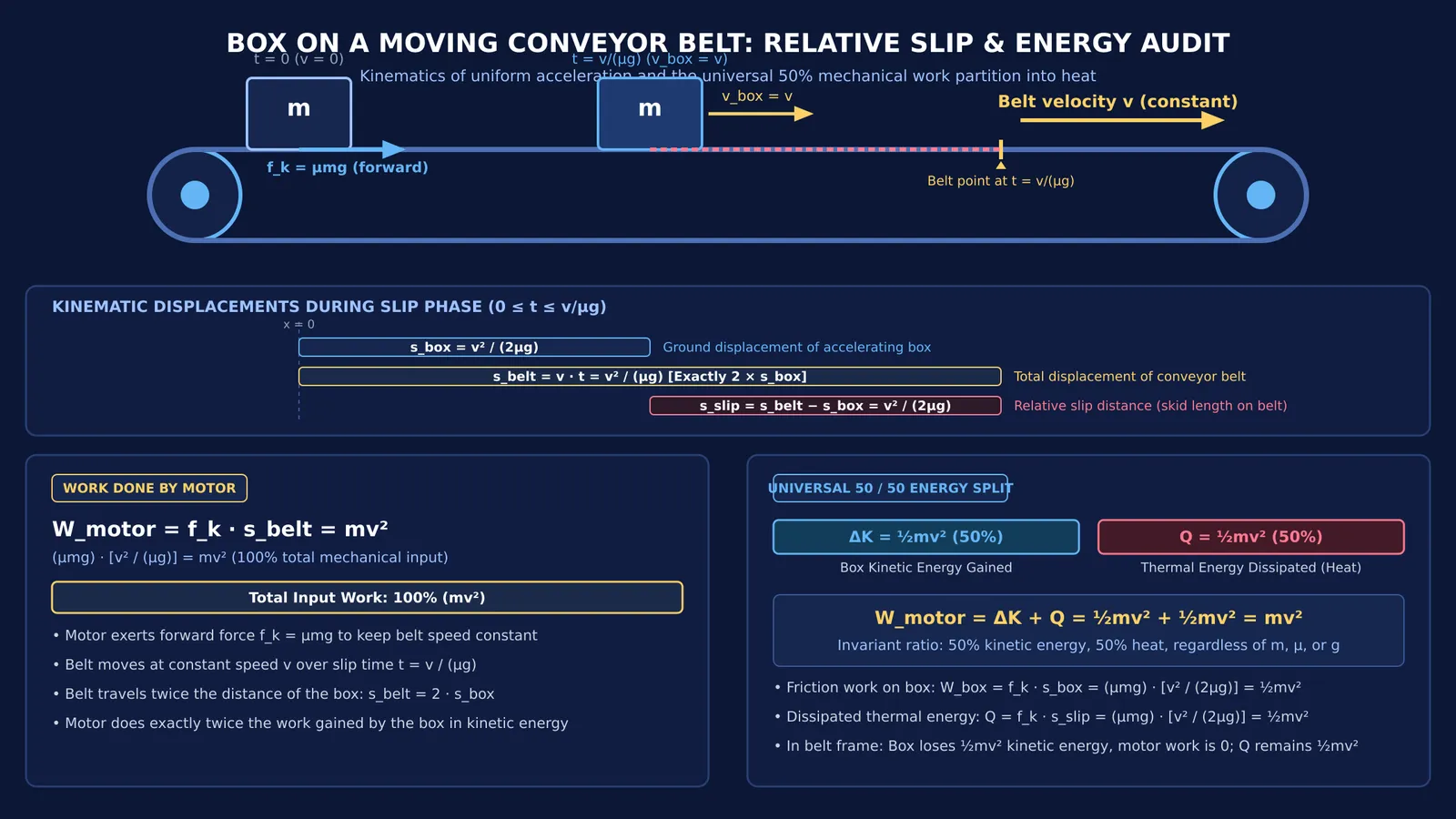
When a box of mass m is placed with zero initial speed on a belt moving right at speed v, the belt slips forward beneath it. Relative to the belt, the box moves backward. The belt therefore exerts a forward kinetic friction force f = μmg on the box, producing forward acceleration a = f/m = μg. Here, μ is the kinetic friction coefficient and g is gravitational acceleration. Kinetic friction does positive work on the box, increasing its speed until it reaches v. This contrasts with stationary surfaces, such as finding the time for a block to slide down a rough incline. Once slipping stops, friction drops to zero and the box travels at constant velocity.
How far does the box slip before matching the belt speed?
To find the slip distance, compare laboratory displacements. The time required for the box to accelerate uniformly from rest to speed v is t = v / a = v / (μg). During this time, the ground displacement of the box is:
s_box = v² / (2a) = v² / (2μg)
Meanwhile, the belt travels at uniform speed v. As shown by Stewart (1989), the belt's displacement during the same interval is:
s_belt = v × t = v² / (μg)
The belt travels exactly twice as far as the box: s_belt = 2 × s_box. The slip distance s_slip, which measures the skid mark on the belt, is their relative displacement:
s_slip = s_belt - s_box = v² / (μg) - v² / (2μg) = v² / (2μg)
The slip distance on the belt matches the distance the box advances across the floor. This contact analysis also underpins finding the minimum force to drag a block on a rough floor.
Why is exactly half the motor's work lost as heat?
In the laboratory frame, work done by friction on the box is W_box = f × s_box = (μmg)(v² / (2μg)) = ½mv², matching the kinetic energy gained, ΔK = ½mv². By Newton's third law, the box exerts an equal backward force f on the belt. To maintain constant speed, the motor supplies forward force f over displacement s_belt. The total work performed by the motor is:
W_motor = f × s_belt = (μmg)(v² / (μg)) = mv²
The motor performs twice the work gained by the box in kinetic energy. As shown by Sherwood and Bernard (1984), the remaining work is dissipated as thermal energy at the rubbing interface:
Q = f × s_slip = (μmg)(v² / (2μg)) = ½mv²
Energy conservation confirms W_motor = ΔK + Q = ½mv² + ½mv² = mv². In the belt frame, as Sherwood (1983) noted, the box loses ½mv² of kinetic energy while motor work is zero, yielding the same heat Q = ½mv². Exactly 50% of the motor's work becomes kinetic energy and 50% becomes heat, regardless of mass, friction, or gravity. For students solving multi-step mechanics questions, the Fermi Problem Library provides worked problems with a step-by-step solver that explains the reasoning rather than printing an answer.
How do slip distance and energy audit work out in practice?
Consider a standard scenario following Stewart (1989). A package of mass m = 5.0 kg is placed on a belt running at v = 3.0 m/s, with friction coefficient μ = 0.30 and g = 9.8 m/s²:
Acceleration: Friction is f = μmg = 0.30 × 5.0 kg × 9.8 m/s² = 14.7 N, giving acceleration a = f / m = 2.94 m/s².
Slipping time: The package reaches belt speed in t = v / a = 3.0 m/s / 2.94 m/s² ≈ 1.020 s.
Displacements: The package travels s_box = (3.0 m/s)² / (2 × 2.94 m/s²) ≈ 1.531 m in the laboratory, while the belt travels s_belt = 3.0 m/s × 1.020 s ≈ 3.061 m (twice s_box).
Slip distance: The skid mark length is s_slip = 3.061 m - 1.531 m = 1.531 m.
Energy audit: Kinetic energy gained is ΔK = ½ × 5.0 kg × (3.0 m/s)² = 22.5 J. Motor work is W_motor = 14.7 N × 3.061 m = 45.0 J. Heat produced is Q = 14.7 N × 1.531 m = 22.5 J.
This audit confirms Stewart's 50/50 partition: 22.5 J of kinetic energy plus 22.5 J of heat equals the 45.0 J supplied by the motor. For visualising relative motion, the Fermi Simulation Lab offers interactive simulations for ideas that are easier to see than to read. To connect friction across mechanics, explore the Fermi Concept Library, which covers every concept in physics with its own lesson and its place in the map.


