

On this page
Put exactly 1 kg of water on a good laboratory balance and it reads about 998.95 g. Put exactly 1 kg of thermocol on the same balance and it reads about 940 g. The balance is fine. Both objects sit in air, and air pushes up on them, just as water pushes up on a stone. The push is tiny for a steel weight and large for a big, light object, and that difference is what the balance sees.
Does air really exert a buoyant force on things you weigh?
Yes. Archimedes' principle works in any fluid, and air is a fluid. The upthrust equals the weight of the air the object displaces: F = ρa V g, where ρa is the air density and V is the object's volume.
Room air at about 20 °C and sea-level pressure has a density close to 1.2 kg/m³. One litre of water displaces one litre of air, about 1.2 g of it. So the upthrust on a litre of water is about 1.2 × 10⁻³ kg × 9.81 m/s² = 0.0118 N, the weight of 1.2 g.
You already know the in-water version of this: a stone weighed in water seems lighter, and the loss gives its relative density, as in finding density by weighing in air and water. Air does the same thing, about 800 times more weakly. A hot air balloon shows that weak upthrust winning over a huge volume.
Why doesn't the upthrust on the weights cancel it?
A beam balance compares your object with standard weights. Both sit in the same air, so both are buoyed. If the upthrusts were equal, they would cancel. They are not, because the upthrust depends on volume, not mass.
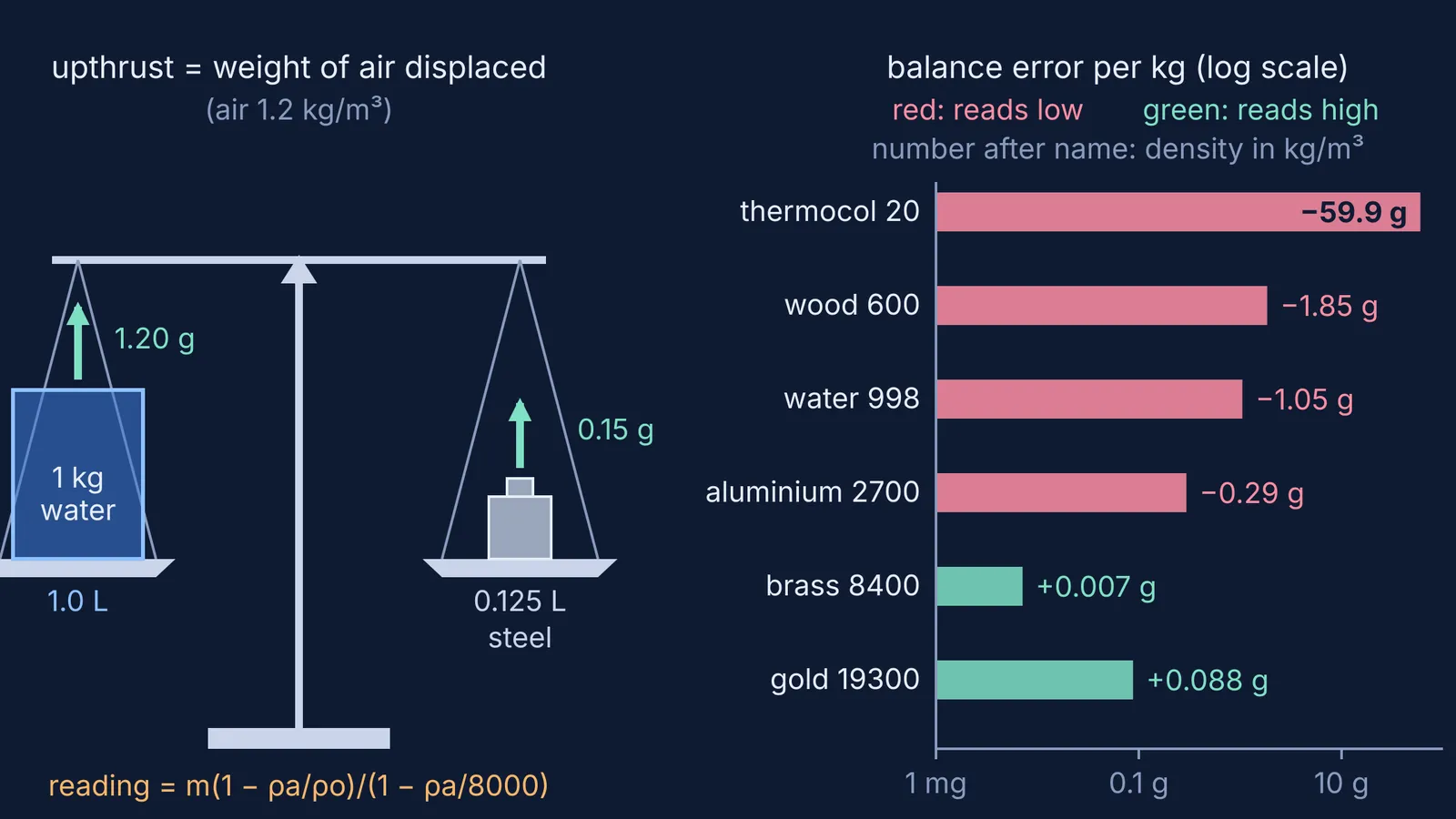
Calibration weights are usually steel, with a density close to 8,000 kg/m³. A kilogram of steel has a volume of only 0.125 L and displaces 0.15 g of air. A kilogram of water has a volume of about 1.0 L and displaces about 1.20 g of air. The water side loses about 1.05 g more, so a lighter set of weights balances it.
A digital balance does not hold weights on a second pan, but it was calibrated with steel weights. It measures a force, as explained in how a digital weighing scale works, and converts it to grams using that calibration. So it shows the same effect.
What formula gives the balance reading?
Write m for the true mass of the object, ρo for its density, ρa for the air density and ρw for the density of the weights. At balance, the net downward force on each side is equal:
m g (1 − ρa/ρo) = R g (1 − ρa/ρw)
where R is the mass of weights needed, which is what the balance reads. So:
R = m (1 − ρa/ρo) / (1 − ρa/ρw)
Three things follow straight away:
If ρo = ρw, the reading is exact. Brass and steel weights read almost true.
If ρo is less than ρw, the reading is low. Water, wood, plastic and powders all read low.
If ρo is greater than ρw, the reading is slightly high. Gold, lead and platinum read high.
Metrologists build this into a standard convention. The "conventional mass" of an object is the mass of reference weights of density 8,000 kg/m³ that balance it in air of density 1.2 kg/m³ at 20 °C. NIST's procedure for applying air buoyancy corrections (SOP 2) lists these same reference values and recommends a buoyancy correction for all high-accuracy mass measurements.
How much does each material read low or high?
Using R = m (1 − ρa/ρo) / (1 − ρa/ρw) with ρa = 1.2 kg/m³ and ρw = 8,000 kg/m³, for 1 kg of each material:
Thermocol (expanded polystyrene, taking 20 kg/m³ as an illustrative round value; real foam varies): reads 940.14 g, about 59.9 g low.
Dry wood (illustrative 600 kg/m³): about 1.85 g low.
Water (998 kg/m³): reads 998.95 g, about 1.05 g low.
Aluminium (2,700 kg/m³): about 0.29 g low.
Brass (8,400 kg/m³): about 7 mg high.
Gold (19,300 kg/m³): about 88 mg high, or 8.8 mg on 100 g.
An analytical balance that reads to 0.1 mg sees every one.
The air density matters too. At about 2,000 m, the standard atmosphere gives an air density close to 1.0 kg/m³. Put that into the formula and the error for 1 kg of water falls from 1.05 g to about 0.88 g. Temperature and humidity shift it a little more, which is why precise laboratories record them while weighing.
Worked example: correcting a pipette calibration
A student checks a 25 mL pipette by weighing the water it delivers at 20 °C. The balance, calibrated with steel weights, reads 24.950 g. The air density is 1.2 kg/m³, and water at 20 °C has a density of about 998.2 kg/m³ (0.9982 g/mL). What volume did the pipette deliver?
Write the reading formula and solve for m. m = R (1 − ρa/ρw) / (1 − ρa/ρo).
Work out the numerator. 1 − 1.2/8000 = 1 − 0.00015 = 0.99985.
Work out the denominator. 1 − 1.2/998.2 = 1 − 0.001202 = 0.998798.
Take the ratio. 0.99985 / 0.998798 = 1.001053. The true mass is about 0.105% more than the reading.
Find the true mass. m = 24.950 × 1.001053 = 24.976 g, so the correction adds 26 mg.
Convert to volume. V = 24.976 g ÷ 0.9982 g/mL = 25.021 mL.
Compare with the uncorrected answer. 24.950 ÷ 0.9982 = 24.995 mL. Skipping buoyancy makes the pipette look short by about 0.026 mL, enough to matter when you are checking glassware to the second decimal place.
Units check: the correction factor is a ratio of two dimensionless numbers, so the mass stays in grams, and grams divided by g/mL gives mL.
If you want to practise more upthrust problems like this one, the Fermi Problem Library has a step-by-step solver that explains the reasoning at each stage.
Does this mean a balance measures mass or weight?
A balance measures a force on its pan: the weight minus the upthrust from the air. It then reports grams by comparing that force with the force from known weights. A beam balance cancels g because both sides feel the same g. It does not cancel the air, because the two sides have different volumes.
For school practicals the effect is usually far smaller than other errors. It becomes important when:
the object is much less dense than the weights (water, foams, powders, gases in containers);
the balance reads to 0.1 mg or better;
you need volume from mass, as in the pipette example;
you compare weighings made in very different air, such as at sea level and in the hills.
Quick checklist
Upthrust in air = ρa V g, with ρa about 1.2 kg/m³ in a room.
The reading R = m (1 − ρa/ρo) / (1 − ρa/ρw), with ρw = 8,000 kg/m³ for steel weights.
Objects less dense than the weights read low; denser ones read slightly high.
1 kg of water reads about 1.05 g low; 1 kg of thermocol about 60 g low.
To correct a reading, multiply by (1 − ρa/ρw) / (1 − ρa/ρo).
Same mass, different readings: the balance sees net force, not mass.


