

On this page
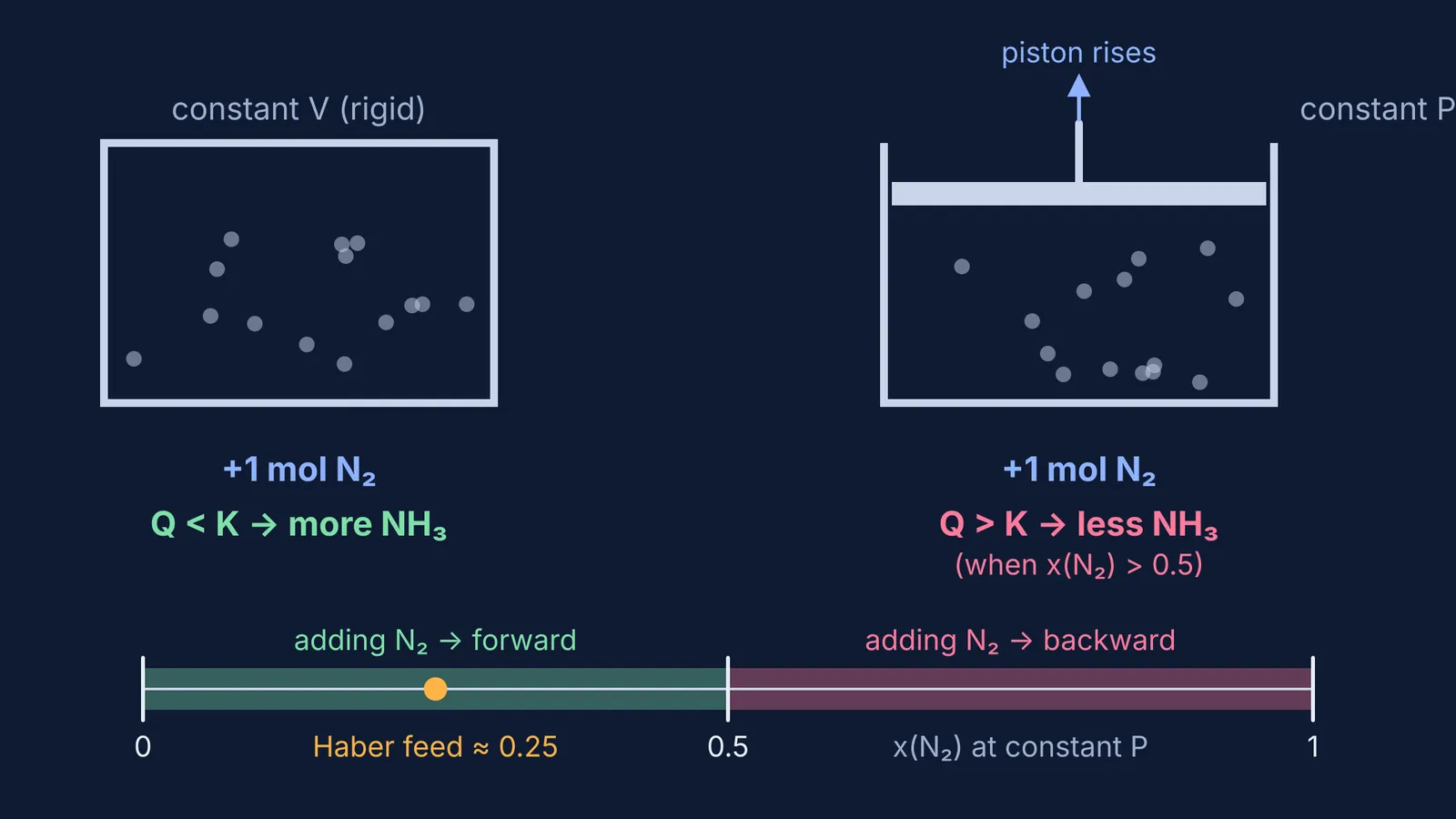
Add more reactant and the equilibrium shifts forward. That is the first thing every student learns about Le Chatelier's principle, and in a rigid vessel it is always true. In a cylinder held at constant pressure it is not. For N₂ + 3H₂ ⇌ 2NH₃, adding a little more N₂ at fixed temperature and pressure pushes the reaction backward whenever N₂ already makes up more than half of the gas. The reaction quotient Q, compared with K, predicts this correctly every time.
Does adding a reactant always shift equilibrium forward?
At constant volume, yes. Adding N₂ raises only the partial pressure of N₂. The partial pressures of H₂ and NH₃ do not change, so Q falls below K and the reaction moves forward to make more NH₃.
At constant pressure, the container has to expand to take the extra gas. That expansion dilutes every other gas. You have seen this dilution before in adding an inert gas at constant volume versus constant pressure, where argon at constant pressure pushes the ammonia reaction backward. Added N₂ does two things at once: it raises the N₂ term, which pushes forward, and it dilutes everything, which pushes backward like an inert gas. Which effect wins depends on how much N₂ is already there.
Why can adding N₂ reduce ammonia at constant pressure?
Write Qp with partial pressures pᵢ = (nᵢ / n_tot) × P:
Qp = n(NH₃)² × n_tot² / (n(N₂) × n(H₂)³ × P²)
Here n_tot is the total number of moles of gas and P is the fixed total pressure. Now add N₂ at constant P:
n(N₂) in the denominator rises, which lowers Q.
n_tot in the numerator rises too, and it is squared, which raises Q.
The n_tot² comes from Δn = 2 − 4 = −2 for this reaction. That is the same factor that makes the reaction favour fewer moles at high pressure, as shown in our post on the relation between Kp, Kc and Kx.
K itself does not change. It depends only on temperature. Only Q moves, and the reaction runs in whichever direction brings Q back to K.
When does Le Chatelier's principle fail for N₂?
Take logarithms: ln Q = 2 ln n(NH₃) + 2 ln n_tot − ln n(N₂) − 3 ln n(H₂) − 2 ln P.
Differentiate with respect to n(N₂), holding the other amounts and P fixed. Remember that n_tot also grows by one for each mole of N₂ added:
∂(ln Q)/∂n(N₂) = 2/n_tot − 1/n(N₂)
This is positive, so Q rises above K and the reaction runs backward, when 2/n_tot > 1/n(N₂), that is when n(N₂)/n_tot > 1/2.
The condition is x(N₂) > 0.5. Below that, a small addition of N₂ behaves as you expect. Above it, the dilution effect wins.
No calculus? Use a finite check instead. Adding δ mol of N₂ multiplies Q by (n_tot + δ)² × n(N₂) / (n_tot² × (n(N₂) + δ)). For a tiny δ this is above 1 exactly when x(N₂) > 0.5.
This result is a known teaching example. Corti and Franses, Chemical Engineering Education, 2003 discuss it for ammonia synthesis, and later work by the same group notes that the 0.5 threshold assumes ideal gases and moves for real gases at high pressure. Everything here assumes ideal gases.
Worked example: constant pressure versus constant volume
Use an illustrative equilibrium mixture at a total pressure of 1 bar: 6 mol N₂, 3 mol H₂ and 1 mol NH₃. These are made-up teaching numbers, not real Haber plant data.
(a) Find K and check x(N₂).
n_tot = 6 + 3 + 1 = 10, so x(N₂) = 6/10 = 0.6. That is above 0.5.
Kp = 1² × 10² / (6 × 3³ × 1²) = 100/162 = 0.617 bar⁻².
(b) Add 1 mol N₂ at constant pressure.
New amounts: 7 mol N₂, 3 mol H₂, 1 mol NH₃, so n_tot = 11.
Q = 1² × 11² / (7 × 3³) = 121/189 = 0.640 bar⁻².
Q > K, so the reaction runs backward: some NH₃ breaks down.
Let y mol of N₂ form. Solve (1 − 2y)² (11 + 2y)² / ((7 + y)(3 + 3y)³) = 0.617.
y ≈ 0.0054, so NH₃ falls from 1.000 mol to about 0.989 mol.
The shift is small, but it is in the "wrong" direction. Finite check: Q changes by a factor of 121 × 6 / (100 × 7) = 1.037, which is above 1.
(c) Two cases that go forward.
Same mixture, same 1 mol N₂, constant volume. The partial pressures of H₂ and NH₃ stay put and only p(N₂) rises from 0.6 to 0.7 bar. Q = 0.1² / (0.7 × 0.3³) = 0.529 bar⁻², which is below K. The reaction runs forward, and NH₃ rises to about 1.043 mol.
A mixture with x(N₂) = 0.25, constant pressure. At the same K and 1 bar, one such equilibrium mixture is about 2.50 mol N₂, 5.78 mol H₂ and 1.72 mol NH₃ (total 10). Add 1 mol N₂ at constant pressure: Q is multiplied by 121 × 2.5 / (100 × 3.5) = 0.864, giving Q ≈ 0.534 bar⁻², below K. The reaction runs forward, and NH₃ rises to about 1.80 mol.
One more detail from the finite check: for a large dose δ, the backward condition becomes n(N₂)(2n_tot + δ) > n_tot². So a big enough addition can push even a low-N₂ mixture backward. For the x = 0.25 mixture above it would take more than 20 mol of N₂.
Haber plants feed N₂ and H₂ in about a 1 : 3 ratio, so x(N₂) is about 0.25 in the feed, well inside the forward region. The plant choices are explained in why the Haber process uses 450 °C and 200 atm.
If you want to see how Q and K move when you change one amount at a time, the Simulation Lab has interactive simulations for ideas that are easier to see than to read.
So is Le Chatelier's principle wrong?
No. It is a useful rule of thumb, and it gives the right answer in almost every textbook case. Le Chatelier's own 1884 statement, covered in our post on Henry Le Chatelier and the rule for shifting equilibria, was a qualitative guide. It does not tell you which effect wins when one change pulls Q two ways at once. Q versus K is the exact test, and it never fails.
Quick checklist
Constant V: adding N₂ always shifts the reaction forward.
Constant P: added N₂ also dilutes H₂ and NH₃.
For N₂ + 3H₂ ⇌ 2NH₃ at constant P, a small addition of N₂ shifts backward when x(N₂) > 0.5.
K does not change; only Q moves.
When in doubt, compute Q and compare with K.
With no condition stated, answer forward, as NCERT does.


