

On this page
What is the relation between Kp, Kc and Kx?
The equilibrium state of a gaseous reaction can be measured in three ways: by partial pressures (Kp), molar concentrations (Kc), or mole fractions (Kx). The link between them is Δn, which is the number of moles of gaseous products minus the number of moles of gaseous reactants Wikipedia.
From the ideal gas law, we get the standard relationship between pressure and concentration: Kp = Kc(RT)^Δn
To find Kx, we use Dalton's law of partial pressures, which states that a gas's partial pressure is its mole fraction multiplied by the total pressure (p = X × P). Substituting this into the Kp expression gives the relationship Wikipedia: Kp = Kx(P)^Δn
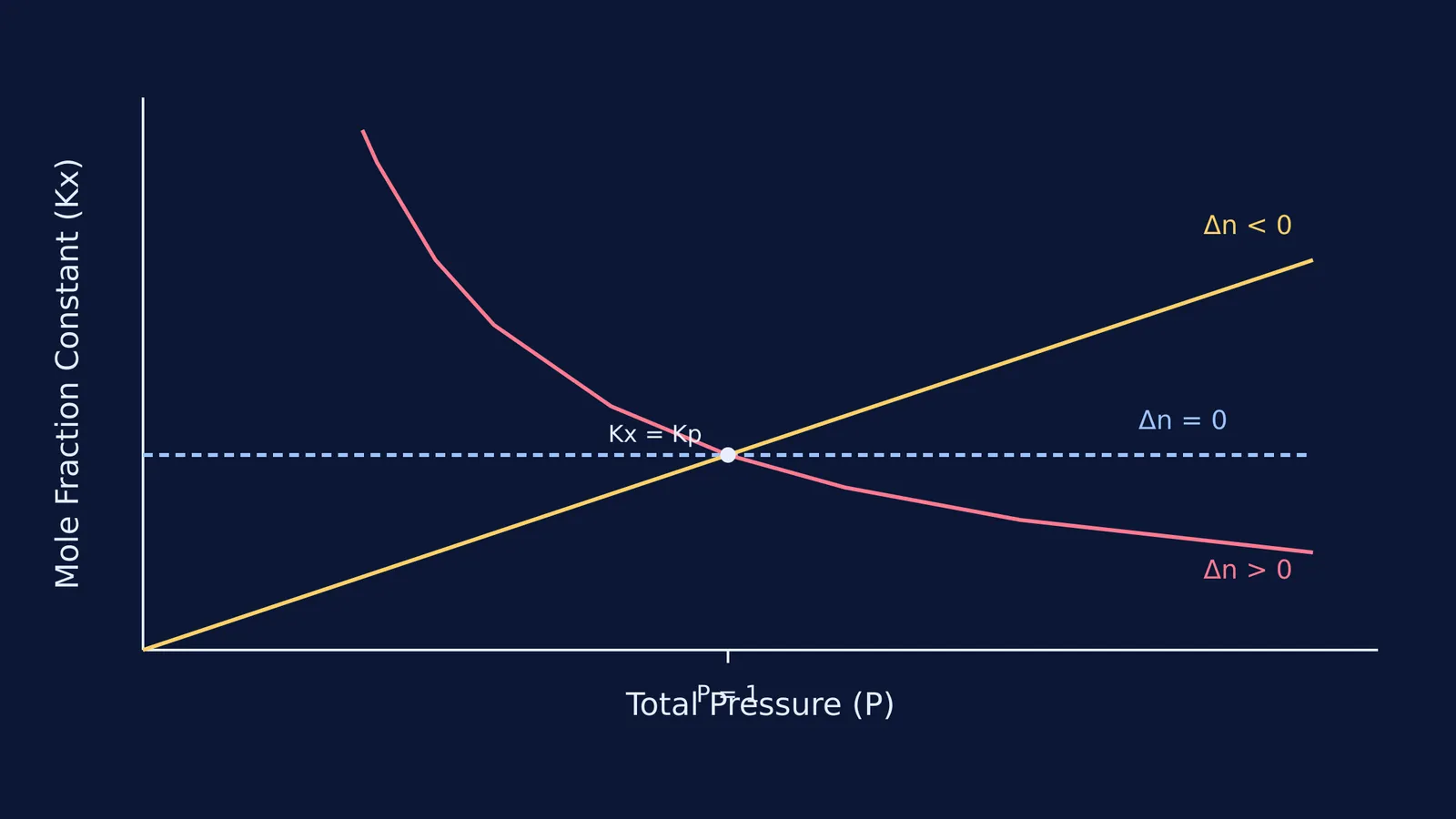
Rearranging this formula shows how the mole fraction constant behaves: Kx = Kp × P^(-Δn)
This equation is a cornerstone in physical chemistry because it bridges the gap between a constant value (Kp) and the shifting composition of a mixture (Kx).
If you are trying to remember these formulas for an upcoming exam, the Fermi Concept Library maps out every derivation in chemical equilibrium so you can see where each term originates rather than just memorising the final equation.
Why does Kx depend on pressure?
When Henry Louis Le Chatelier published his famous principle in 1884, he observed that increasing the pressure on a gas mixture causes it to shift toward the side with fewer molecules Wikipedia. While this is a helpful rule of thumb, the equation Kx = Kp × P^(-Δn) explains exactly why it happens.
Because Kp is locked by the temperature, any change in the total pressure P forces Kx to adjust.
If Δn < 0 (fewer product moles): The -Δn exponent becomes positive. If you increase the pressure, Kx must increase. To make Kx larger, the reaction creates more products.
If Δn > 0 (more product moles): The -Δn exponent is negative. Increasing the pressure causes Kx to shrink, meaning the reaction runs backwards to create more reactants.
If Δn = 0: The pressure term becomes P⁰ = 1. Pressure has no effect on the mole fractions, and Kp = Kc = Kx.
You can avoid common Chemical equilibrium problems by treating Le Chatelier's rule not as magic, but as the mathematical consequence of keeping Kp constant.
A worked example: The Haber process
Let us apply this to the synthesis of ammonia, one of the most tested reactions in chemistry: N₂(g) + 3H₂(g) ⇌ 2NH₃(g)
Calculate Δn: We have 2 moles of product and 4 moles of reactants, so Δn = 2 - 4 = -2.
Write the relation: Kx = Kp × P^(-(-2)) = Kp × P².
Change the pressure: If we double the total pressure from 1 atm to 2 atm, the term P² increases by a factor of 4.
Determine the shift: Because Kp does not change, the new mole fraction constant Kx must become 4 times larger.
The expression for Kx in this reaction is: Kx = (X_NH₃)² / (X_N₂ × (X_H₂)³)
For Kx to quadruple, the mole fraction of ammonia (X_NH₃) in the numerator must increase while the reactant fractions in the denominator decrease. This means the system must convert more nitrogen and hydrogen into ammonia to reach the new equilibrium state. The reaction shifts to the right, exactly as Henry Le Chatelier predicted in 1884 when he described how systems oppose applied changes.
How to solve Kp and Kx problems without errors
When tackling these questions, the hardest part is setting up the initial and equilibrium moles correctly. Here is a reliable framework:
Write the balanced equation and calculate Δn immediately.
Draw an ICE (Initial, Change, Equilibrium) table using moles, not concentrations or pressures. Let the initial moles be 1 or a, and the change be proportional to the stoichiometry (e.g. -x or -3x).
Sum the equilibrium row to find the total number of moles at equilibrium.
Divide each substance's moles by the total moles to find its mole fraction.
Write the Kx expression and substitute it into Kp = Kx(P)^Δn.
If the algebraic steps feel overwhelming, you can bring your work to the Fermi Problem Library. Our AI tutor acts as a guide, checking your ICE tables for equilibrium line by line and catching misplaced coefficients before you get to the final answer.


