

On this page
Turn a parked car's steering wheel to full lock and look at the front tyres from the front. They are not parallel. The wheel on the inside of the turn is angled more sharply than the one on the outside. That is not a fault. It is geometry, and it comes from one idea you already use in rotational kinematics: a body rolling without slipping turns about a single instantaneous centre.
Why must the inner front wheel turn more than the outer?
At low speed, a tyre should move along the direction it points. Pushed sideways, it scrubs: rubber drags across the road and the tyre wears.
So during a slow turn, every wheel should roll along a circle about one common centre. Each wheel's own axle line, the line through its hub at right angles to the wheel, must then pass through that centre. The rear wheels do not steer, so their axle line is the line of the rear axle. The turning centre must lie somewhere on that line, off to the side of the car.
Now look at the two front wheels. The inner one is closer to the centre and runs on a tighter circle. To point at right angles to its line from the centre, it must be steered through a larger angle. The outer wheel, further away, needs a smaller angle. This is the Ackermann condition.
A Penn State engineering thesis defines the same ideal case: each tyre tangent to a circle drawn from the turn centre (Troupe, Pennsylvania State University, 2011).
What is the Ackermann steering formula?
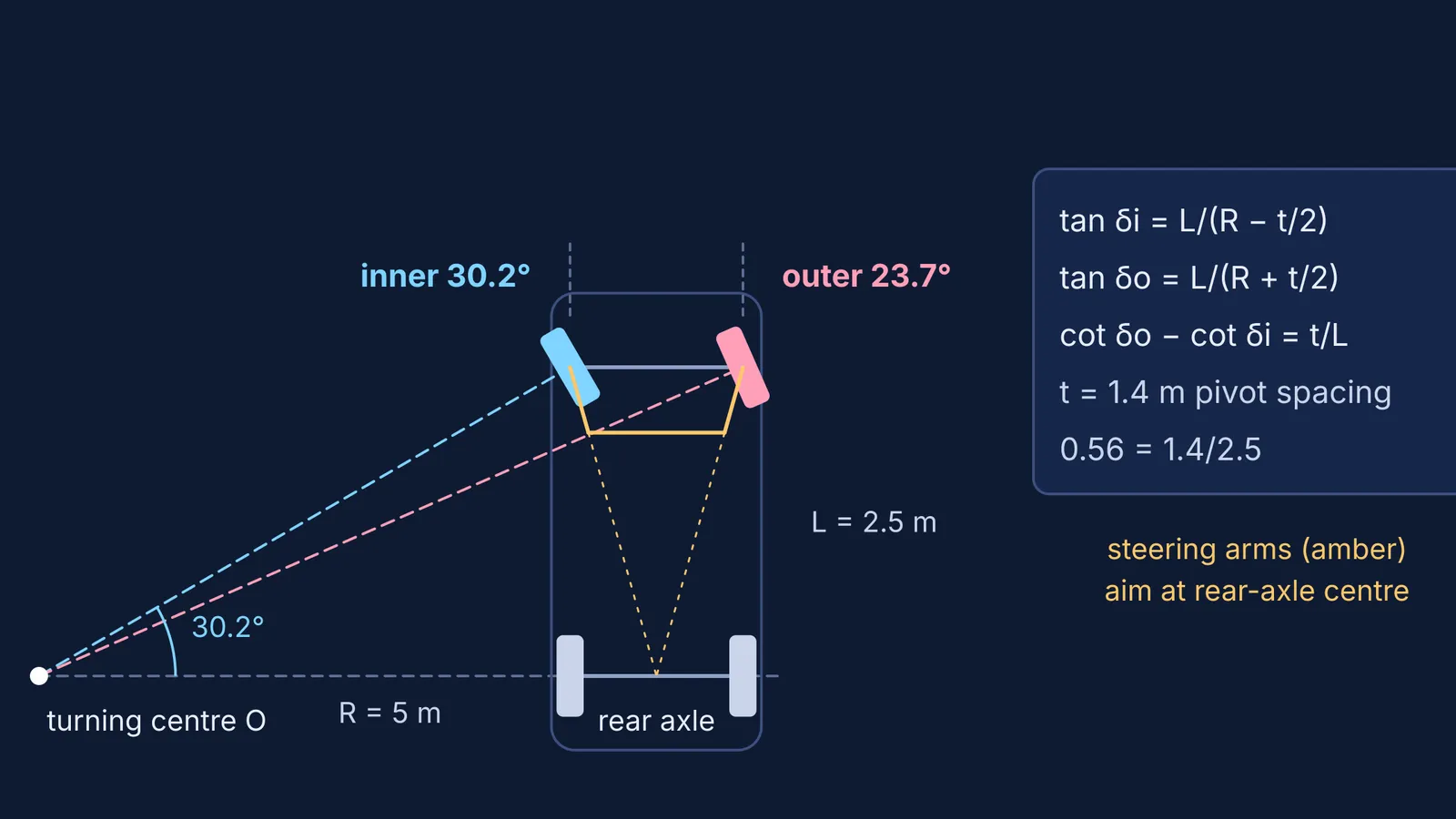
Call the wheelbase L (front axle to rear axle), the distance between the two front steering pivots t, and the turning radius R, measured from the turning centre to the middle of the rear axle. The inner front pivot is R − t/2 from the centre along the rear-axle line and L ahead of it. The outer pivot is R + t/2 along and L ahead.
Inner wheel: tan δi = L / (R − t/2)
Outer wheel: tan δo = L / (R + t/2)
Take cotangents and subtract:
cot δo − cot δi = (R + t/2)/L − (R − t/2)/L = t/L
R cancels, so the difference of the cotangents is fixed for a given car at every turning radius.
Here t is the spacing of the steering pivots (kingpins), which is close to, but not the same as, the track width between tyre centres.
Worked example: a 5 m turn
Take an illustrative small car: L = 2.5 m, t = 1.4 m, turning on a circle of radius R = 5 m measured to the middle of the rear axle.
Inner pivot position. R − t/2 = 5 − 0.7 = 4.3 m along the rear-axle line, 2.5 m forward.
Inner angle. tan δi = 2.5/4.3 = 0.5814, so δi = 30.17°.
Outer pivot position. R + t/2 = 5.7 m along, 2.5 m forward.
Outer angle. tan δo = 2.5/5.7 = 0.4386, so δo = 23.68°.
Difference. 30.17° − 23.68° = 6.49°.
Check. cot 23.68° − cot 30.17° = 2.28 − 1.72 = 0.56, and t/L = 1.4/2.5 = 0.56. The formula holds.
Paths. The inner front wheel runs on a circle of radius √(4.3² + 2.5²) = 4.97 m. The outer front wheel runs on √(5.7² + 2.5²) = 6.22 m. The rear wheels run on 4.3 m and 5.7 m. Four wheels, four radii, one centre.
What goes wrong with parallel steering?
Suppose both front wheels were turned through the same 30.17°. The inner wheel would be correct. The outer wheel's axle line would now cross the rear-axle line 5.7 − 4.3 = 1.4 m away from the true turning centre. That wheel would "want" to circle a point that the rest of the car is not circling.
The car cannot follow two centres at once, so the outer tyre is dragged sideways, pointing about 6.49° away from the direction it actually travels. You hear this as squeal in tight car parks and pay for it in tyre wear.
How does a simple steering linkage get close to Ackermann?
The classic layout is a trapezium. Each front wheel has a short steering arm fixed to it, and a tie rod joins the ends of the two arms. If the arms were parallel to the wheels, the linkage would be a parallelogram and both wheels would turn equally. Instead the arms are angled inward so that, with the wheels straight, lines along them meet near the middle of the rear axle.
For our car, each arm is angled inward by arctan((t/2)/L) = arctan(0.7/2.5) = 15.6°. When you steer, the tie rod pulls the inner arm through a bigger angle than the outer one, which is what the Ackermann condition asks for.
The same thesis describes this rule of thumb (project lines from the steering arms to the centre of the rear axle) and shows that no trapezium linkage gives ideal geometry at every turning radius (Troupe, 2011). Our own calculation agrees: with 15 cm arms on this car, when the inner wheel is at 30.17° the linkage sets the outer wheel at about 25.6°, roughly 2° more than the ideal 23.68°.
Does Ackermann geometry still matter at high speed?
Ackermann geometry is a low-speed rule. It assumes the tyres roll with no sideways slip. In a fast corner, the tyres must make sideways force to bend the car's path, and they only do that by running at small slip angles. Then the right steering angles depend on load transfer and tyre behaviour, not on geometry alone. How much Ackermann a race car should use is still studied; one paper compared Ackermann and parallel steering on a Formula SAE car model (Veneri and Massaro, Vehicle System Dynamics, 2020).
The linkage is named after Rudolph Ackermann, who took out British patent no. 4212 for it in 1818. The design itself is credited to the Munich carriage builder Georg Lankensperger, with Erasmus Darwin having sketched a similar idea earlier (Troupe, 2011).
How does this connect to what you study?
The rear wheels also run on different radii, 4.3 m and 5.7 m here, which is why the driven axle needs a differential; see how a car differential splits wheel speeds. The force at the steering wheel is a separate question, covered in how hydraulic and electric power steering work.
The core tool here is the instantaneous centre of rotation, the same method that solves the ladder sliding down a wall. If the idea is still shaky, the Concept Library explains rolling without slipping and the instantaneous axis step by step.
Quick checklist
In a slow turn, every wheel's axle line passes through one turning centre on the rear-axle line.
Inner wheel: tan δi = L/(R − t/2). Outer wheel: tan δo = L/(R + t/2).
cot δo − cot δi = t/L, the same at every turning radius.
For L = 2.5 m, t = 1.4 m, R = 5 m: 30.17° inside, 23.68° outside.
Parallel steer makes the outer tyre scrub at about the angle difference.
A trapezium linkage with arms aimed at the rear-axle centre gets close, not exact.
At speed, tyre slip angles matter more than this geometry.


