

On this page
A ladder slipping down a wall is a common JEE rigid-body question and a Class 12 related-rates problem. One end falls and one slides, but the ladder's fixed length ties them together. Here are three ways to see that link.
How are the velocities of the two ends of a sliding ladder related?
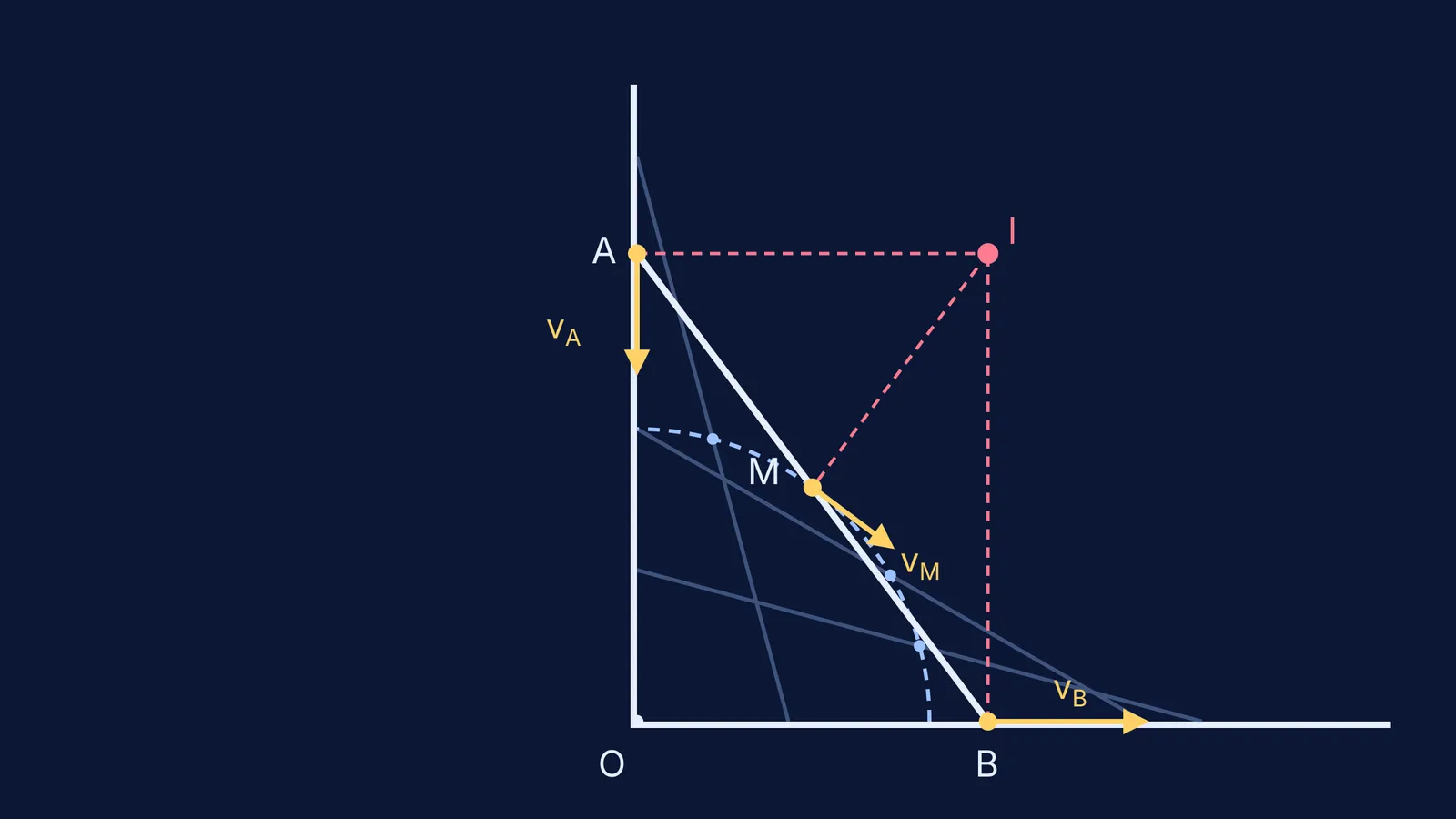
Put the origin at the corner. Let the top A be at height y, the foot B at distance x from the wall, the ladder's length L and its angle with the floor θ.
The constraint is Pythagoras: x² + y² = L², true at every instant while both ends touch.
Differentiate with respect to time: 2x(dx/dt) + 2y(dy/dt) = 0. If the foot moves out at speed v_B, the top moves down at speed v_A = (x/y)v_B = v_B cot θ.
A second route: a rigid rod cannot stretch, so both ends have the same velocity component along the rod. That gives v_A sin θ = v_B cos θ, the same result. It is the idea behind constraint relations in pulley problems, with a rod in place of a string.
What path does the midpoint of a sliding ladder follow?
The midpoint M sits at (x/2, y/2). Its distance from the corner is half of √(x² + y²), which is L/2 at every instant. So the midpoint moves on a quarter circle of radius L/2 centred at the corner. The trammel of Archimedes, a rod pinned to two sliders that run in perpendicular channels and used to draw ellipses, rests on the same geometry: the point midway between its pivots moves on a circle.
Each component of the midpoint's velocity is half that of an end, so v_M = ½√(v_A² + v_B²) = v_B / (2 sin θ). For a uniform ladder the midpoint is also the centre of mass, and a 2020 arXiv paper on teaching rigid-body motion uses this constraint, x_cm² + y_cm² = ℓ² for a ladder of length 2ℓ, to get v_cm = ℓω.
How does the instantaneous centre method work for a sliding ladder?
The instant centre of rotation is a point with zero velocity at that instant; every other point moves as if the body were turning about it. It lies where lines perpendicular to the velocities of two points meet.
A moves vertically and B horizontally, so the perpendiculars are the horizontal line through A and the vertical line through B. They meet at I = (x, y), the far corner of the rectangle that has the ladder as its diagonal.
Now every speed is ω times a distance from I:
v_A = ω × IA = ωx
v_B = ω × IB = ωy
v_M = ω × IM = ωL/2, since IM is half the rectangle's other diagonal
Dividing the first two gives v_A/v_B = x/y, with no calculus. Our post on the instantaneous axis of rotation for rolling bodies uses the same idea for wheels.
Worked example: a 5 m ladder pulled at 2 m/s
The foot of a 5 m ladder is 3 m from the wall and is pulled away at 2 m/s. Find the speeds of the top and the midpoint.
Geometry: y = √(25 − 9) = 4 m.
Constraint: v_A = (3/4) × 2 = 1.5 m/s, downward.
Instant centre: ω = v_B / IB = 2/4 = 0.5 rad/s.
Midpoint: v_M = ω × L/2 = 0.5 × 2.5 = 1.25 m/s.
Check: M moves at (1, −0.75) m/s, so v_M = √1.5625 = 1.25 m/s.
Which method to pick:
Only the two ends asked: differentiate x² + y² = L².
The midpoint, any other point, or ω asked: instant centre, one distance each.
Energy questions: you need ω and v_cm together, so find the instant centre first.
If you get stuck on a variant, the Fermi Problem Library has worked problems with a step-by-step solver that explains the reasoning rather than printing an answer.
Why does the textbook answer break down near the floor?
The formula v_A = (x/y)v_B goes to infinity as y goes to zero, which no ladder does. Burke, Jackson and Kifowit, writing in The College Mathematics Journal, explain that a real ladder leaves the wall partway down and then falls as a pendulum whose pivot slides along the floor. In a textbook case of a 13 ft ladder with its foot pulled at 8 ft/s, the related-rates answer for the top's speed at a height of 5 ft is 19.2 ft/s; their model says the top has already left the wall at about 6.085 ft and is falling at about 18.375 ft/s at that height (preprint).
A related classic: a uniform ladder released from rest, with a frictionless wall and floor, loses contact with the wall at two-thirds of its initial height. Kleppner and Kolenkow's mechanics textbook sets this as an exercise, as the arXiv paper above notes. Use the constraint relation only while both ends touch, and say so in your answer.
For the static case with friction, read torque and equilibrium for ladders, beams and hinged rods.


