

On this page
With the engine off, a parked car's steering wheel feels like arm-wrestling; with it running, two fingers do. That difference is power steering, built on two Class 11 ideas: torque and pressure.
How does rack and pinion steering work?
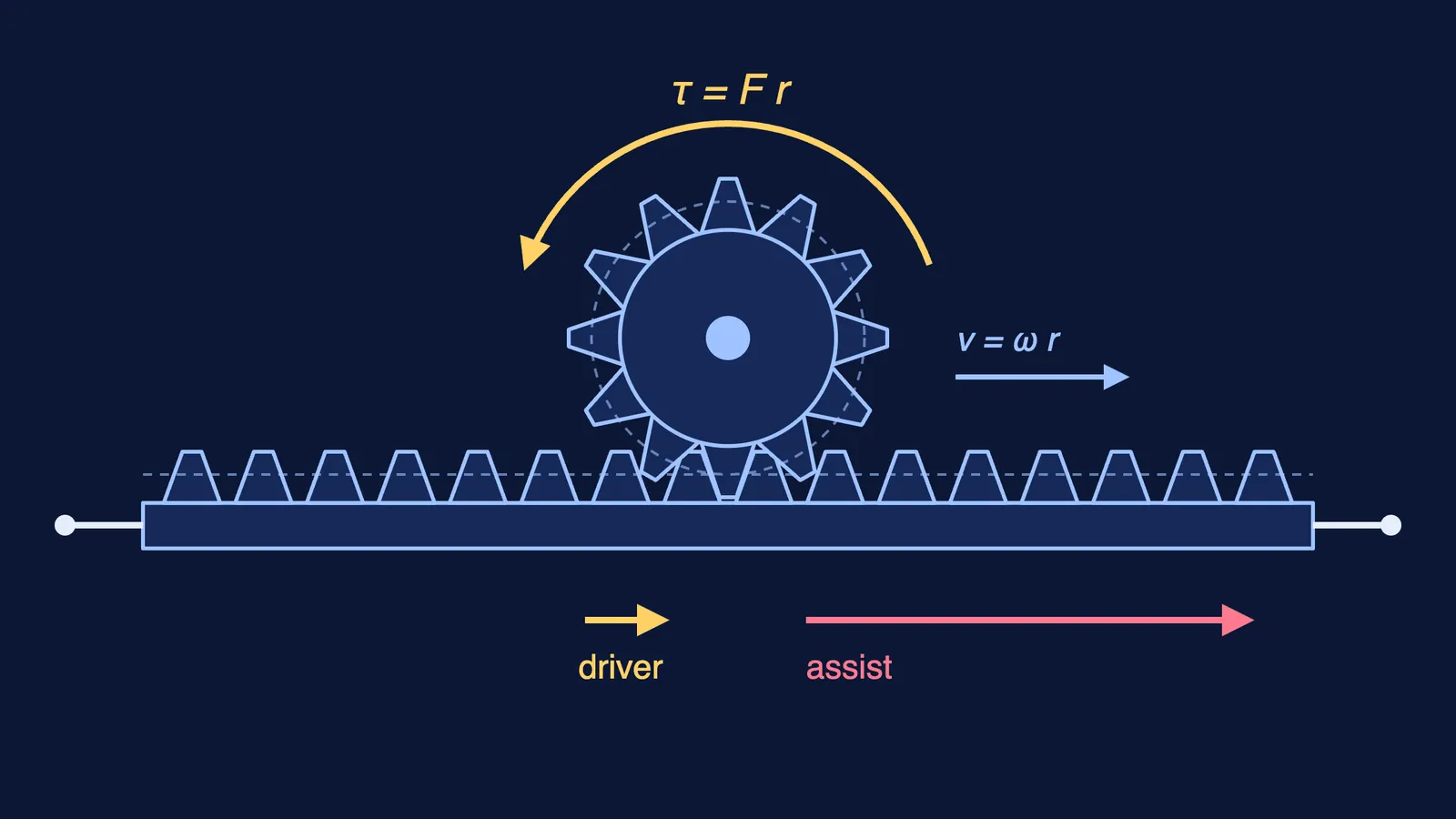
In rack and pinion steering, the steering column ends in a small gear, the pinion, whose teeth mesh with a straight toothed bar, the rack; an assist motor or cylinder pushes on the column or the rack (kfz-tech, electric power steering). Turn the wheel and the rack slides sideways, pushing rods that turn the front wheels.
Your hands apply a torque: τ = F × R, where R is the steering wheel's radius.
The pinion turns it into a push on the rack: F_rack = τ ÷ r, where r is the pinion's radius.
The rack moves at v = ω × r.
A small pinion gives a large push, the same logic as bicycle gears trading torque for speed. Unsure whether torque is in joules? See the units of torque and moment of inertia.
Worked example: how much help does the driver need?
These are round numbers for the arithmetic, not measurements from a real car.
You push the rim of a steering wheel of radius 0.18 m with 20 N. Torque = 20 × 0.18 = 3.6 N m.
The pinion has radius 0.008 m. Force on the rack = 3.6 ÷ 0.008 = 450 N.
Suppose turning the tyres while parked needs 3,000 N at the rack. Unassisted, that needs 3,000 × 0.008 = 24 N m of torque, or 24 ÷ 0.18 ≈ 133 N at the rim: like holding up a 13.6 kg bag.
The assist supplies the missing 3,000 − 450 = 2,550 N.
Hydraulically, with a 10 cm² (0.001 m²) piston, that needs p = F ÷ A = 2,550 ÷ 0.001 = 2.55 × 10⁶ Pa, about 25 bar: why pressure depends on area, put to work.
Hydraulic vs electric power steering: what is the difference?
In hydraulic power steering, a high-pressure oil pump driven by the engine supplies oil to a cylinder on the steering gear, where a piston separates two working chambers (kfz-tech, hydraulic power steering). A control valve in the steering shaft reacts to the slightest turn and sends oil to one side of the piston, pushing the rack your way.
The catch: the pump turns whenever the engine does, even on a straight highway. Geoffrey Dyer's 1997 SAE analysis found conventional hydraulic steering grossly inefficient because of high parasitic losses, and judged on-demand electric systems likely the best for energy use (SAE paper 970379).
In electric power steering, a short section of the steering column twists slightly as you steer, and the twist angle is a measure of your steering torque (kfz-tech, electric power steering). A control unit reads it and drives a motor geared to the column or the rack, drawing energy only when help is needed.
NHTSA estimated that switching to electric power steering reduces fuel consumption by 1.3% in a midsize car, 1.1% in a large car and 0.8% in a large light truck, as tabulated in a 2015 National Research Council report (National Academies, Appendix S, Table S.1).
What happens to power steering when the engine is off?
A hydraulic pump is driven by the engine, so when the engine stops, the oil pressure is gone and you are back to step 3: moving the rack with your arms alone.
Electric systems lose their assist too. A 2021 Kia owner's manual puts it plainly: "If the engine is off or if the power steering system becomes inoperative, the vehicle may still be steered, but it will require increased steering effort" (Kia owner's manual, power steering).
How to explain power steering in an exam answer
A five-line plan for a long answer or viva:
Draw the pinion on the rack; mark τ = F × R.
Write F_rack = τ ÷ r and v = ω × r.
Name the assist: oil on a piston (F = p × A) or an electric motor.
Energy use: hydraulic whenever the engine runs, electric only while you steer.
Engine off: no assist, still steerable, more effort.
If rotation turning into straight-line motion is hard to picture, the Fermi Simulation Lab has interactive simulations for ideas easier to see than read. To practise torque and pressure problems like this one, Fermi's AI tutor works out what you already know and builds a plan for the session.
Next time you are in a car, picture the rack sliding under the wheel.


