

On this page
Read the FSSAI standard for chilli powder and two lines look odd for a food: total ash, not more than 8.0%, and ash insoluble in dilute HCl, not more than 1.3%. The second number, usually called acid-insoluble ash (AIA), is how a food lab spots sand and soil in a spice. The test is two steps of NCERT inorganic chemistry: burn the organic matter away, then dissolve everything except silica in acid.
What is acid-insoluble ash?
Total ash is what is left when a spice powder is burnt completely in a furnace. Acid-insoluble ash is the part of that ash that will not dissolve when boiled with dilute hydrochloric acid. In practice that is almost all silica (SiO₂) and silicate minerals: sand, soil and dust, plus a little silica that the plant laid down in its own tissue.
FSSAI's Food Products Standards (Chapter 2.9, salt, spices and condiments) set both numbers spice by spice, on a dry basis. For powders, for example:
Chilli powder: total ash not more than 8.0%, AIA not more than 1.3%
Turmeric powder: total ash not more than 9.0%, AIA not more than 1.5%
Coriander powder: total ash not more than 7.0%, AIA not more than 1.5%
Whole spices have their own lines in the same FSSAI spices standard, so always check which product a limit belongs to.
What happens when a spice is ignited at 550 °C?
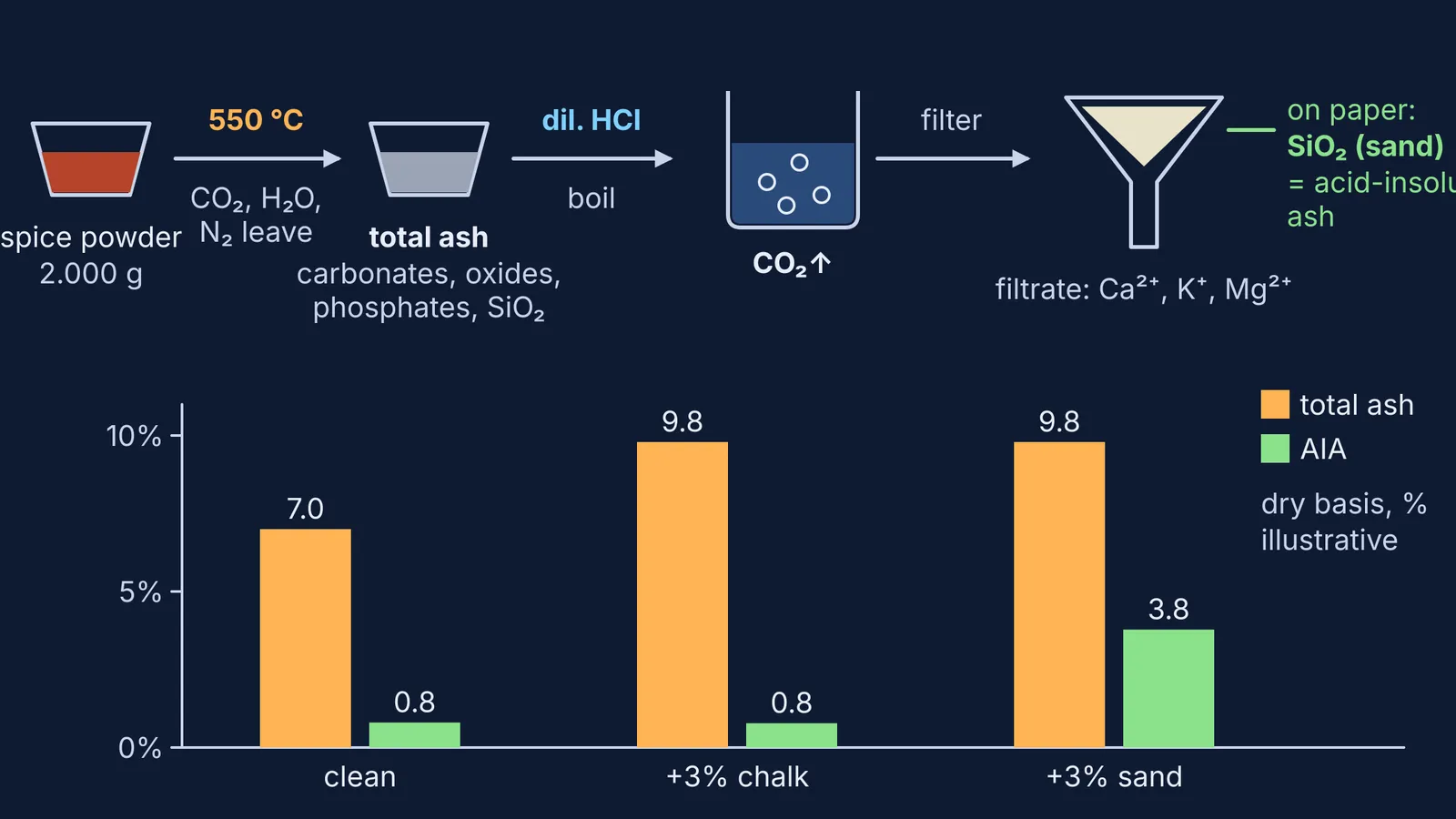
FSSAI's manual of methods for spices and condiments (based on IS 1797 and AOAC 941.12) asks for about 2 g of powder in a dish, charred gently and then ignited in a muffle furnace at 550 ± 25 °C for 3–4 hours, until the ash is free of black carbon specks. It is weighed to constant mass.
At that temperature the organic matter burns:
Carbon leaves as CO₂
Hydrogen leaves as H₂O
Nitrogen leaves as N₂ and nitrogen oxides
What stays is the mineral part, but not in the form it had in the plant. Potassium and calcium that were bound to organic acids end up mostly as carbonates and oxides. Phosphate stays as phosphate. Silica stays as silica. So ash is not "the minerals in the food" as they were; it is what those minerals turn into on burning. For a similar idea outside the lab, see why incense stick ash keeps its shape.
Some methods add sulphuric acid before ashing to give "sulphated ash"; that is a different number.
Why does dilute HCl dissolve everything except sand?
Boil the ash with 25 mL of dilute HCl and the basic part reacts:
K₂CO₃ + 2HCl → 2KCl + H₂O + CO₂
CaCO₃ + 2HCl → CaCl₂ + H₂O + CO₂
CaO + 2HCl → CaCl₂ + H₂O
Ca₃(PO₄)₂ + 6HCl → 3CaCl₂ + 2H₃PO₄
All the products are soluble. Silica is different. SiO₂ is a giant covalent network of Si–O bonds and is not attacked by HCl, H₂SO₄ or HNO₃. The only common acid that dissolves it is hydrofluoric acid (SiO₂ + 4HF → SiF₄ + 2H₂O), which is why HF is never stored in glass.
The mixture is filtered through ashless filter paper, and the paper is washed with hot water until a drop of the washings gives no white precipitate with silver nitrate:
Ag⁺ + Cl⁻ → AgCl↓
That check matters. Any chloride salt left on the paper would be weighed as "insoluble" and inflate the AIA. The paper is then burnt off at 550 °C, and the residue is weighed.
How do the two numbers tell sand from chalk?
Chalk (CaCO₃) and fine sand are both cheap, white or dull powders that add weight. The two ash numbers react to them differently:
Chalk raises total ash, because it does not burn away. But it dissolves in HCl, so AIA barely moves.
Sand raises total ash and AIA by about the same amount, because it neither burns nor dissolves.
Both are reported on a dry basis: % on dry basis = % as received × 100 / (100 − moisture %).
Worked example: a chilli powder sample
(a) Does the sample pass? 2.000 g of chilli powder with 9.0% moisture gives 0.1440 g of total ash. After boiling with HCl, filtering and re-igniting, 0.0420 g remains.
Total ash as received: 0.1440 / 2.000 × 100 = 7.20%.
On dry basis: 7.20 × 100 / (100 − 9.0) = 7.20 / 0.91 = 7.91%. Limit 8.0%: passes, just.
AIA as received: 0.0420 / 2.000 × 100 = 2.10%.
On dry basis: 2.10 / 0.91 = 2.31%. Limit 1.3%: fails.
Total ash alone would have let this sample through. The AIA shows about 1 percentage point more acid-insoluble matter than a clean powder is allowed, which points to soil or sand.
(b) The fingerprint. Take a clean powder with 7.0% total ash and 0.8% AIA (dry basis, illustrative numbers). Mix 97 g of it with 3 g of adulterant.
With 3 g fine sand: total ash = 0.97 × 7.0 + 3.0 = 9.79%; AIA = 0.97 × 0.8 + 3.0 = 3.78%. Both rise by about 3 points.
With 3 g chalk, assuming it survives as CaCO₃: total ash = 9.79%; AIA = 0.97 × 0.8 = 0.78%. Only total ash rises.
If the chalk were fully converted to CaO, each gram would leave 56.1/100.1 = 0.560 g, so total ash = 6.79 + 3 × 0.560 = 8.47%. AIA is still 0.78%.
Which line applies depends on the furnace. CaCO₃ ⇌ CaO + CO₂ only becomes fast at roughly 800–900 °C, so at 550 °C most of the chalk stays as carbonate, and the first chalk figure is the realistic one. Either way the pattern holds: chalk moves one number, sand moves both.
(c) Why the limit is not zero. Spices are grown in soil, dried in the open and handled in dusty places, and plant tissue itself holds a little silica. A clean powder always shows some AIA. The limit is set just above that natural level.
If the dry-basis conversion or the mixture arithmetic trips you up, the Fermi Problem Library has a step-by-step solver that explains the reasoning behind each line.
What can acid-insoluble ash not detect?
AIA only sees material that survives fire and acid. It says nothing about synthetic dyes such as metanil yellow, lead chromate, starch or sawdust, which need their own tests. Some of the simpler screens are in FSSAI's DART home tests for food adulteration.
Quick checklist
Total ash: ignite at about 550 °C; C, H and N leave as gases.
Acid-insoluble ash: boil the ash in dilute HCl; carbonates, oxides and phosphates dissolve, silica does not.
Wash until AgNO₃ gives no AgCl, or chloride inflates the result.
Report on dry basis: × 100 / (100 − moisture).
Chalk raises total ash only; sand raises both.
Limits differ by spice and by whole or powder; read the FSSAI table.


