

On this page
Why does hydrofluoric acid attack glass when other acids do not?
Most students preparing for CBSE board examinations or JEE Main learn that common mineral acids like hydrochloric acid (HCl), nitric acid (HNO₃), and sulphuric acid (H₂SO₄) are safely stored in standard glass reagent bottles. Hydrofluoric acid (HF) is a striking exception. Although HF is chemically classified as a weak acid in dilute aqueous solution—a property explored when examining conjugate acid-base pairs—it readily dissolves common soda-lime and borosilicate laboratory glassware.
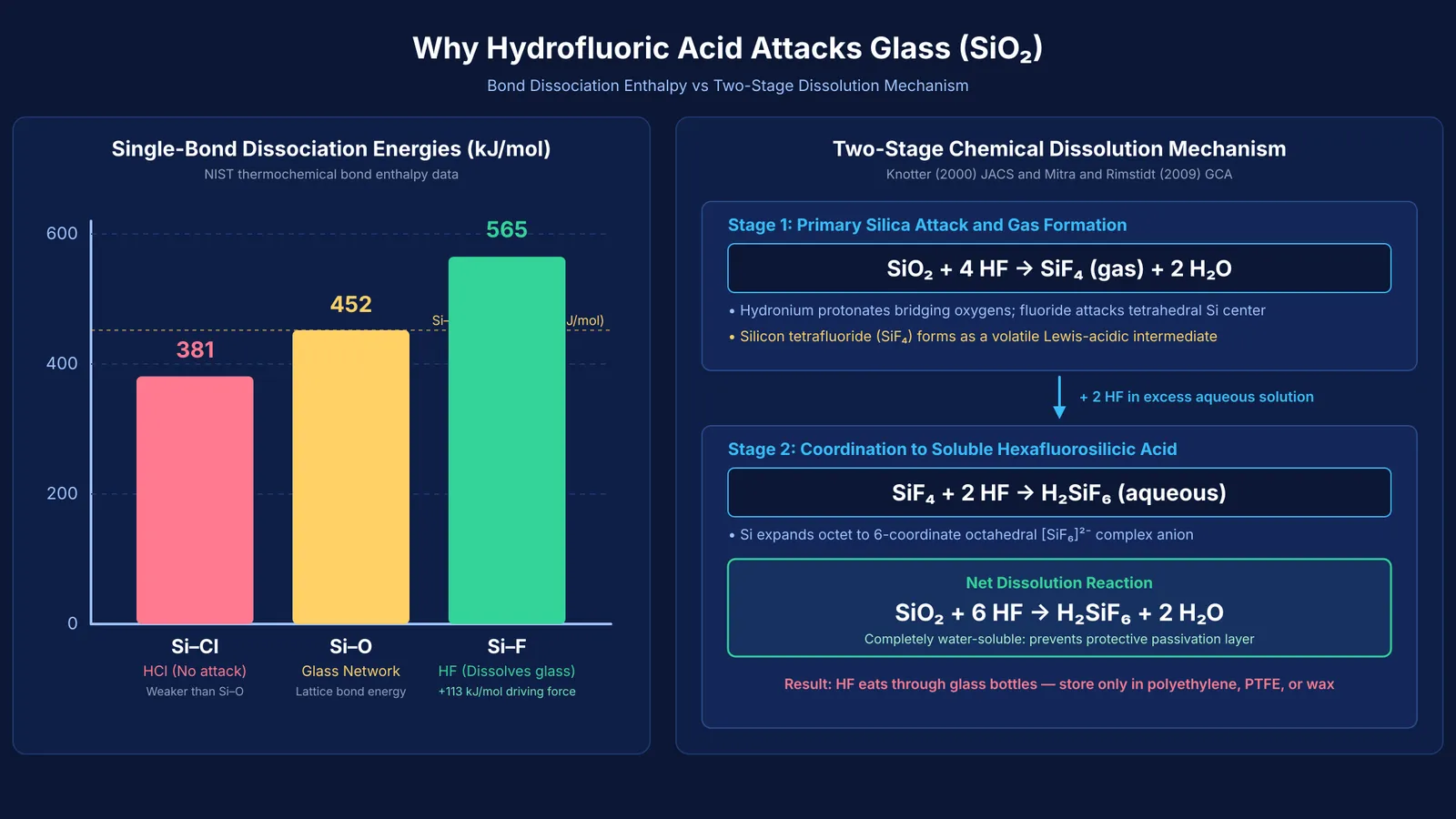
The explanation lies in thermochemistry rather than classical acid strength. Glass is predominantly composed of silicon dioxide (SiO₂), held together by a rigid network of silicon-oxygen (Si–O) covalent bonds. According to the NIST Chemistry WebBook, the average bond energy of an Si–O single bond in silicates is approximately 452 kJ/mol. Hydrochloric acid cannot attack this network because the resulting silicon-chlorine (Si–Cl) bond has a much lower bond energy of roughly 381 kJ/mol, making the substitution thermodynamically unfavorable.
In contrast, silicon forms exceptionally stable bonds with fluorine. Data compiled in the NIST Chemistry WebBook show that the average Si–F bond energy reaches approximately 565 kJ/mol. The immense enthalpy released upon forming Si–F bonds provides the thermodynamic driving force to break the silica lattice and drive the reaction forward.
What chemical reactions happen when hydrofluoric acid meets silica?
When aqueous hydrofluoric acid meets silica, dissolution proceeds through a two-stage mechanism. As described by D. Martin Knotter, hydronium ions protonate bridging oxygen atoms while fluoride species attack silicon centers.
Silica initially reacts with hydrofluoric acid to produce silicon tetrafluoride gas and water:
SiO₂ + 4 HF → SiF₄ + 2 H₂O
Silicon tetrafluoride (SiF₄) is a volatile gas with tetrahedral geometry. In the presence of excess aqueous hydrofluoric acid, electrophilic silicon acts as a strong Lewis acid—similar to the behavior analyzed in the Lewis acidity of boron trihalides—accepting two additional fluoride ions to yield hexafluorosilicic acid:
SiF₄ + 2 HF → H₂SiF₆
Combining these steps yields the net dissolution equation:
SiO₂ + 6 HF → H₂SiF₆ + 2 H₂O
Hexafluorosilicic acid is water-soluble, dissociating into octahedral [SiF₆]²⁻ anions and solvated protons. As Arijit Mitra and J. Donald Rimstidt showed, continuous removal of products into solution prevents protective passivation, allowing the acid to eat through the container wall.
For students exploring coordinate geometry and reaction pathways, the Fermi Concept Library covers every concept in physics, chemistry, biology, mathematics and computing, each with its own lesson and its place in the map.
What containers safely store hydrofluoric acid in the laboratory?
Because hydrofluoric acid dissolves glass, ceramics, and concrete, storing it safely requires silicon-free materials. According to the PubChem Hydrofluoric Acid Summary and the NIOSH Pocket Guide to Chemical Hazards, compatible storage materials include:
Polyethylene bottles: High-density polyethylene (HDPE) and low-density polyethylene (LDPE) consist of inert hydrocarbon chains that HF cannot cleave.
Fluoropolymer containers: Polytetrafluoroethylene (PTFE or Teflon) and perfluoroalkoxy (PFA) offer maximum chemical resistance for high-purity acid.
Paraffin wax vessels: Historically, chemists stored HF in thick beeswax or paraffin wax bottles before modern plastics became widespread.
Laboratories must never place hydrofluoric acid in glass beakers or volumetric flasks, where it quickly frosts surfaces and breaches container walls.
How does industry turn glass etching into a precision tool?
While hazardous to glassware, hydrofluoric acid's ability to dissolve silica makes it valuable in industry. A review by G. A. C. M. Spierings outlines its primary applications:
Semiconductor fabrication: In microelectronics, buffered oxide etch (BOE)—a calibrated mixture of ammonium fluoride (NH₄F) and HF—selectively removes silicon dioxide films from silicon wafers.
Glassware calibration: Instrument makers coat glass in wax, scribe scale markings through to the glass, and expose them to HF vapor to etch permanent graduations.
Frosted glass production: Dilute acid solutions create microscopic surface pits that scatter light, producing decorative matte finishes.
For students practicing stoichiometry and equilibrium problems, the Fermi Problem Library provides worked problems with a step-by-step solver that explains the reasoning rather than printing an answer.
How do you calculate silica consumption in a spill?
Competitive exams like JEE Advanced frequently test etching stoichiometry. Here is how to calculate silica loss during an acid exposure.
Problem: A 50.0 mL spill of 4.00 M hydrofluoric acid reacts completely with a glass plate via SiO₂ + 6 HF → H₂SiF₆ + 2 H₂O. What mass of SiO₂ is consumed?
Find moles of HF: 4.00 mol/L × 0.0500 L = 0.200 mol HF.
Apply stoichiometry: 6 moles of HF consume 1 mole of SiO₂, yielding 0.200 / 6 = 0.0333 mol SiO₂.
Calculate mass dissolved: According to atomic weights published by the NIST Chemistry WebBook, the molar mass of SiO₂ is 60.08 g/mol. Mass = 0.0333 mol × 60.08 g/mol = 2.00 g SiO₂.
This shows that just 50 mL of 4 M acid dissolves 2.00 grams of glass—enough to pierce standard glassware. Connecting coordination mechanisms with acid classifications, as detailed in Arrhenius, Bronsted-Lowry and Lewis acid definitions, helps students master both practical laboratory safety and core inorganic principles.


