

On this page
Under India's immunization schedule, you probably had a tetanus-containing shot as a baby, again as a toddler, again before school and again as a teenager. Your measles shots stopped before you turned two. Same body, same immune system, so why does one vaccine keep coming back? The answer is a graph every Class 12 biology student draws: the primary and secondary immune response.
What happens after the first dose and after a booster?
The first time your immune system meets an antigen, the response is slow and small. The second time, memory cells are already waiting, so antibodies rise sooner and higher. We cover the basic curve in primary vs secondary immune response: why the second is faster; here is what it means for vaccines.
The US CDC's Principles of Vaccination chapter says that for inactivated vaccines, "the first dose does not produce protective immunity, but 'primes' the immune system," and a protective response develops after the second or third dose. The same chapter explains that memory B cells stay in the blood and bone marrow for many years and, on re-exposure, "begin to replicate and produce antibody rapidly to reestablish protection."
A booster is a planned re-exposure: it uses the fast secondary response to push antibody levels back up before they fall too low.
Why do toxoid and inactivated vaccines need boosters?
A toxoid vaccine is made from a bacterial toxin that has been inactivated, according to the CDC Pink Book. Tetanus and diphtheria vaccines work this way. Inactivated vaccines, like the one described in how Covaxin was made by growing a virus and then killing it, also cannot multiply inside you. The CDC notes that the response to an inactivated vaccine is mostly antibody production, and that antibody titres against inactivated antigens diminish with time.
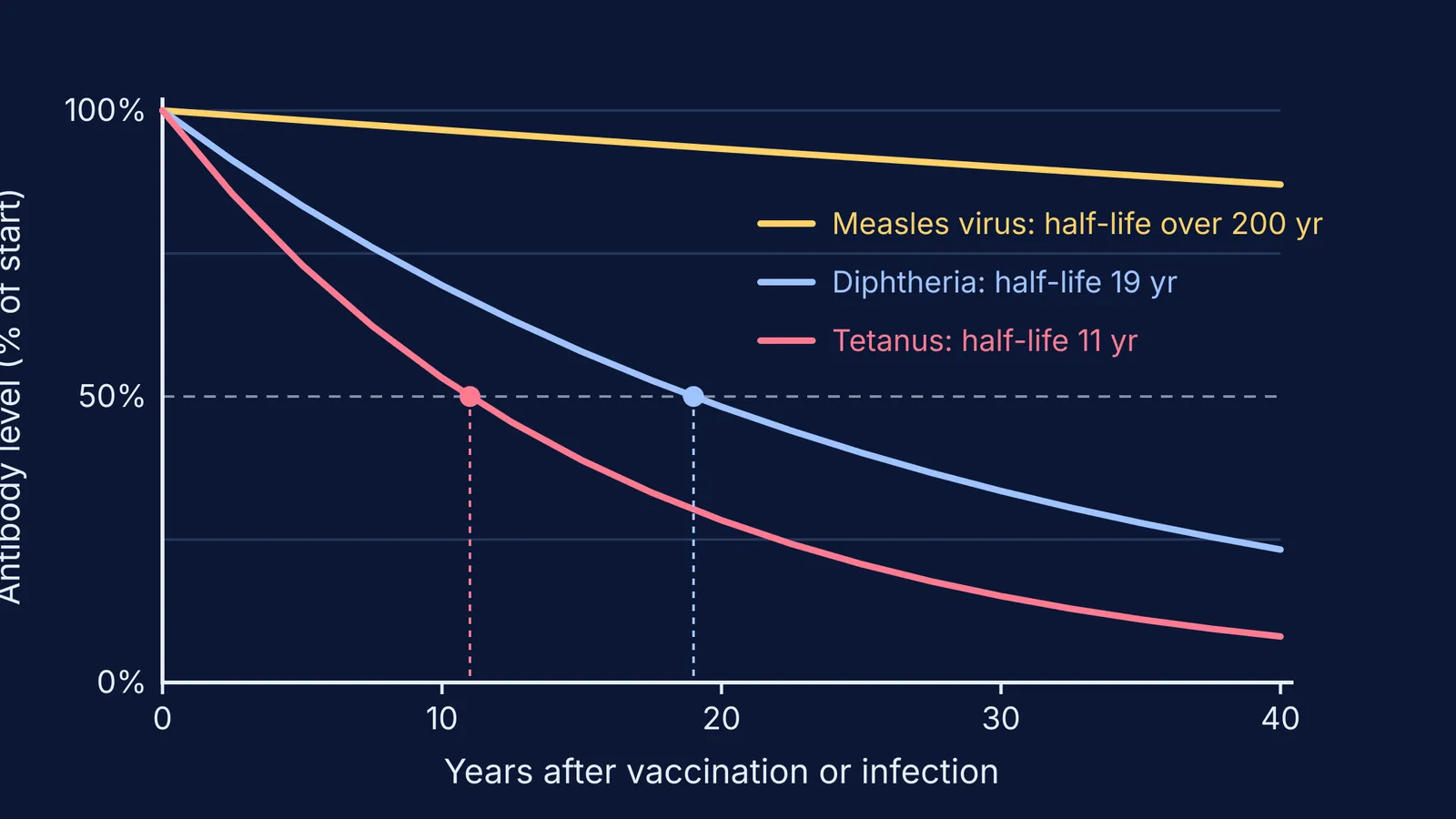
How fast? A study in the New England Journal of Medicine followed antibody levels in 45 people for up to 26 years. The researchers estimated that antibodies to tetanus have a half-life of 11 years and antibodies to diphtheria a half-life of 19 years. Each booster restarts that slow decline from a higher point.
That is why the WHO tetanus position paper aims for 6 doses for lifelong protection: 3 primary doses in infancy plus 3 boosters, given at 12-23 months, 4-7 years and 9-15 years. India's National Immunization Schedule follows the same pattern, with DPT boosters in early childhood and tetanus-containing doses again in the school years.
Why don't some live vaccines need boosters?
Live attenuated vaccines, such as measles, mumps and rubella, contain a weakened germ that must replicate in the vaccinated person to work, says the CDC Pink Book. Because it multiplies, the response closely resembles natural infection. The CDC states that injected live vaccines produce immunity in most recipients with one dose.
The same NEJM study found antibody responses to viruses such as measles and mumps were remarkably stable, with estimated half-lives of more than 200 years. The abstract does not separate infection from vaccination, but this fits the CDC's point that a live vaccine behaves like an infection. In the diagram at the top, that is the almost flat yellow line next to the falling tetanus and diphtheria curves.
How do you draw the antibody titre curve in an exam?
A worked example, with timing from India's schedule. Question: a child gets a tetanus-containing vaccine at 6, 10 and 14 weeks and a booster at 16-24 months. Sketch the antibody titre and explain the shape.
Draw time on the x-axis and antibody titre on the y-axis. Mark each dose with a small arrow.
First dose: a lag, then a low peak that falls back. Label it "primary response".
Second and third doses: each rise starts sooner and climbs higher, because memory cells now exist.
Booster: a steep, quick rise to the highest peak. Label it "secondary response: memory cells".
After the booster: a slow downward slope. Write one line: toxoids do not replicate, so titres fall and another booster is due later.
For an injected live vaccine on the same axes, draw one dose, one rise, and a curve that stays almost flat.
A quick checklist for any vaccine question:
Toxoid, killed or subunit vaccine: expect a primary series plus boosters.
Injected live attenuated vaccine, such as MMR: expect one or two doses; a second dose often catches non-responders.
Real schedules also depend on the disease and the age at risk, so quote the official schedule, not just the rule.
If the curve still feels abstract, the Fermi Concept Library covers every concept in biology, each with its own lesson and its place in the map. For practice, the Fermi Problem Library has worked problems with a step-by-step solver that explains the reasoning rather than printing an answer.


