On this page
Covaxin, made by Bharat Biotech with the Indian Council of Medical Research, is a whole-virion inactivated vaccine. That phrase hides a factory process: grow the real virus, kill it chemically, clean it up, and stick what is left onto a mineral that makes your immune system pay attention.
How was Covaxin made, step by step?
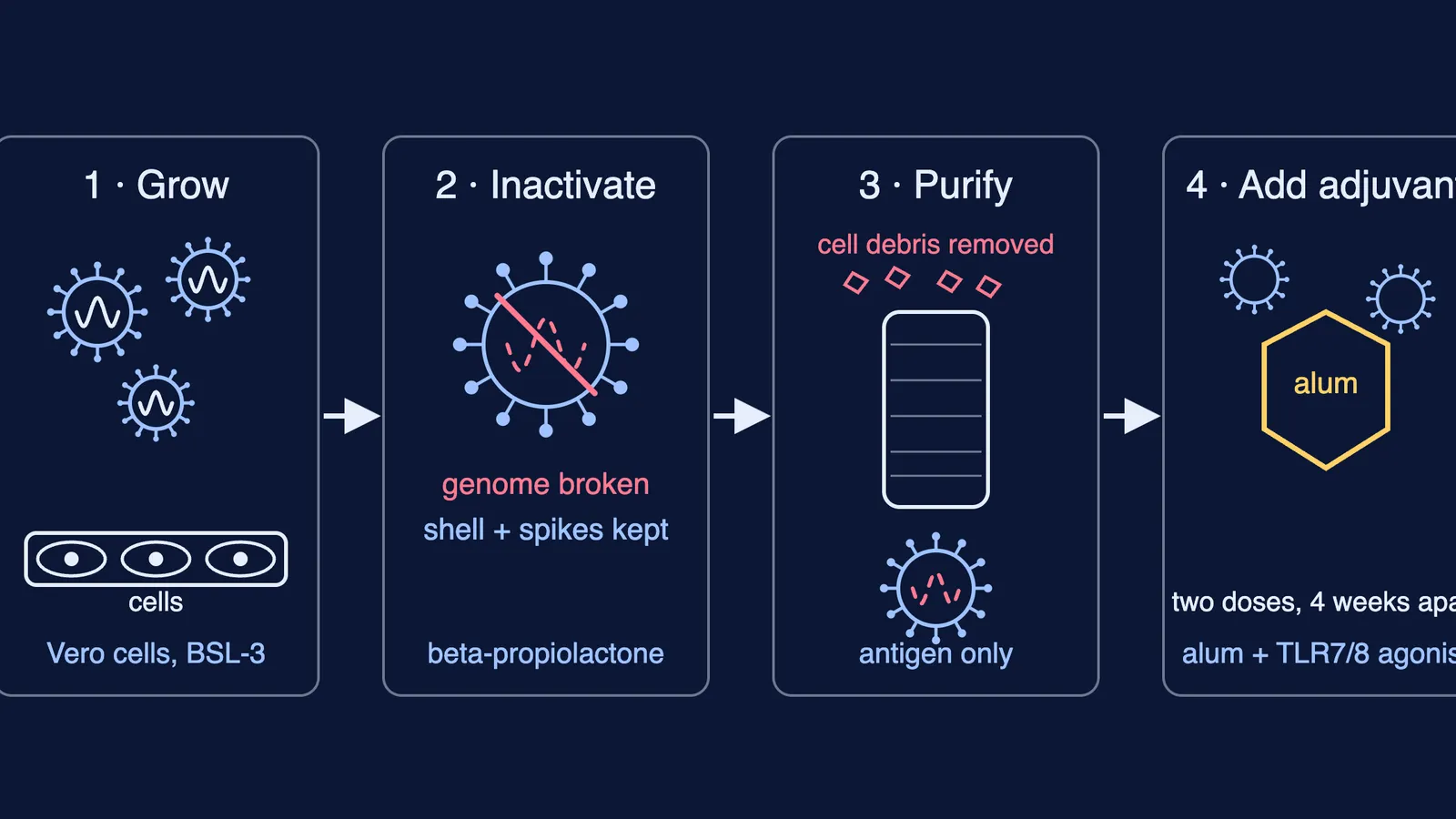
It began with one isolate. Scientists at ICMR's National Institute of Virology in Pune grew the strain NIV-2020-770 in Vero CCL-81 cells and deposited its sequence in GISAID; the seed was then adapted to a manufacturing cell platform and banked, as described in the development and safety paper in iScience. The same paper gives the four production steps:
Grow. The virus is multiplied in Vero cells inside a biosafety level 3 facility. Virus titres reached 7.0 log10 TCID50 between 36 and 72 hours.
Inactivate. Beta-propiolactone is added and held at 2-8 degrees Celsius through three successive 24-hour cycles, with samples drawn every four hours.
Purify. Cell debris and growth medium are stripped away, leaving a purified inactivated bulk: the antigen, and little else.
Add adjuvant. The antigen is formulated with aluminium hydroxide gel (Algel), or with Algel carrying a TLR7/8 agonist molecule (Algel-IMDG). The formulations taken into trials were 3 micrograms of antigen with Algel-IMDG, 6 micrograms with Algel-IMDG, and 6 micrograms with Algel.
What does beta-propiolactone actually destroy?
It attacks the genetic material, not the shape. After inactivation the iScience team saw no cytopathic effect in cell culture, while electron microscopy still showed intact, oval particles with the crown-like spike layer, and western blots still found the spike and nucleocapsid proteins in the purified bulk. So your immune system meets the whole outside of the virus, and nothing in the vial can copy itself.
That is the opposite design choice from the vaccines that deliver instructions instead of particles, which we explain in how mRNA vaccines work, step by step. If the chain from antigen to antibody is the fuzzy part for you, what tonsils do in the immune system covers it from the body's side, and the Fermi Concept Library has a lesson for every concept in biology, each with its place in the map.
Why does a killed virus need an adjuvant?
Because a corpse raises less alarm than an intruder. Alum has been used for decades to hold antigen at the injection site; Covaxin's second formulation chemisorbs an imidazoquinoline TLR7/8 agonist onto that alum, which in mice raised the IgG2a to IgG1 antibody ratio against plain Algel, read by the authors as a Th1-biased response, per the same paper. That paper reports no significant difference between the formulations in IFN-gamma-producing CD4 T cells.
How do you prove the killed virus still works?
In stages, each with its own published numbers.
Animals first: in rhesus macaques, vaccinated groups cleared virus from bronchoalveolar lavage fluid, nasal and throat swabs and lung tissue by day 7 after challenge, with no pneumonia on histopathology, unlike the placebo group.
Phase 1, 375 adults: seroconversion of 87.9, 91.9 and 82.8 per cent in the three formulations (3 micrograms with Algel-IMDG, 6 micrograms with Algel-IMDG, 6 micrograms with Algel), reported in The Lancet Infectious Diseases30942-7).
Phase 3, 25,798 participants: 24 symptomatic cases among 8,471 vaccine recipients against 106 among 8,502 placebo recipients, giving 77.8 per cent efficacy (95% CI 65.2-86.4), published in The Lancet02000-6).
Regulatory review: the World Health Organization issued an emergency use listing on 3 November 2021, citing 78 per cent efficacy against COVID-19 of any severity 14 or more days after the second dose, with two doses four weeks apart for ages 18 and above.
How can you check a vaccine claim yourself?
Use these five questions on any vaccine paper you are handed. The answers below are the worked example, taken from the iScience development paper, the phase 3 trial in The Lancet02000-6) and the WHO listing.
What exactly is in the vial? (Whole inactivated virion, 3 or 6 micrograms of antigen.)
What killed it, and under what conditions? (Beta-propiolactone, 2-8 degrees Celsius, three 24-hour cycles.)
How did they show it was dead but intact? (No cytopathic effect; electron microscopy and western blot.)
Who was compared with whom, and how many got ill? (24 of 8,471 against 106 of 8,502.)
Which independent body reviewed it, and on what date? (WHO emergency use listing, 3 November 2021.)
A vaccine story is also a records story: how a billion doses were logged is covered in how CoWIN handled a billion vaccine records. And if a step above stayed abstract, the Fermi Simulation Lab holds interactive simulations for the ideas that are easier to see than to read.