

On this page
Your NCERT Class 12 biology chapter on human health puts the whole idea in one line: "The principle of immunisation or vaccination is based on the property of 'memory' of the immune system". Older vaccines train that memory by injecting the antigen itself. An mRNA vaccine keeps the same principle and changes one thing: it injects the instructions, and your own cells make the antigen.
What is inside an mRNA vaccine?
The trial paper for the Pfizer-BioNTech vaccine describes it in one sentence: BNT162b2 is a lipid nanoparticle-formulated, nucleoside-modified RNA vaccine that encodes a membrane-anchored SARS-CoV-2 full-length spike protein (Polack et al., NEJM 2020).
Every part is Class 12 vocabulary:
mRNA that encodes the spike protein: a transcript carrying the codons for one protein, the spike found on the surface of the coronavirus. It codes for that protein only, not for the whole virus.
Nucleoside-modified: some of the bases are chemically altered. The 2023 Nobel Prize in Physiology or Medicine went to Katalin Karikó and Drew Weissman for their discoveries about these base modifications; the prize announcement explains that base-modified mRNA blocks inflammatory reactions and increases protein production (Nobel Prize press release).
Lipid nanoparticle: a tiny fat bubble. Lab-made mRNA was considered unstable and hard to deliver, which is why carrier lipid systems had to be developed to wrap it, the same press release explains.
How do mRNA vaccines work, step by step?
The US Centers for Disease Control and Prevention describes the sequence on its vaccine basics page. Mapped onto your syllabus:
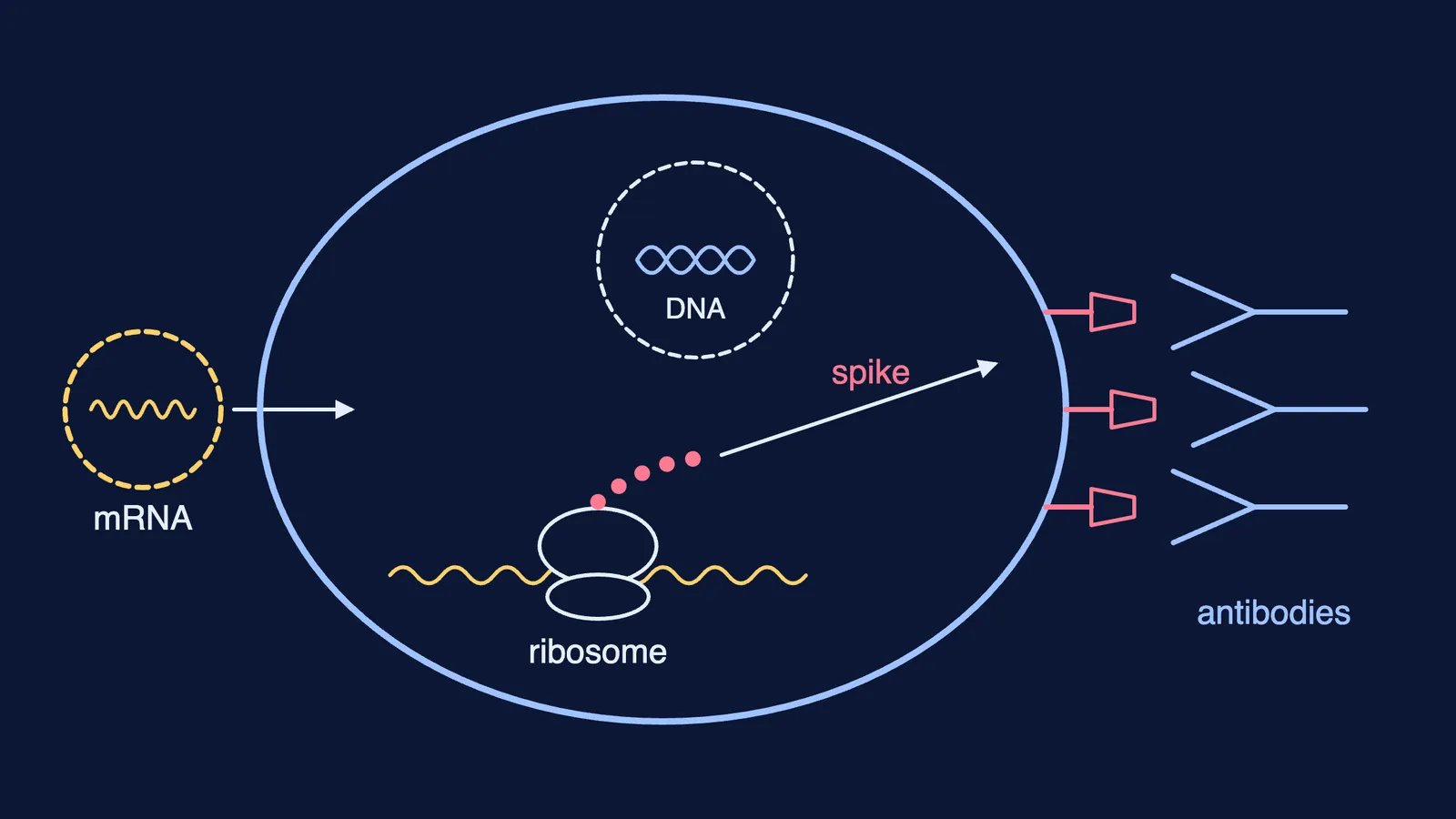
Delivery. After the injection, the mRNA, in its lipid wrapping, enters muscle cells.
Translation. Ribosomes in the cytoplasm read the codons and make a harmless piece of the spike protein, the process in our translation simulation from mRNA codons to a protein.
Recognition. The spike piece is an antigen. The immune system produces antibodies and activates other immune cells, as if fighting an infection.
Clean-up. Cells then break down the mRNA and remove it. CDC states the vaccines do not enter the nucleus and do not affect or interact with your DNA.
Memory. NCERT notes that vaccines generate memory B and T cells, which is why a later infection meets a faster, larger secondary immune response.
If that feels shaky, revise what mRNA, tRNA and rRNA each do.
How are mRNA vaccines different from older vaccines?
The World Health Organization sorts vaccines by what they carry: weakened or inactive parts of an organism, the weakened or reconstituted whole virus or bacterium, or, in newer vaccines, the blueprint for the antigen as DNA or RNA (WHO, How do vaccines work?). Use that to compare:
Whole pathogen, weakened or inactivated: you inject the microbe itself, made harmless. NCERT's description of a vaccine covers this: inactivated or weakened pathogen.
Antigen made elsewhere: recombinant DNA technology lets bacteria or yeast make the antigen, which is then injected. NCERT's example is the hepatitis B vaccine produced from yeast (NCERT chapter 7).
mRNA: you inject the recipe, and the antigen is made inside your own cells.
In all three, the immune system meets the antigen and forms memory. What changes is where the antigen is made.
How well did mRNA vaccines work in trials?
In the Pfizer-BioNTech trial, 43,548 people were randomised and 43,448 were injected: 21,720 with the vaccine and 21,728 with a placebo, two doses 21 days apart (Polack et al., NEJM 2020). Counting from 7 days after the second dose, there were 8 Covid-19 cases in the vaccine group and 162 in the placebo group.
You can check the efficacy yourself. The groups were almost equal in size, so the ratio of cases approximates the ratio of risks:
Ratio of cases = 8 / 162 = 0.049
Efficacy = 1 - 0.049 = 0.951, or about 95%
The paper reports 95%; treat this as a quick check, not the paper's method. The Moderna trial of 30,420 volunteers reported 94.1% efficacy (Baden et al., NEJM 2021).
How do you write this in a Class 12 answer?
A five-mark answer on vaccines can follow five points, one line each:
Principle: vaccination relies on immune memory.
What is injected: mRNA coding for a pathogen antigen, in a lipid nanoparticle.
Inside the cell: ribosomes translate it into the antigen, in the cytoplasm.
Response: antibodies plus memory B and T cells.
Contrast: older vaccines inject the antigen or a weakened or inactivated pathogen.
Two common slips to avoid: writing that mRNA enters the nucleus, and calling antibodies "memory cells". Antibodies are proteins; memory cells are lymphocytes.
If transcription, translation or antibody structure still feel shaky, the Fermi Concept Library gives every biology concept its own lesson and its place in the map, so you can fix the gap before the vaccine question.


