On this page
NEET-UG and board biology papers can ask you to tell the three main RNAs apart. Give each one a job title: mRNA is the message, tRNA is the adaptor, and rRNA is the machine. Below we compare their jobs, shapes and origins, then watch all three at work in translation.
What does each type of RNA do?
mRNA (messenger RNA) is a copy of a gene. Its bases are read three at a time, and each triplet, called a codon, stands for one amino acid or a stop signal.
tRNA (transfer RNA) is the translator. As OpenStax Microbiology puts it, "serving as adaptors, each tRNA type binds to a specific codon on the mRNA template and adds the corresponding amino acid to the polypeptide chain."
rRNA (ribosomal RNA) builds the ribosome. The same OpenStax chapter describes the ribosome as made of catalytic rRNAs (ribozymes), structural rRNAs and many proteins. The peptide bond itself is made by peptidyl transferase, "an RNA-based ribozyme" in the 50S large subunit.
In 2000, Nissen, Hansen, Ban, Moore and Steitz used atomic structures of the large ribosomal subunit of the archaeon Haloarcula marismortui to establish that "the ribosome is a ribozyme": no protein side-chain atoms sit closer than about 18 angstroms to the peptide bond being made (Science, 2000).
How do mRNA, tRNA and rRNA differ in shape?
mRNA: a single strand read in a straight line, 5' to 3', codon by codon.
tRNA: small and folded. A review in RNA Biology gives canonical tRNA lengths of 76 to 90 bases, with a stem-loop (cloverleaf) pattern in two dimensions and an L shape in three.
rRNA: large folded strands packed with proteins into two subunits. In E. coli the 70S ribosome has a 30S small subunit containing 16S rRNA and a 50S large subunit containing 5S and 23S rRNA (OpenStax Microbiology).
The same RNA Biology review notes that the three anticodon positions are always numbered 34, 35 and 36, and that the amino acid is attached at the 3' CCA end. Our post on the tRNA clover leaf and its anticodon loop labels every arm.
Where are they made, and which enzyme makes them in bacteria?
"Bacteria use the same RNA polymerase to transcribe all of their genes," says OpenStax Microbiology. In E. coli that enzyme is a core of five subunits plus a sixth, sigma, which lets it bind to promoters. Bacteria have no nucleus, so transcription and translation can run at the same time, and one mRNA can carry several ribosomes at once (OpenStax).
Eukaryotes split the work across three enzymes. According to OpenStax Biology 2e, RNA polymerase I sits in the nucleolus and makes all rRNAs except 5S; polymerase II, in the nucleus, makes the protein-coding pre-mRNAs; and polymerase III, also in the nucleus, makes tRNAs, 5S rRNA and small nuclear RNAs. Our guide to the three RNA polymerases in eukaryotes goes through each one.
How much of each RNA is there? rRNAs and tRNAs make up 95-97% of the total RNA isolated from bacterial cells, according to BioNumbers, citing Rosenow and colleagues in Nucleic Acids Research (2001). That leaves only a few percent for mRNA and all other RNAs.
How do all three work together in translation?
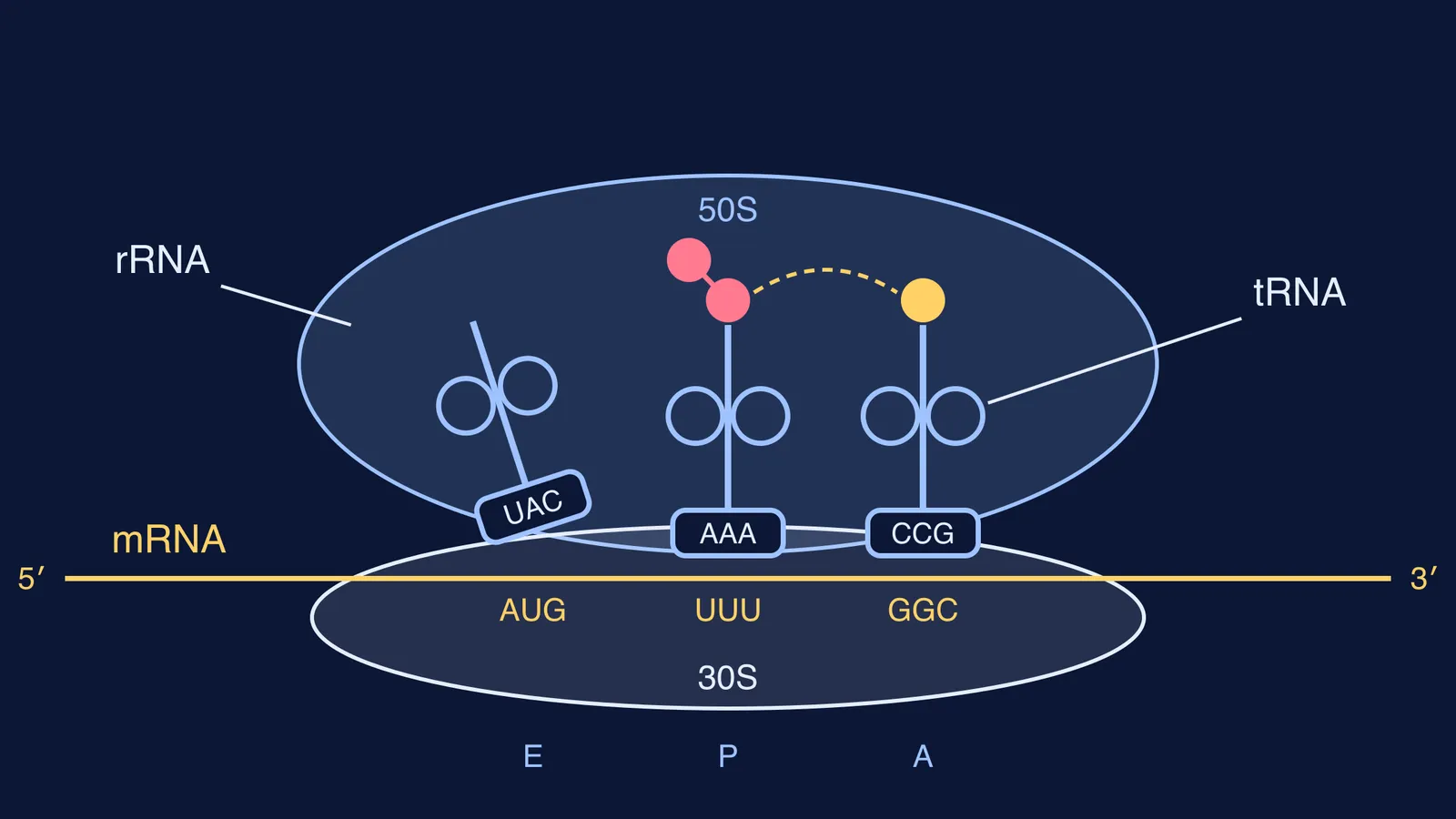
Take the mRNA stretch 5'-AUG UUU GGC-3' in a bacterium. The diagram at the top of this post shows the moment after the first two amino acids have been joined.
The ribosome (rRNA plus protein) holds the mRNA between its 30S and 50S subunits. It has three tRNA sites: A for the incoming tRNA, P for the one holding the growing chain, E for the exit.
The start tRNA (anticodon UAC, paired with AUG) has handed over its amino acid and is leaving from the E site.
The P-site tRNA (anticodon AAA, on codon UUU) holds the two-amino-acid chain.
A new tRNA (anticodon CCG, on codon GGC) has arrived in the A site with the next amino acid.
The 50S rRNA catalyses a peptide bond that moves the chain onto the A-site amino acid. The ribosome shifts one codon towards the 3' end and the cycle repeats.
If it helps to watch this happen codon by codon, try our translation simulation.
How should you revise this for the exam?
Close your notes and answer these four questions for mRNA, tRNA and rRNA:
Job: message, adaptor or machine?
Shape: straight strand, cloverleaf and L, or folded inside ribosomal subunits?
Where made: in a bacterium, the cytoplasm; in a eukaryote, the nucleus or the nucleolus?
Which enzyme: in a bacterium, the one RNA polymerase; in a eukaryote, polymerase I, II or III?
If one row keeps going wrong, go back to the concept. The Fermi Concept Library covers every concept in biology, each with its own lesson and its place in the map, so you can revisit transcription or the ribosome and see how they connect.