

On this page
Press two fingers to your wrist and you feel a steady tap. Press the blue vein on the back of your hand and you feel nothing. The difference is pressure: how high it is, and whether it changes with each heartbeat.
Why can you feel a pulse in arteries but not veins?
Each time the left ventricle contracts, it pushes a burst of blood into the aorta. The OpenStax Anatomy and Physiology textbook explains that elastic fibres in the artery walls expand to take in this blood and then recoil, and this expansion and recoil is what we call the pulse.
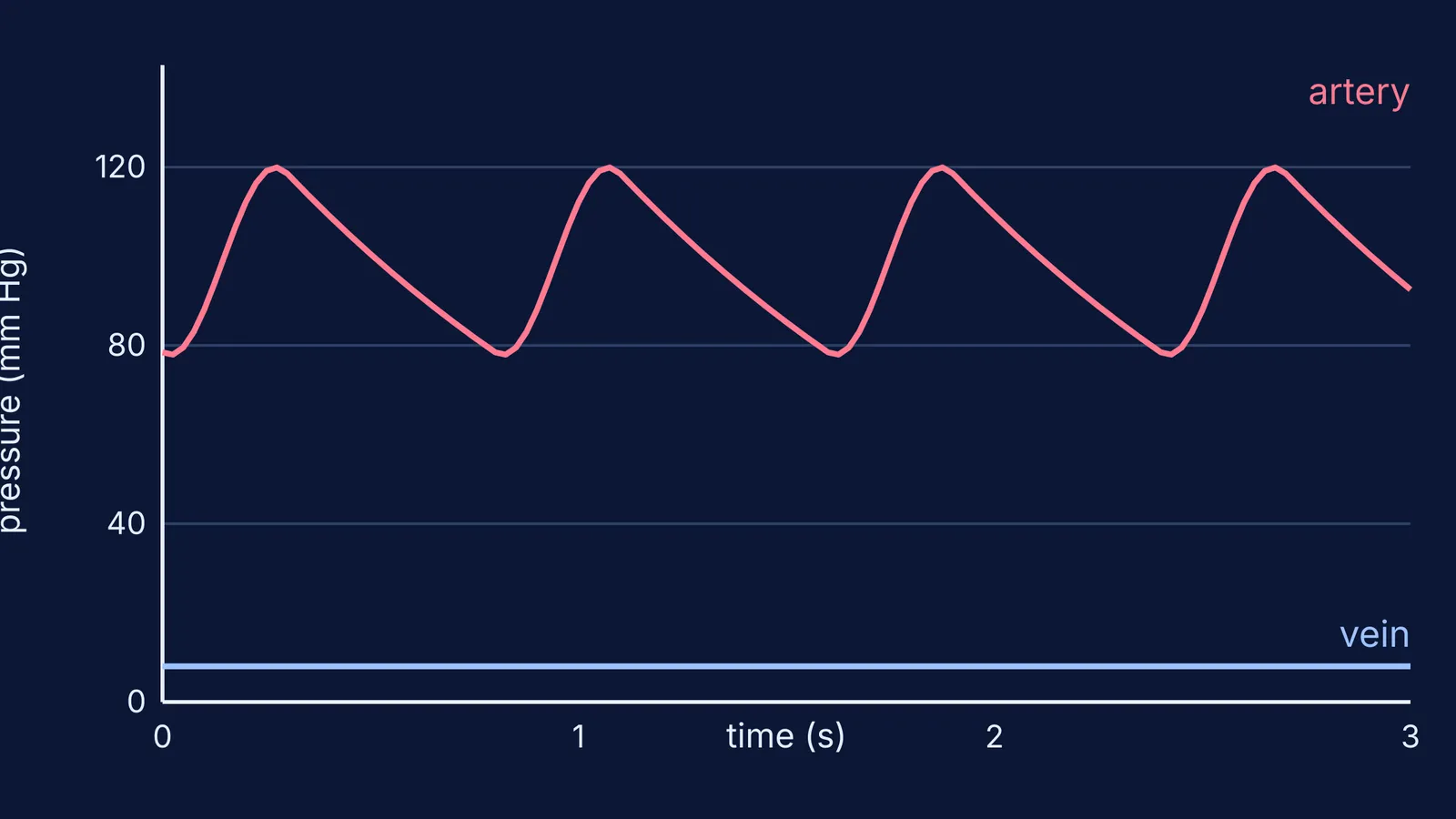
The same textbook gives typical values: systolic pressure is around 120 mm Hg, diastolic pressure is about 80 mm Hg, and the difference between them, the pulse pressure, is about 40 mm Hg. That swing of about 40 mm Hg on every beat is what pushes the artery wall against your fingertips.
Veins have no such swing. Our post on why a cut artery spurts but a vein oozes shows the same difference more dramatically.
Where does the pressure go before blood reaches the veins?
Blood pressure falls unevenly as blood moves from arteries to arterioles, capillaries, venules and veins, because it meets more and more resistance (OpenStax Anatomy and Physiology). The textbook notes that the pulse fades with distance from the heart, but you can still detect parts of it as far down as the arterioles.
By the large veins, blood pressure is only about 4 to 15 mm Hg (OpenStax College Physics, Table 11.5). The same chapter says pressure keeps falling, almost to zero, as blood moves from the aorta to the small veins.
Veins are highly compliant, or stretchy, and the systemic veins hold about 64 percent of total blood volume (OpenStax Anatomy and Physiology). Squeezing leg muscles and breathing push this blood along, while one-way valves stop backflow. That push has no beat to feel. For a side-by-side revision list, see how arteries, veins and capillaries differ.
Is the pulse just blood arriving at your wrist?
No. The pulse is a pressure wave running along the artery wall, much faster than the blood itself.
A European study of arterial stiffness pooled data from 16,867 people. Its normal values come from 1,455 of them who had no cardiovascular risk factors and optimal or normal blood pressure. In that group, the mean pulse wave velocity from the carotid artery to the femoral artery was 6.2 m/s under age 30 and 10.9 m/s at 70 and above, as arteries stiffen with age.
Compare that with the blood. OpenStax College Physics works out an average blood speed in the aorta of 0.27 m/s for a flow of 5.0 L/min. Worked example: 6.2 divided by 0.27 is about 23, so in a young adult the pressure wave travels roughly 20 times faster than the average flow of blood in the aorta.
If the stretch-and-recoil idea is hard to picture, the Fermi Simulation Lab has interactive simulations for ideas that are easier to see than to read.
How do you find and count your radial and carotid pulse?
These steps follow MedlinePlus, from the US National Library of Medicine, and the British Heart Foundation.
Sit or lie down and rest for about five minutes first.
For the radial pulse, turn one palm up. Place the pads of the index and middle fingers of your other hand on the inside of the wrist, just below the base of the thumb.
Press lightly. If you feel nothing, press a little harder or move your fingers slightly.
For the carotid pulse, place the same two fingers on the side of your neck, in the soft hollow beside the windpipe, just below the jaw.
Count the beats for a full 60 seconds, or count for 30 seconds and multiply by 2.
If the beat feels irregular, count for the full 60 seconds.
Worked example: you count 36 beats in 30 seconds at the wrist. Multiply by 2 to get 72 beats per minute.
What is a normal pulse rate?
For children aged 10 and over and for adults, a normal resting rate is 60 to 100 beats per minute, and well-trained athletes can sit at 40 to 60 (MedlinePlus). The American Heart Association gives the same 60 to 100 range for someone sitting or lying down, calm and feeling well.
One reading is not a diagnosis; activity and caffeine can change it, which is why the steps above start with rest. If you are concerned about your pulse, the British Heart Foundation suggests talking to your doctor. To link your pulse count to the two numbers on a blood pressure cuff, read our guide to systolic and diastolic blood pressure.
To revise the whole chapter in order, the Fermi Concept Library gives every biology and physics concept its own lesson and shows where it sits on the concept map.


