

On this page
In 2025, 41.0 million people were living with HIV and 1.2 million acquired it that year, according to the UNAIDS global fact sheet. Medicines control the virus, but HIV.gov states that "the human body can't get rid of HIV and no effective HIV cure exists." There is still no vaccine to prevent it.
Why is HIV so hard to make a vaccine for?
HIV defeats the usual vaccine plan in four ways.
1. It mutates faster than antibodies can keep up
HIV copies its RNA genome with an error-prone enzyme, reverse transcriptase. A 1995 study in the Journal of Virology measured a mutation rate of 3.4 × 10^-5 mutations per base pair per replication cycle. A 1996 study in Science estimated that an infected person produces about 10.3 billion virus particles a day, with a generation time of 2.6 days.
Try a rough estimate: 10.3 × 10^9 × 3.4 × 10^-5 ≈ 350,000. So any single letter of HIV's genome could be changed in hundreds of thousands of new particles a day, in one person (roughly, since not every particle is a fresh copy). A vaccine trained on one version meets a crowd of variants.
2. A sugar coat hides its weak spots
Antibodies have to grab HIV's surface spike, called Env. A review in the Annual Review of Biophysics notes that glycans (sugar chains) make up approximately 50% of the mass of the Env trimer. The infected human cell builds these sugars, so they resemble the body's own. A 2003 paper in Nature described an "evolving glycan shield": as HIV changes where its sugars sit, antibodies can no longer bind, but the virus can still attach to cells.
3. It hides in a latent reservoir
The latent reservoir is a pool of resting memory CD4 T cells that carry a silent copy of HIV, even during treatment, as a Nature Medicine study showed. The researchers found the reservoir shrinks so slowly (a half-life of 44 months) that wiping it out is unlikely. A silent copy makes no virus for the immune system to spot, so a vaccine cannot let infection start and clean up later. It has to block HIV at the door.
4. It attacks the helper T cells that run the defence
HIV infects CD4 helper T cells, the cells that help B cells make antibodies (see how HIV replicates inside helper T cells). HIV.gov gives a healthy CD4 count of 500 to 1,600 cells/mm3, and says HIV has progressed to AIDS when the count falls below 200 (or certain opportunistic infections appear). It damages the system a vaccine must train.
What have HIV vaccine trials found so far?
RV144, Thailand: 16,402 adults aged 18 to 30 took part, and the estimated vaccine efficacy was 31.2% in the main (modified intention-to-treat) analysis, reported in the New England Journal of Medicine in 2009.
HVTN 702, South Africa: a related regimen, also using the ALVAC vector, was tested in more than 5,400 volunteers at 14 sites. On 4 February 2020, UNAIDS reported that the trial had been stopped after an interim analysis found 129 infections in the vaccine group and 123 in the placebo group. The final results in the NEJM counted 138 and 133.
What are broadly neutralising antibodies, and can they help?
Broadly neutralising antibodies (bnAbs) are antibodies that block many different HIV strains, often by gripping parts of Env the virus cannot easily change, including some of the glycans, as the glycan-shield review explains.
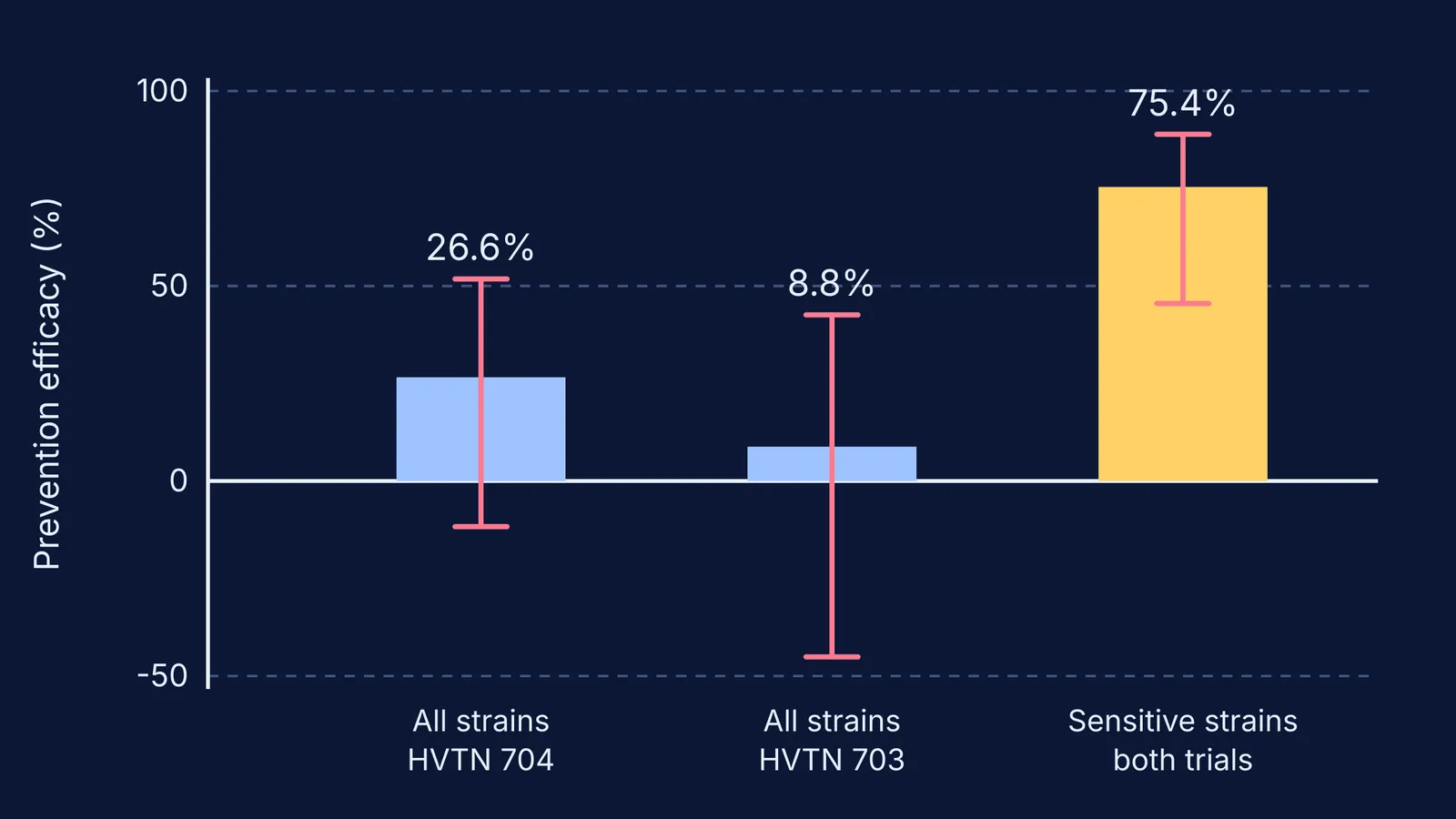
The AMP trials, published in the NEJM in 2021, enrolled 2,699 people in one trial and 1,924 in another, who received infusions of one bnAb, VRC01, or a placebo. Against all strains, prevention efficacy was 26.6% and 8.8%, neither statistically significant. Against strains sensitive to VRC01, it was 75.4%. Only 30% of the viruses in the placebo groups were that sensitive. The idea works, but one antibody does not cover enough strains.
So scientists now try to teach the body to make bnAbs itself. In a phase 1 human trial reported in Science in 2022, a germline-targeting vaccine called eOD-GT8 60mer produced early precursors of VRC01-class antibodies in 97% of recipients. That is a first step towards protection, not protection itself.
How do you answer "why is there no HIV vaccine" in an exam?
Use the MGLH frame, one line and one fact each:
Mutation: error-prone copying makes many variants.
Glycan shield: sugars make up about half of Env's mass and resemble the body's own.
Latent reservoir: silent HIV in resting CD4 T cells, so infection must be blocked completely.
Helper T cells: HIV destroys the cells that help B cells make antibodies.
End with one sentence on bnAbs and the AMP result. For bonus points, link it to why a CCR5 mutation makes some people resistant to HIV or contrast it with how mRNA vaccines work.
If a term feels shaky, such as glycoproteins or how helper T cells switch on B cells, the Fermi Concept Library has a lesson for every concept in biology, with its place in the map.
Tonight, write the MGLH answer from memory, then check it against this page.


