

On this page
A mule is the foal of a male donkey (a jack) and a female horse (a mare). The reverse cross, a stallion with a female donkey (a jenny), gives a hinny, as described in a chromosome study of fertile hybrids in China. Both are healthy, and both almost never breed. Simple counting plus one idea from meiosis explains why.
How many chromosomes do a horse, a donkey and a mule have?
The domestic horse has 64 chromosomes and the domestic donkey has 62, according to a 2026 review in Cytogenetic and Genome Research. A 2015 study of hinny testes lists the stallion as 2n = 64, the jack donkey as 2n = 62 and the hybrid as 2n = 63.
Here is the worked example:
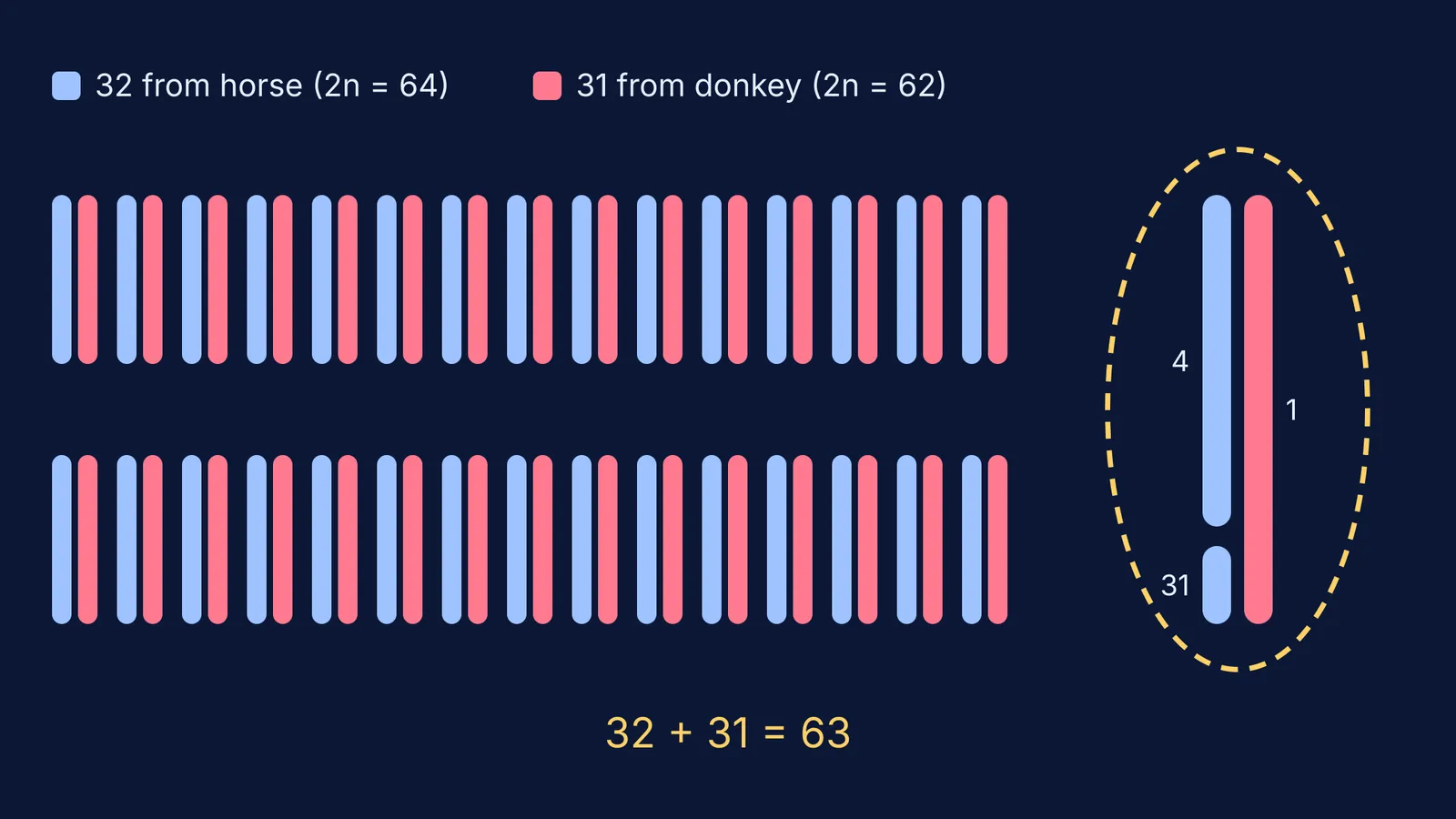
Horse body cells have 2n = 64, which is 32 pairs. Each horse egg or sperm carries n = 32.
Donkey body cells have 2n = 62, which is 31 pairs. Each donkey gamete carries n = 31.
Fertilisation adds the two: 32 + 31 = 63. Every cell of the mule holds 63 chromosomes, 32 from the horse and 31 from the donkey.
So the mule's 63 is not a set of pairs: it is one horse set and one donkey set sharing a nucleus. To revise n and 2n, read our explainer on chromosome counts in mitosis and meiosis, and keep this list of chromosome numbers in common organisms handy for MCQs.
Why can't a mule's 63 chromosomes pair in meiosis?
Meiosis needs each chromosome to find its partner (its homologue) and line up with it along its full length, a step called synapsis, before the cell can make gametes. In a horse or a donkey, every chromosome has an exact partner. In a mule, it does not. Three problems stack up:
The odd one out. The 64 versus 62 gap arises mainly from one fusion: two horse chromosomes, numbered 4 and 31, correspond to a single chromosome in the donkey, the 2026 review explains. In a mule, that donkey chromosome faces two separate horse chromosomes, so a simple one-to-one pairing is impossible.
Rearranged partners. The same review reports that several dozen structural rearrangements have been found between horse and donkey chromosomes, including inversions and moved centromeres. Even apparent partners do not match neatly.
A built-in quality check. A 2023 review in Molecular Biology and Evolution explains that unsynapsed or mispaired homologues can trigger early meiotic arrest, or separate at random and give sperm the wrong number of chromosomes. It lists sterile mules and hinnies among hybrids with incomplete synapsis.
The hinny testis study saw this directly: most sperm-forming cells stopped in synapsis mid-meiosis, and the authors concluded the main cause was probably failed pairing of homologous chromosomes.
What does a sterile mule show about reproductive isolation?
Biologists sort the barriers that keep species apart into two groups. Prezygotic mechanisms prevent fertilisation, while postzygotic mechanisms act after fertilisation and reduce the viability or reproductive success of hybrids, as this open textbook chapter on reproductive isolation sets out. The same chapter names three post-zygotic forms:
Hybrid inviability: the hybrid fails to develop or dies before maturity.
Hybrid sterility: the hybrid survives but cannot produce viable offspring.
Hybrid breakdown: first-generation hybrids are fertile, but later generations lose fitness or fertility.
The mule is hybrid sterility. The zygote grows into a healthy adult, so the barrier is neither prezygotic nor inviability. Because the mule cannot pass on a mixed genome, the two gene pools stay separate, so horse and donkey remain different species. For how such barriers arise, see what a geographic isolation speciation simulation reveals.
Are mules ever fertile?
Rarely, and the cases confirmed by chromosome analysis are females. Researchers in China verified a fertile female mule and a fertile female hinny this way; each mated with a donkey and produced a filly foal whose karyotype differed from its mother's, the published report says. The 2015 hinny study adds that good scientific evidence explaining such cases has not yet been produced. So in your answer, write "almost always sterile".
A five-line answer for your exam
Horse 2n = 64 (n = 32); donkey 2n = 62 (n = 31) (2026 review).
The mule receives 32 + 31 = 63 chromosomes.
Horse and donkey chromosomes are not true homologues: one donkey chromosome matches two horse chromosomes, and many others are rearranged.
Synapsis fails in meiosis I, so meiosis usually stalls and functional gametes are rarely, if ever, formed.
This is hybrid sterility, a post-zygotic isolating mechanism that keeps horse and donkey separate species.
If synapsis still feels abstract, the Fermi Concept Library gives each biology concept its own lesson and its place in the map, and Fermi's AI tutor draws the figure as it explains and checks your understanding as it goes.


