

On this page
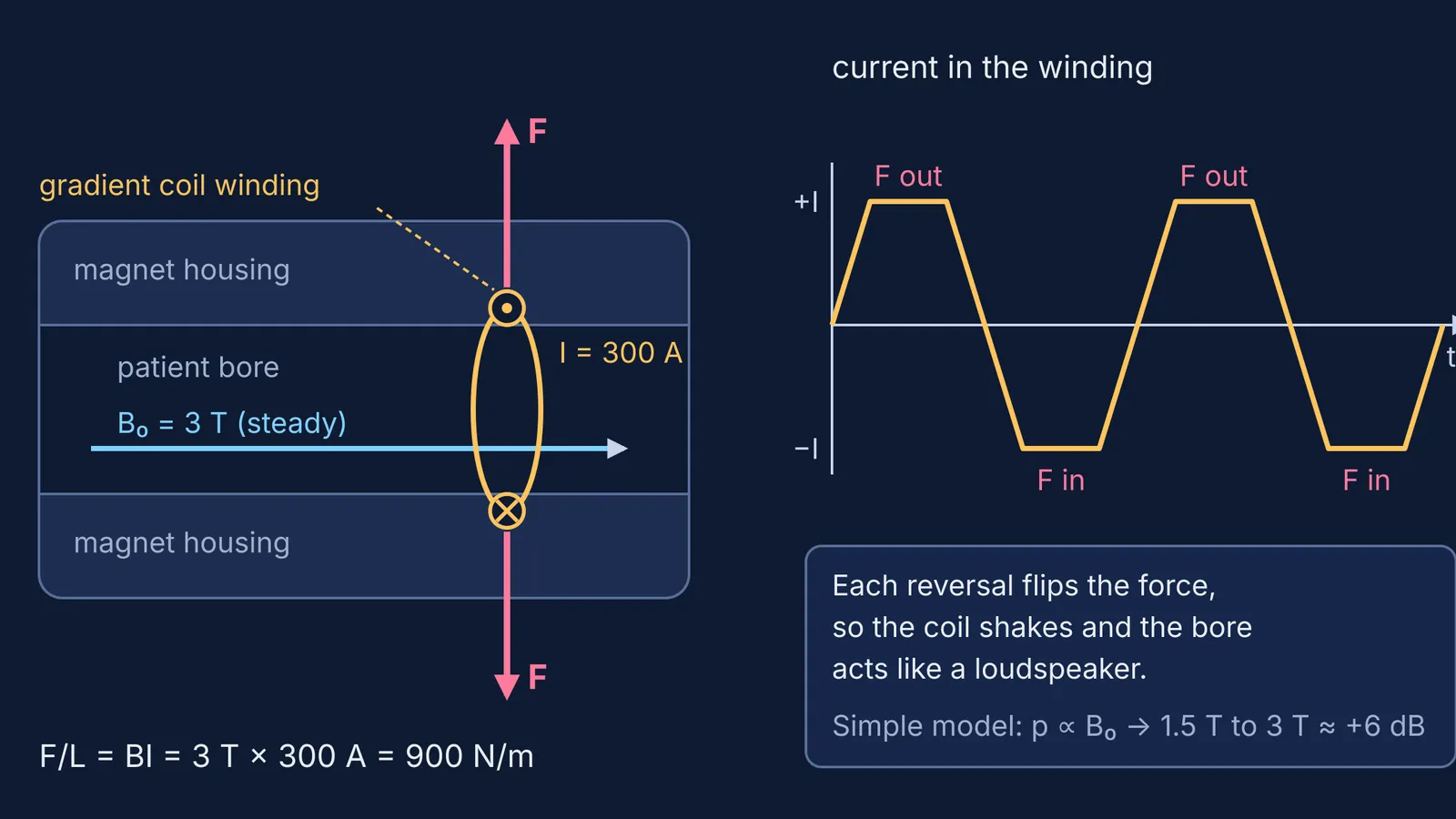
An MRI scan is loud: knocks, buzzes and beeps that change with every part of the scan. The huge main magnet is not the source. The noise comes from the smaller gradient coils, and the physics behind it is the first formula you learn in magnetism: the force on a current-carrying wire, F = BIL.
Which part of an MRI scanner makes the noise?
An MRI scanner has two kinds of magnetic field. The main field B₀, 1.5 T or 3 T in most hospital scanners, comes from a superconducting magnet. It stays on all the time and does not change, so it makes no sound. Why it can stay on for years is covered in how an MRI magnet stores its energy without resistance.
On top of B₀ sit three gradient coils, one each for x, y and z. They add a small field that changes with position, so that each slice of your body has a slightly different field and the scanner can tell where a signal came from. How those signals become a picture is in how an MRI scanner sees inside your body. Here we only need one fact: to build an image, the gradient currents are switched on, off and reversed many times a second.
A review of gradient coil design by Motovilova and Winkler in Frontiers in Physics (2022) states the cause directly: the gradient coils "undergo large Lorentz forces as rapidly switched electrical currents are passing through them", the conductors vibrate, and the vibration radiates into the air as sound.
How big is the force on a gradient coil wire?
The force on a straight wire of length L carrying current I at right angles to a field B is F = BIL, so the force per metre is F/L = BI. Its direction is given by Fleming's left-hand rule, or by the cross product F = I L × B.
How much current flows? A white paper on gradient systems from the scanner maker Siemens Healthineers gives peak currents of today's whole-body gradient systems as 100 A to 1,200 A, and a coil sensitivity of about 0.05 mT/m per ampere. That is a manufacturer document, not a peer-reviewed one, so below we use a round illustrative value of 300 A, well inside that range.
Worked example: the force on one metre of gradient winding
Data. B₀ = 3 T, I = 300 A (illustrative), wire at right angles to B₀, L = 1 m.
Force per metre. F/L = BI = 3 T × 300 A = 900 N/m.
Check the units. 1 T = 1 N/(A·m), so T × A = N/m. Correct.
Compare with a weight. 900 N is the weight of about 92 kg (900 ÷ 9.8).
Same coil at 1.5 T. F/L = 1.5 × 300 = 450 N/m, half as much.
What gradient does this make? With a sensitivity of 0.05 mT/m per ampere, 300 A gives 0.05 × 300 = 15 mT/m.
A gradient winding runs around the bore, so its current is mostly at right angles to B₀, which points along the bore. In the hero diagram the current comes out of the page at the top of the loop and goes into the page at the bottom. With B₀ to the right, I L × B points up at the top and down at the bottom: the loop is pushed outwards all round. Reverse the current and it is squeezed inwards.
Why does a steady force not make noise, but a switched one does?
A constant force just loads the clamped coil. Sound needs a force that changes. Every time the gradient current ramps up, flips sign or switches off, the 900 N/m push changes, and the coil and its mounting flex a tiny amount. That flexing pushes the air, the way a speaker cone does.
How fast are the changes? The same Siemens paper gives a top slew rate of 200 T/m/s for whole-body scanners, meaning a 45 mT/m gradient can rise from zero in 225 µs. At that rate our 15 mT/m gradient rises in 15 × 10⁻³ ÷ 200 = 75 µs. Imaging sequences repeat such pulses hundreds to thousands of times a second.
That puts the sound right where your ears are sensitive. Ravicz, Melcher and Kiang measured scanner noise in the Journal of the Acoustical Society of America (2000) and found the strongest part of the spectrum at 1 kHz on a 1.5 T scanner and 1.4 kHz on a 3 T scanner.
Is a 3 T scanner louder than a 1.5 T scanner?
In the simplest model, the sound pressure p is proportional to the force, and the force is proportional to B₀. Doubling B₀ doubles p, which adds 20 log₁₀ 2 = 6.0 dB.
Real scanners are messier. The Ravicz study recorded peak levels of 123 dB on its 1.5 T scanner and 138 dB on its 3 T scanner, 15 dB apart. Those were two different machines with different coils and sequences, so the gap is not just the field. The 2022 review goes further: it notes that sound levels do not grow simply in proportion to B₀, partly because a stronger field also damps the coil's motion. So treat "+6 dB for double the field" as a first estimate, not a measured rule.
What do those decibels mean in pressure? Using p = 20 µPa × 10^(L/20):
110 dB: p ≈ 6.3 Pa
120 dB: p = 20 Pa, an intensity p²/ρc ≈ 1 W/m² in air
138 dB: p ≈ 160 Pa
The review gives 110 to 120 dB as the range for echo-planar imaging, one of the loudest sequences.
What do safety rules say about MRI noise?
We do not give medical advice here; we report what the regulator says. The US Food and Drug Administration's guidance on significant-risk MR studies (2014) lists as significant-risk conditions a peak unweighted sound pressure level above 140 dB, and an A-weighted rms level above 99 dBA with hearing protection in place. That is why scanning staff hand patients earplugs or headphones. If you have a scan, follow the instructions the hospital gives you.
Engineers also make "quiet" sequences by ramping the current more gently, so the force changes more slowly and less of the sound lands in the kilohertz range.
Where else does this force show up in your syllabus?
The same BIL force is behind the attraction between two parallel currents, worked in force between two parallel current-carrying wires, and behind every loudspeaker. If you want to watch a wire jump in a field as you change the current, the Simulation Lab has interactive simulations for ideas that are easier to see than read.
Quick checklist
The main field B₀ is steady and silent; the switched gradient coils make the noise.
Force per metre on a wire at right angles to B: F/L = BI. At 3 T and 300 A that is 900 N/m.
Use F = BIL sin θ; segments parallel to B₀ feel no force.
Reversing the current reverses the force, so the coil vibrates and radiates sound.
Simple model: double B₀, double the pressure, +6 dB. Measured differences vary with the scanner.
Convert dB to pressure with p = 20 µPa × 10^(L/20).


