

On this page
Someone drops jeera into hot ghee in the next room. You have not seen the plate yet, but your mouth is already wet. That is the first stage of digestion, and it starts in your head.
Biologists call it the cephalic phase. "Cephalic" means "of the head", because the trigger is something your brain senses or thinks, not food touching your stomach.
What is the cephalic phase of digestion?
Cephalic phase responses are "innate and learned physiological responses to sensory signals that prepare the gastrointestinal tract for the optimal processing of ingested foods", according to a 2010 review in Nutrition Reviews by Paul Smeets, Alfrun Erkner and Cees de Graaf.
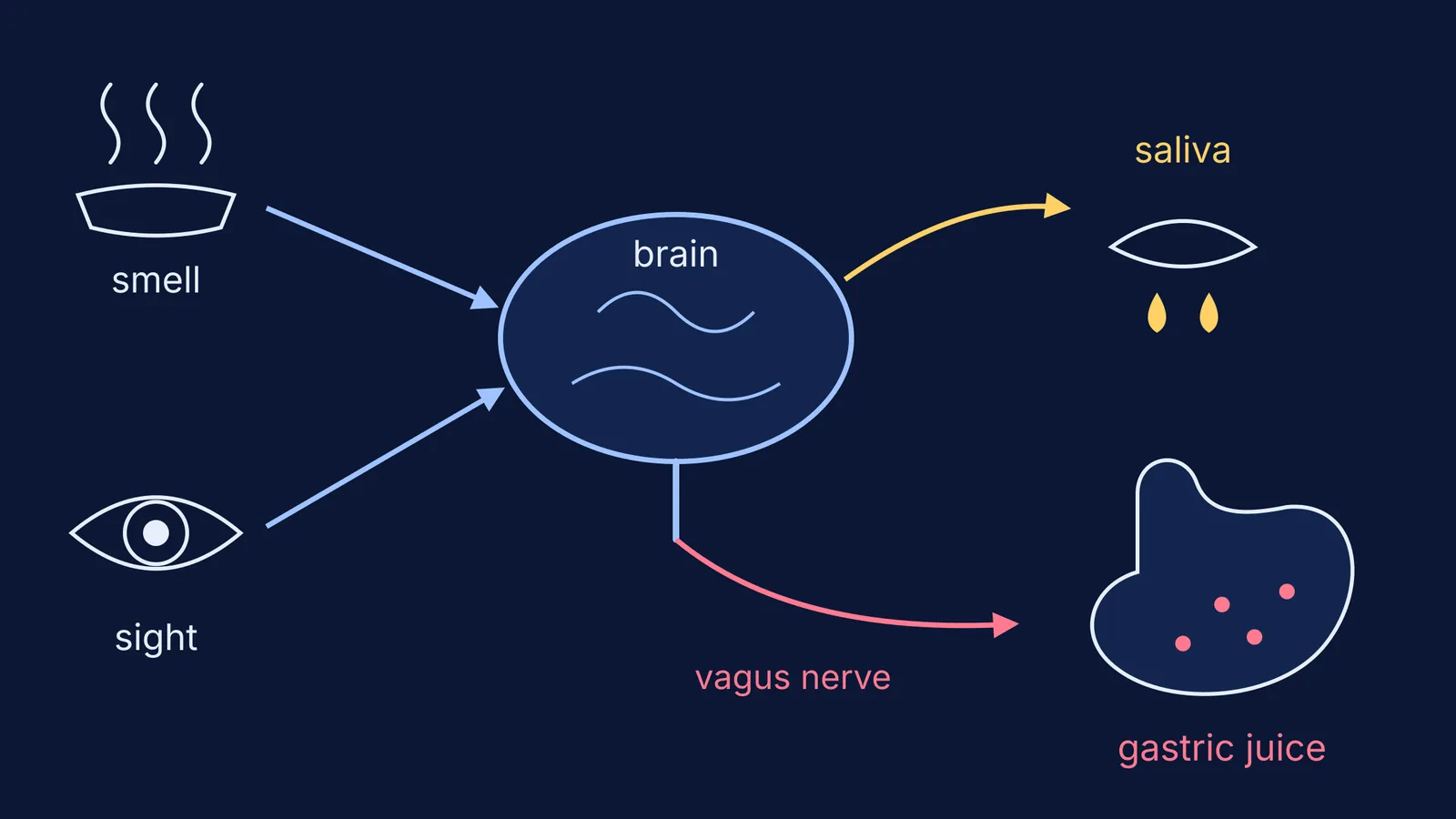
In plain terms, the pathway runs in four steps:
Receptors in your nose and eyes pick up a food cue.
The signal travels to your brain, which recognises it as food.
Your brain sends signals out along nerves to the salivary glands and the stomach.
The glands respond: saliva in your mouth, gastric juice in your stomach.
Nothing in this chain needs food to arrive.
Why does your mouth water when you smell food?
Smell is one trigger, and adding more senses adds more saliva. In a 2020 study in Physiology and Behavior, 46 healthy volunteers were exposed to bread, cucumber and a non-food control at four levels: smell only, smell plus sight, then taste, then chewing. Salivation rose with each added level of sensory stimulation. The researchers concluded that the build-up of sensory information mattered more than which food it was.
A 2026 systematic review and meta-analysis pooled 24 studies covering 1,008 adults. Its six randomised trials found that food sensory cues increased saliva, while the effect on how much people then ate was uncertain.
What did Pavlov's experiment show?
Ivan Pavlov won the 1904 Nobel Prize in Physiology or Medicine "in recognition of his work on the physiology of digestion". In his Nobel lecture of 12 December 1904, he described sham feeding: dogs had been operated on so that swallowed food fell out of the oesophagus before it reached the stomach.
Within a few minutes of the dog eating, pure gastric juice began to trickle out of its empty stomach. When the vagus nerves in the neck were cut, sham feeding no longer produced any gastric juice. So the signal depended on those nerves, not on food reaching the stomach.
Pavlov called this the "appetite juice". He also reported that the mere sight of food made nervous, excitable dogs secrete several hundred cubic centimetres of gastric juice, and quiet dogs only a few. More in our profile of Ivan Pavlov and conditioned reflexes.
That difference is worth knowing for exams: saliva when food touches your tongue is a natural reflex, while saliva at a cue you have learned to link with food is a conditioned one. Our guide to conditioned vs natural reflexes has more examples.
Does your stomach really start working before you eat?
Yes, and it has been measured in people. In a 1981 study in Gut, eight patients with duodenal ulcers chewed food and spat it out, a method called modified sham feeding. Their stomach acid peaked after 15 minutes of sham feeding at about 68% of the maximum produced by pentagastrin, a drug used to drive acid secretion to its peak. Gastrin, a stomach hormone, did not rise significantly, which points again to nerves doing the work. Healthy volunteers tested the same way gave a similar peak relative to their own maximum.
The acid comes from parietal cells in the gastric glands. If you want to know which cell makes what, see our explainer on gastric gland cells, HCl and pepsinogen.
How do you write this in an exam answer?
Answers on gastric secretion need a chain, not a definition. Use five lines:
Stimulus: sight, smell, taste or thought of food.
Receptor and sensory nerve: nose, eyes or tongue send signals to the brain.
Centre: the brain recognises food.
Motor nerve: the vagus nerve carries the signal to the stomach.
Effect: gastric glands secrete acid and enzymes; salivary glands secrete saliva.
Then check these common slips:
Calling the cephalic phase hormonal. It is mainly nerve-driven; cutting the vagus stopped it in Pavlov's dogs.
Saying it needs food in the stomach. It starts before swallowing.
Mixing up natural and conditioned reflexes when the question mentions Pavlov.
If the nerve map itself is the blurry part, the Fermi Concept Library has a lesson on every concept in biology, each with its place in the map, so you can see where the nervous system meets digestion.
Next time your mouth waters at the smell of dal, you will know the order: nose, brain, nerve, gland.


