

On this page
You accidentally touch a hot *tava* and jerk your hand back before you even register the pain. Later that day, you walk past a bakery and your mouth waters at the smell of fresh bread. Both of these are rapid, automatic reactions, but they take entirely different paths through your nervous system.
Understanding how your body handles these responses is a core part of the biology syllabus, particularly in chapters on reflexes, brain and hormones. Knowing how to classify them also explains how human beings learn complex physical habits.
What are natural reflex examples?
A natural reflex (often called an unconditioned reflex) is an inborn, automatic response to a stimulus. It is hardwired into your nervous system from birth and does not require any prior experience or learning.
The most common examples exist to protect you from immediate harm. If an object flies quickly towards your face, you blink. If a newborn baby's cheek is brushed, they turn their head to suckle. When a doctor taps the tendon just below your kneecap, your lower leg kicks forward in what is known as the patellar reflex.
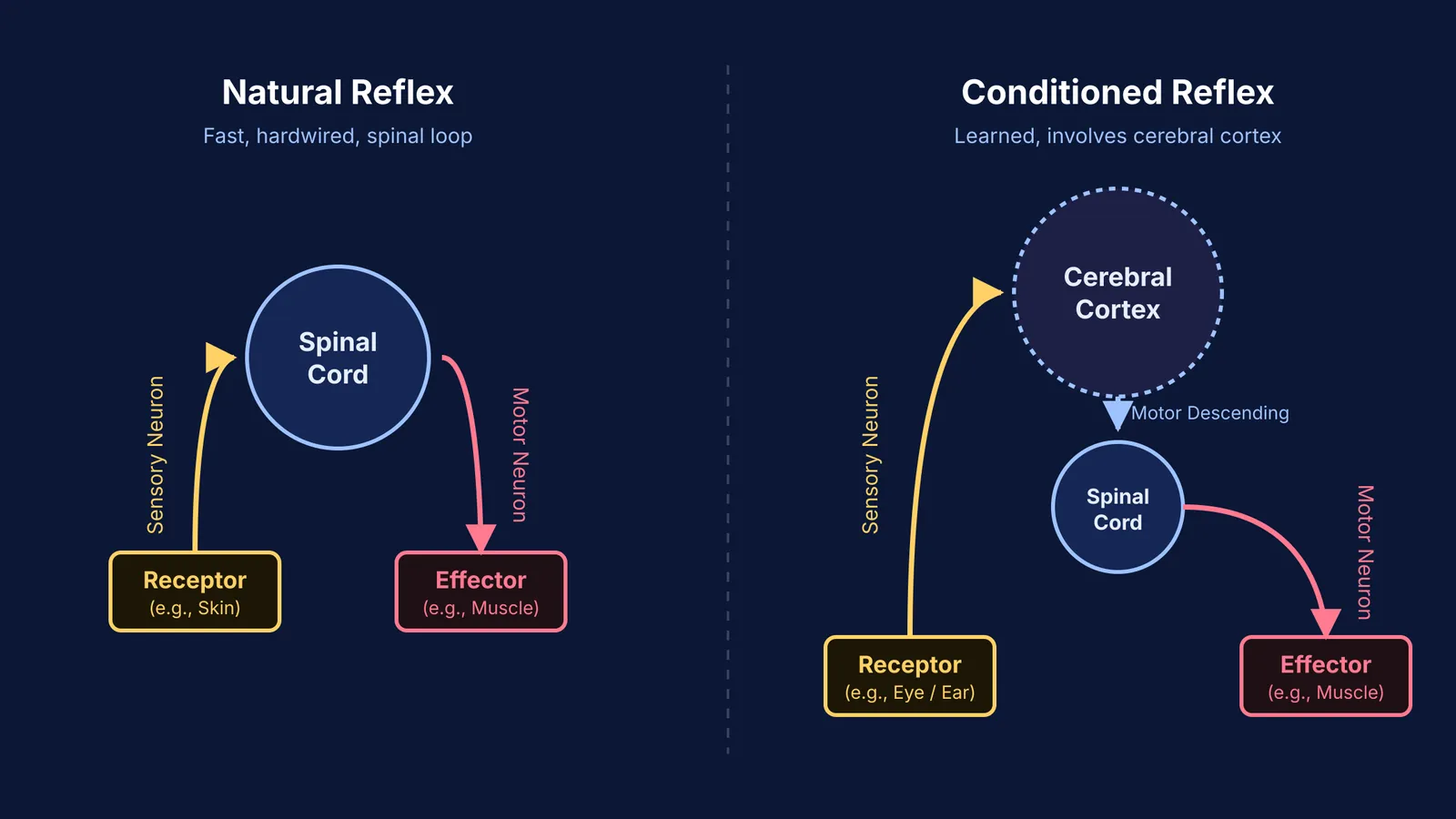
These survival responses are incredibly fast because they bypass the brain's complex decision-making centres. Instead, the signal travels along a sensory nerve to your spinal cord (or the brainstem), crosses a single synapse, and fires a motor nerve right back to the muscle. This simple, rapid loop is called a reflex arc. A typical short-latency stretch reflex takes just 30 to 50 milliseconds to complete.
What are conditioned reflex examples?
A conditioned reflex (or acquired reflex) is a learned response. It is built through experience, training, and repetition.
When you are learning to ride a bicycle, you have to think carefully about how hard to squeeze the brakes. After months of practice, squeezing the brakes when an obstacle appears in the road becomes an automatic, conditioned reflex. A typist's fingers flying across a keyboard or a musician playing a chord upon seeing sheet music are also complex acquired reflexes.
The classic demonstration of this was published in Ivan Pavlov's 1927 book, *Conditioned Reflexes*, translated by G. V. Anrep. Pavlov famously showed that dogs could learn to salivate at the sound of a bell if that sound was repeatedly paired with the arrival of food. While a newborn only salivates when food is actually in its mouth (a natural reflex), salivating at the mere smell, sight, or sound of food is a learned association.
Because conditioned reflexes involve learning a new association, they rely on the cerebral cortex—the outer layer of your brain responsible for higher-level processing. The cortex links the new stimulus (the bell) to the existing response (salivating) and, through repetition, locks in the habit.
How do natural and conditioned reflexes differ?
If you are facing an exam question asking you to classify a reflex, you can use this simple three-step framework to find the answer:
The Newborn Test: Is this response present at birth? If a one-day-old baby would do it (like coughing to clear an airway), it is a natural reflex. If it requires growing up and experiencing the world, it is conditioned.
The Control Centre: Which part of the central nervous system is in charge? Natural reflexes are primarily integrated in the spinal cord or brainstem. Conditioned reflexes always require the cerebral cortex to build the initial association.
Permanence: Can it be forgotten? Natural reflexes are permanent and essentially the same in every healthy member of a species. Conditioned reflexes can fade—a process known as extinction—if the habit is not reinforced over time.
If you find yourself stuck on the differences between neural pathways or how the spinal cord interacts with the brain, the Fermi Concept Library can help you trace these circuits step by step. When you make a mistake on a tricky multiple-choice question about the nervous system, the Fermi Problem Library provides a step-by-step solver that explains the reasoning rather than just printing the right answer. And if you are overwhelmed by the syllabus and do not know where to start, Fermi's AI tutor can work out what you already know and build a plan for your session, so you sit down to a clear next step.


