

On this page
If you have eaten nalli nihari, you have held the answer in your hand. The nalli is a shank bone: a hard shaft with soft marrow down the middle. Your thigh bone is built the same way, and the reason is the physics of bending.
What is inside a long bone?
The diaphysis is “the tubular shaft that runs between the proximal and distal ends of the bone,” according to the OpenStax Anatomy and Physiology textbook.
The hollow inside that shaft is the medullary cavity, filled with yellow marrow, and its walls are dense compact bone, says the same OpenStax chapter. The ends hold spongy bone, a lattice of struts that forms along lines of stress. The skeleton puts its heaviest material in the walls of a tube, exactly where an engineer would.
Why does a hollow tube resist bending so well?
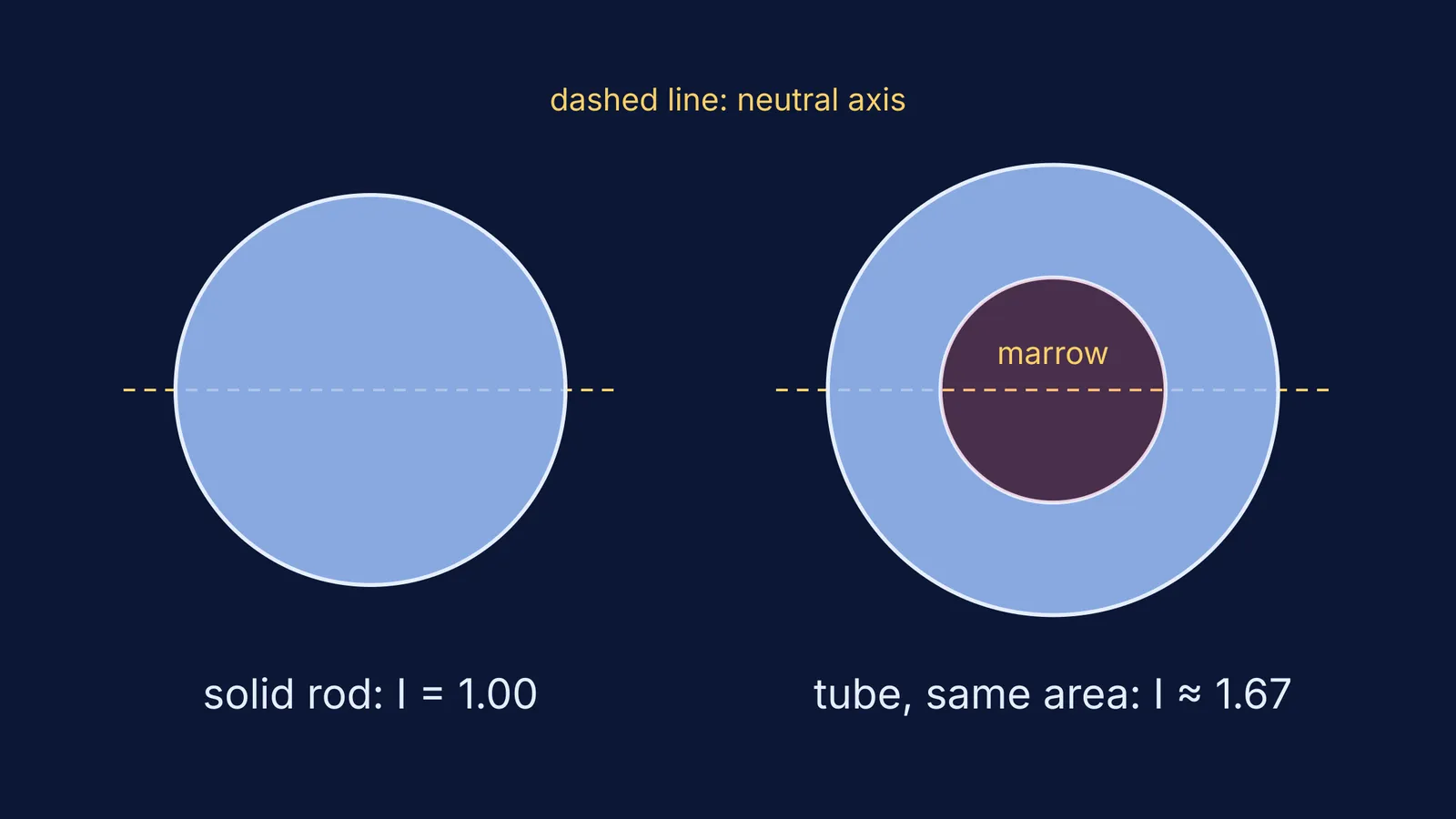
Bend a rod and one side stretches while the other squashes. In between is a line that does neither, the neutral axis. In Euler–Bernoulli beam theory, bending stress is σ = Mz/I, so stress grows in proportion to z, the distance from the neutral axis.
So the material at the centre of a bent rod barely works, and the outer surface carries most of the load.
A beam's resistance to bending is its flexural rigidity, EI, where E is the material's stiffness and I is the second moment of area of the cross-section, per the same beam-theory reference. I sums every bit of area times its distance from the axis squared, so area far from the centre counts far more.
Worked comparison: solid rod vs hollow tube
From the standard list of second moments of area: a solid circle of radius R has I = πR⁴/4, and a ring with outer radius R and inner radius r has I = π(R⁴ − r⁴)/4.
Case 1: same outer size. Take a tube whose hole is half its outer diameter, r = R/2.
Area: π(R² − R²/4) = 0.75 × πR², so 25% less bone than the solid rod.
I: π(R⁴ − R⁴/16)/4 = 0.9375 × πR⁴/4, so about 94% of the solid rod's stiffness.
You lose a quarter of the weight and only about 6% of the stiffness, because the removed bone sat near the neutral axis.
Case 2: same mass. Spend the saved bone on a wider tube. A solid rod of radius a and a tube with r = R/2 have equal area when 0.75R² = a², so R ≈ 1.155a.
I: 0.9375 × (1.155a)⁴ × π/4 ≈ 1.67 × πa⁴/4, so about 1.7 times as stiff.
Bending strength goes as I divided by the outer radius: 1.67 ÷ 1.155 ≈ 1.44 times as strong.
Same bone, stiffer and stronger. OpenStax makes a related point about spongy bone: its spaces make bones lighter, so muscles can move them more easily.
If the algebra here trips you up, the Fermi Concept Library covers every concept in physics, chemistry, biology, mathematics and computing, each with its own lesson and its place in the map.
Why aren't bones even thinner-walled?
Why not a bone like a drinking straw? Squash a straw sideways and you see why: very thin walls dent and buckle.
Zoologists John Currey and R. McNeill Alexander studied this in the Journal of Zoology in 1985. They described each bone by K, the ratio of inner to outer diameter. Their analysis showed that the K that keeps bone mass lowest depends on whether the bone mainly needs fatigue strength, ultimate strength, impact strength or stiffness, and on whether the cavity holds marrow or gas, as in birds. They compared real limb bones of mammals, birds and some reptiles with these optima.
So a bone is a compromise, not a maximum. Engineers make the same trade, as our post on why beams have an I-shaped cross section shows, and so does a plant, in why puja pandals are built from bamboo.
Try it: the paper-tube test
You need two identical A4 sheets, tape, two stacks of books, thread, a small plastic bag and coins.
Roll sheet one tightly around a pencil, tape it and slide the pencil out: a near-solid rod.
Roll sheet two around a thick marker, tape it and remove the marker: same paper, wider tube.
Set the books 20 cm apart and lay the first roll across the gap.
Hang the bag from the middle and add coins one at a time until the roll sags 1 cm on a ruler. Count them.
Repeat with the wide tube, then with one rolled around a bottle.
Predict first: the worked example says the wider tube wins. Watch the bottle-sized one, though. If it kinks under the thread instead of bending smoothly, you have seen Currey and Alexander's point about walls that are too thin.
For more bending problems worked step by step, the Fermi Problem Library explains the reasoning rather than printing an answer. For the living side of bone, read three pieces of evidence that bone is a living tissue.


