

On this page
Hold up your right hand. The command that lifted it started in the left half of your brain. OpenStax Anatomy and Physiology 2e puts it in one line: the right motor cortex controls muscles on the left side of the body, and vice versa. Where the wiring crosses answers a whole family of exam questions, and explains why a stroke shows up on one side of the body.
Where do the nerve pathways cross over?
A decussation is the point where a nerve pathway crosses the midline to the other side. Three crossings matter, at three different levels.
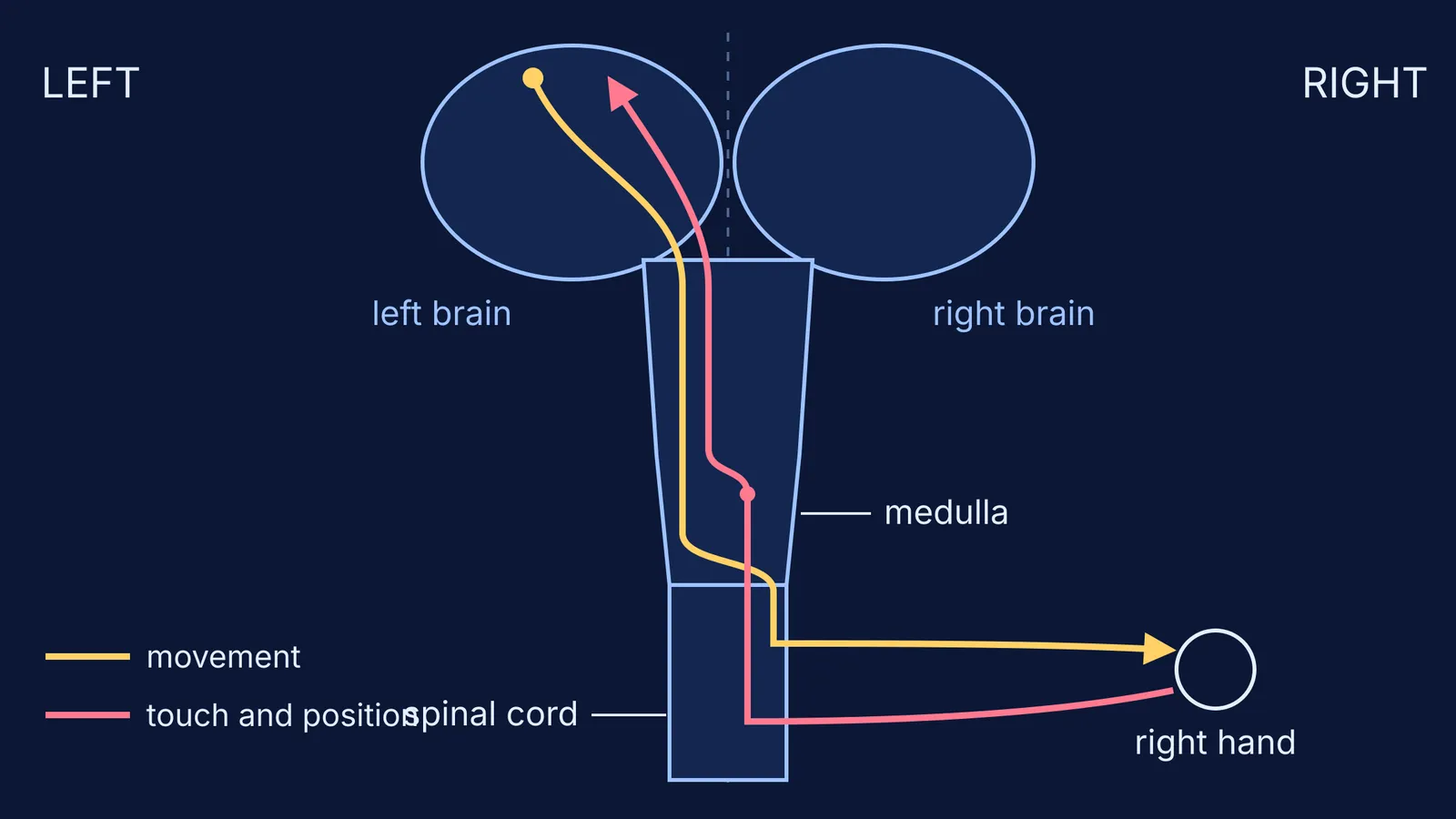
Movement (corticospinal tract). Signals start in the primary motor cortex, run down through a bundle called the internal capsule, and form the pyramids of the medulla. At the border of the medulla and spinal cord, most fibres cross at the pyramidal decussation and continue as the lateral corticospinal tract (OpenStax, Motor Responses).
Fine touch and body position (dorsal column). These fibres climb the spinal cord on the side they entered, then the second neuron in the chain crosses the midline of the medulla (OpenStax, Central Processing).
Pain and temperature (spinothalamic tract). These fibres cross early, inside the spinal cord, and then climb on the opposite side (same OpenStax chapter).
Not every movement fibre crosses there. From 75% to 90% of corticospinal fibres cross to form the lateral corticospinal tract, according to Neuroanatomy Online from UTHealth Houston. The rest form the anterior corticospinal tract, which controls trunk muscles; these cross in the spinal cord, at the level where they leave it (OpenStax).
How do you trace a pathway in an exam question?
Ask three questions, in this order.
Which pathway carries this function: movement, fine touch and position, or pain and temperature?
Where does that pathway cross: the lower medulla, the medulla, or the spinal cord?
Is the damage above or below that crossing? Above it, symptoms appear on the opposite side. Below it, they appear on the same side.
Worked example 1: damage in the left internal capsule. The internal capsule is in the cerebrum, above every crossing. Movement fibres for the right arm have not crossed yet, and touch and pain fibres from the right side have already crossed onto the left. Result: the right side is weak and numb.
Worked example 2: damage to the right half of the spinal cord in the neck. Now you are below the medulla. Movement fibres for the right arm have already crossed and run on the right, so the right side is weak. Dorsal column fibres from the right side have not crossed yet, so right-side fine touch and position are lost. Pain fibres from the left side crossed into the right half of the cord, so the left side loses pain and temperature. This split pattern is Brown-Sequard syndrome; OpenStax describes the paralysed leg still sensing pain but not fine touch or position.
Example 2 is where marks slip, so sketch the three lines and a horizontal cut before you answer. If the sketch is the hard part, the Fermi Concept Library gives each biology concept its own lesson, and Fermi's AI tutor can draw the figure with you and check your understanding as you trace each pathway.
For the cellular side, read why a nerve impulse travels only one way along an axon, and revise with these memory aids for the neural control chapter.
Why does a stroke affect one side of the body?
Most strokes damage one hemisphere, above all the crossings, so symptoms land on the opposite side. The NHS stroke symptoms page lists one side of the face drooping, not being able to lift both arms, slurred or confused speech, and weakness or numbness down one side of the body. Its FAST check stands for face, arms, speech and time.
Speed matters. A 2006 paper in the journal Stroke by Jeffrey Saver estimated that in a typical large-vessel ischaemic stroke, the patient loses 1.9 million neurons for each minute it goes untreated (Saver, Stroke, 2006). Stroke is also common: the WHO stroke fact sheet says 1 in 4 adults is predicted to have a stroke in their lifetime.
What should you do if you notice these signs?
This is everyday guidance, not medical advice. If someone suddenly has a drooping face, a weak arm or slurred speech, call 112, India's single emergency number (Press Information Bureau, Ministry of Home Affairs). The NHS says to get help straight away if stroke signs appeared within the last 24 hours, even if they have stopped (NHS).
A short script helps:
I think this person is having a stroke.
Their face droops on the right and their right arm is weak.
It started at 4:10 pm.
Our address is (give it slowly).
Next, read how muscle memory works in the cerebellum.


