

On this page
Once a red kangaroo is hopping, going faster costs it almost no extra fuel. The reason is a stretchy rope of tissue at the back of each leg.
What did the treadmill experiment find?
In 1973, Terence Dawson and Richard Taylor at Harvard trained two female red kangaroos, weighing 18 kg and 28 kg, to hop on a treadmill while wearing a light face mask that measured how much oxygen they used (Dawson and Taylor, Nature, 1973). Oxygen use tracks energy use.
They found two patterns:
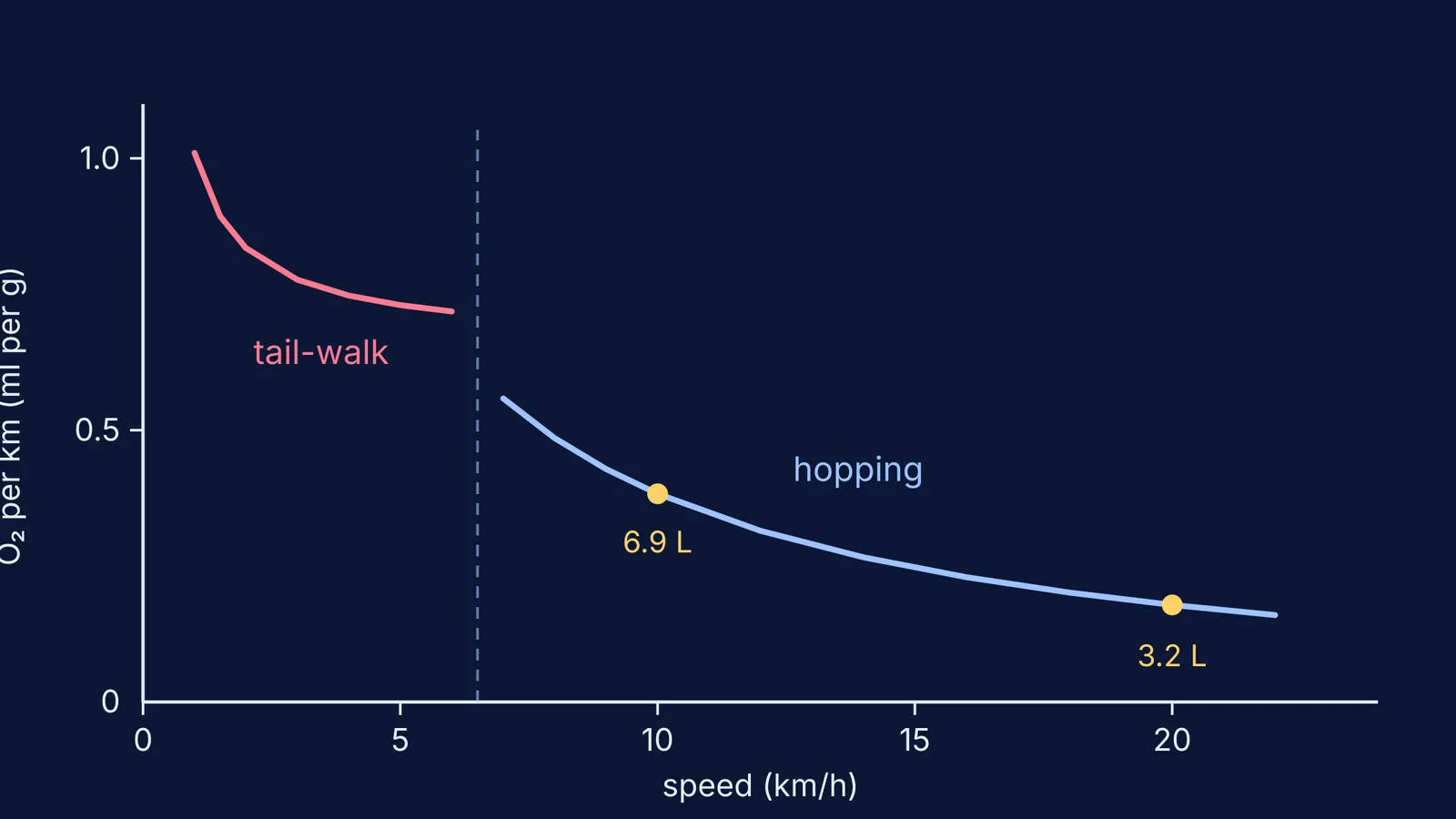
Below about 6 km/h the kangaroo does not hop. It walks on its front paws and tail as a fifth leg, swinging both back legs forward together. Oxygen use rose steadily with speed, and at 6 km/h it was about twenty times the animal's predicted resting metabolic rate.
From 7 to 22 km/h it hops, and oxygen use fell slightly as speed rose. The 18 kg animal's hopping data fit a line that sloped gently downward.
The kangaroos made almost the same number of hops per minute across a wide range of speeds. To go faster they made each hop longer, and the energy spent per hop stayed nearly constant. The same paper reports that below 18 km/h a hopping kangaroo uses more energy than predicted for a four-legged mammal of the same weight running, but above 18 km/h hopping appears cheaper.
Why do kangaroos hop instead of run?
The answer is elastic energy. On landing, the kangaroo's weight bends the ankle and stretches the Achilles tendon, which joins the calf muscles to the heel. The stretched tendon stores energy, then hands much of it back at take-off, so the muscles need not make it all fresh.
Dawson and Taylor dissected a 40 kg kangaroo and found an Achilles tendon about 1.5 cm thick and 35 cm long (Nature, 1973). They suggested that faster landings stretch these tendons more, recycling more energy, which would explain why speed did not cost more.
Two years later, R. McNeill Alexander and Alexandra Vernon filmed kangaroos and a wallaby hopping across a force plate (Journal of Zoology, 1975). They measured peak ground forces of about six times body weight and calculated that elastic storage in the Achilles tendon saved about 40% of the energy a wallaby would otherwise need at moderate speed.
Tendons join muscle to bone; see how tendons differ from ligaments.
A worked energy sketch: one kilometre at two speeds
You can do this with the line from the 1973 paper. For the 18 kg kangaroo hopping, oxygen use was about 4.09 minus 0.026 times speed, in millilitres of oxygen per gram per hour, with speed in km/h (Dawson and Taylor, Nature, 1973).
At 10 km/h: rate = 4.09 − 0.26 = 3.83 ml per gram per hour. One kilometre takes 0.1 hour, so it costs 0.383 ml per gram. For 18,000 g that is about 6.9 litres of oxygen.
At 20 km/h: rate = 4.09 − 0.52 = 3.57 ml per gram per hour. One kilometre takes 0.05 hour, so it costs 0.179 ml per gram, or about 3.2 litres.
Compare: doubling the speed cut the oxygen cost of the same kilometre by a bit more than half.
Check against the slow gait: the tail-walking line was 0.35 + 0.66 times speed. At 5 km/h that is 3.65 ml per gram per hour, or 0.73 ml per gram per kilometre, about 13 litres for the same trip.
If energy moving in and out of a spring is hard to picture, the Fermi Simulation Lab has interactive simulations for ideas that are easier to see than to read.
For the textbook version, see elastic potential energy in a stretched wire and why you cannot bounce higher on a trampoline for free.
If faster is cheaper, why don't kangaroos always sprint?
Rodger Kram and Terence Dawson asked exactly this in a 1998 review (Comparative Biochemistry and Physiology, 1998). They confirmed that oxygen use stays nearly the same as a red kangaroo hops faster on level ground, while its muscle efficiency is normal, about 30%. So unusual muscle is probably not the explanation, though the full mechanism remains unsettled.
Their suggested answer is safety: red kangaroos prefer relatively slow speeds that avoid high levels of tendon stress. A spring that saves energy can also snap.
How to use this in a Class 11 answer
A strong answer to why hopping suits kangaroos has four parts:
Structure: long, thick Achilles tendons in the hind legs.
Mechanism: tendons stretch on landing, store elastic energy and return it at take-off.
Evidence: oxygen use stays flat or falls slightly as hopping speed rises (Dawson and Taylor, 1973).
Limit: high speeds raise tendon stress, which may be why kangaroos usually travel slower than the cheapest speed.
If elastic energy still feels shaky, the Fermi Concept Library gives each physics and biology concept its own lesson.


