

On this page
When you study tissues in Class 9 or prepare for biology exams, the difference between a tendon and a ligament is a common test question. Both are tough, fibrous structures, but they have distinct roles in the human body.
What is the difference between a tendon and a ligament?
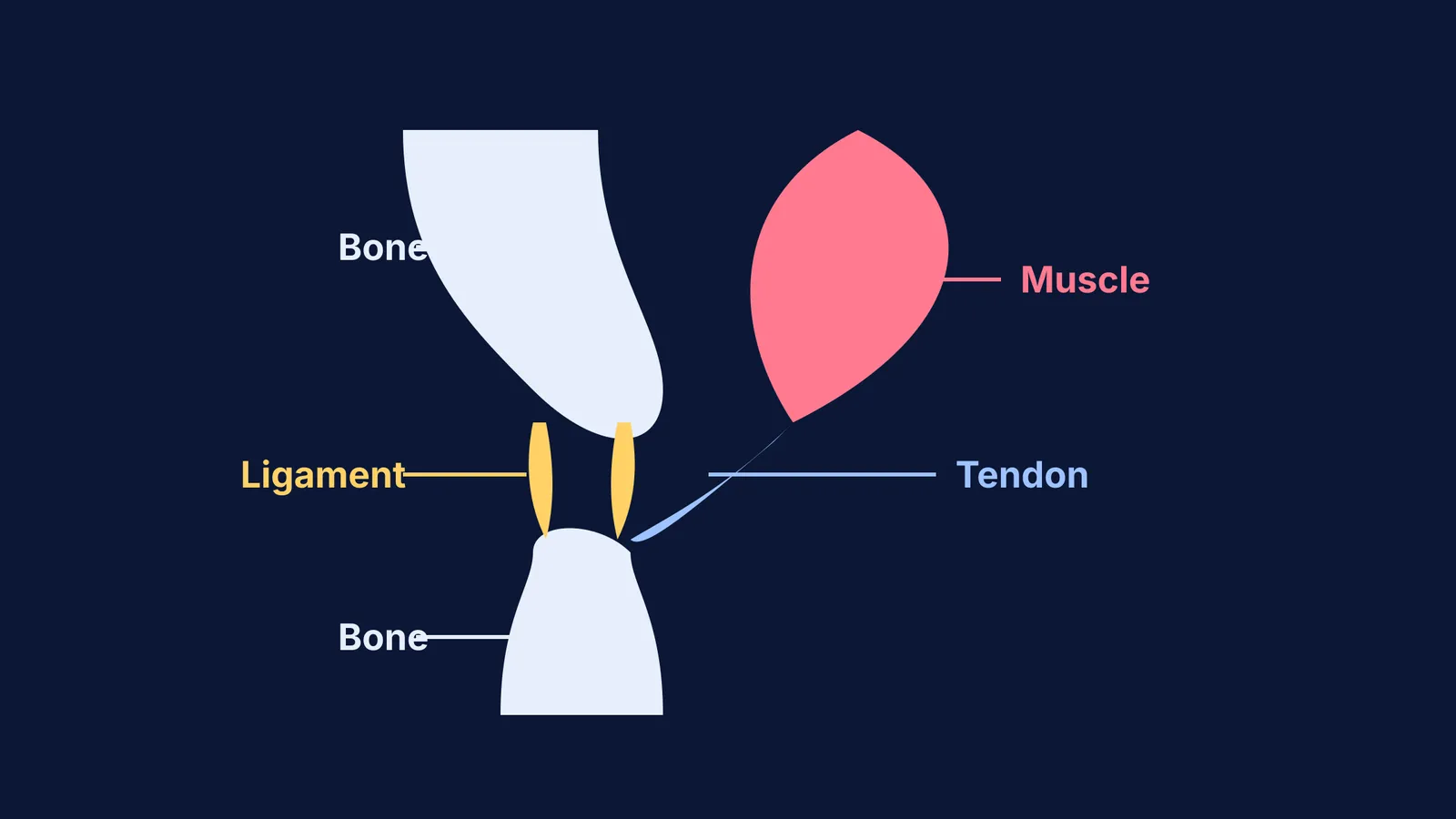
The main difference between the two is what they connect. Tendons attach skeletal muscles to bones, transmitting the mechanical force of muscle contraction to the skeletal system so you can move. There are about 4,000 tendons in the adult human body (Wikipedia).
Ligaments connect bones to other bones at joints, holding the skeleton together and keeping joints stable. For example, the anterior cruciate ligament provides 85% of the restraining force to anterior tibial displacement in the knee (Wikipedia).
To see these structures in the context of the whole skeletal system, review locomotion and movement.
Dense regular connective tissue
Despite their different roles, tendons and ligaments are both classified as dense regular connective tissue. You will also see these tissues detailed in the chapter on structural organisation in animals.
In dense regular connective tissue, the collagen fibres are bundled in a parallel fashion. This regular, longitudinal arrangement gives the tissue great tensile strength, meaning it can strongly resist pulling forces in one direction. However, this tissue has a very poor blood supply. Because of this limited blood flow, damaged tendons and ligaments are notoriously slow to heal.
While they are structurally similar, ligaments are slightly more stretchy and contain more elastic fibres than tendons do. This elasticity allows joints to move smoothly without dislocating.
Composition and structure
When you look closely at these tissues, they share a very similar internal design. Tendons are composed mostly of collagen, with their dry mass consisting of 60% to 85% collagen, primarily Type I collagen (Wikipedia). This collagen spontaneously assembles into fibrils, which bundle together to form structures called fascicles. In a tendon, these fascicles are bound by an outer sheath of dense irregular connective tissue.
Ligaments also consist of dense bundles of collagenous fibres, but they have subtle structural differences. Because they must allow joints to move naturally without dislocation, ligaments exhibit a property called viscoelasticity. This means they can gradually stretch under tension and return to their original shape when that tension is removed (Wikipedia). Some people naturally have more elastic ligaments than others, a trait known as hypermobility. However, if a ligament is stretched past its elastic limit or held under tension for too long, it may permanently lengthen and leave the joint unstable.
Is it a sprain or a strain?
Because they do different jobs, injuries to tendons and ligaments have different medical names.
Sprain: A soft tissue injury to a ligament within a joint, often caused by a sudden movement that forces the joint beyond its normal range of motion.
Strain: An acute injury involving the tearing of muscle fibres or a tendon.
If you are trying to determine which injury a question is describing, use this checklist:
Did the injury happen at a joint (like an ankle or knee)? It is likely a sprain.
Did the injury happen along the length of a muscle (like a hamstring)? It is likely a strain.
Is it a tear of tissue connecting two bones? It is a sprain.
Is it a tear of tissue connecting muscle to bone? It is a strain.
How to learn biological structures
If you are reviewing connective tissues or the skeletal system, Fermi's AI tutor can work out what you already know and build a plan for the session, writing on a board and checking your understanding as it goes. For a complete map of these topics in biology, you can explore the Concept Library.
Learning the structural differences between these tissues is the first step to understanding how the human body moves and protects itself.


