

On this page
Jump on a trampoline and it feels as if the mat gives you something for free. It doesn't. Every bounce is a trade between three kinds of energy: motion, height and stretch. Once you see the trade, you can predict the whole bounce.
What is the physics of a trampoline?
A trampoline is a stretched mat held by springs, and together they act like one big spring. Hooke's law says the restoring force is proportional to the stretch, F = −kx, where k is the force constant in newtons per metre (OpenStax College Physics 2e, section 16.1). The minus sign means the force points back towards the flat position.
A trampoline, like every tightly stretched elastic membrane, has a spring constant, and you can find it by adding a known weight and measuring how far the mat sinks, using k = mg/d (University of Illinois Physics Van). Treat this as a model. Real springs pull at an angle and a very deep dip is not perfectly linear, but one effective spring gets you close.
How much energy does a trampoline store?
The elastic potential energy stored in any deformed system that obeys Hooke's law is ½kx² (OpenStax College Physics 2e). Because x is squared, a dip twice as deep stores four times the energy.
How deep does a trampoline sink for a 50 kg student?
These numbers are illustrative. They use Hooke's law and conservation of energy from OpenStax University Physics, section 8.3, with g = 9.8 m/s².
Stand still on the mat. Suppose it sinks d = 0.10 m. Then k = mg/d = (50 × 9.8)/0.10 = 4900 N/m.
Now bounce so that your feet rise 1.0 m above the flat mat at the top of each jump.
You are momentarily at rest at the top and again at the lowest point. Measuring height from the lowest point, all the energy is gravitational at the top and elastic at the bottom: mg(1.0 + x) = ½kx².
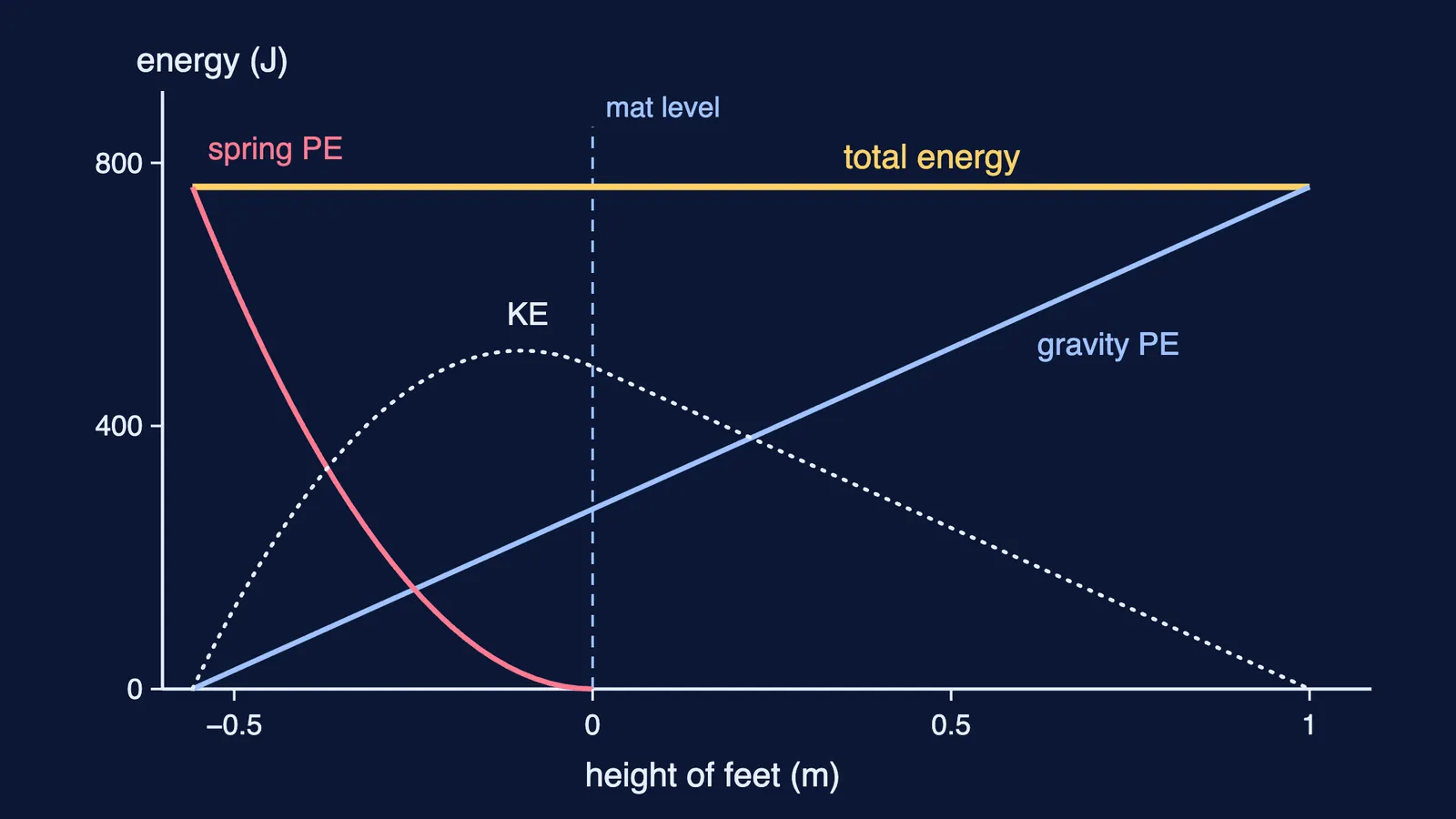
Put in the numbers: 490(1.0 + x) = 2450x², which gives x ≈ 0.56 m.
Stored energy: about 760 J. Peak force from the mat: kx ≈ 2700 N, about 5.6 times your weight.
That last number is the surprise: for an instant the mat pushes on you with several times your weight. The diagram at the top plots this same bounce. For the exam version of this set-up, see our walkthrough of finding the maximum compression when a mass is dropped onto a spring.
Why can't you bounce higher without adding energy?
Mechanical energy, the sum of kinetic and potential energy, stays constant unless forces from outside the system or non-conservative forces do work on it (OpenStax University Physics, section 8.3). On a trampoline those non-conservative forces are always at work: air drag, friction in the springs and the flexing mat. Dissipative forces remove mechanical energy and gradually reduce the motion until it stops (OpenStax College Physics 2e).
Researchers at the University of Canterbury in New Zealand used drop tests to build a model of the energy a trampoline absorbs for a known weight, then measured healthy adults bouncing with a gas analyser to estimate how much energy they spend (Alexander, Clement and Draper, European Journal of Sport Science). Rubbery materials lose a little energy on every stretch too; our post on elastic hysteresis in rubber shows why the loading and unloading curves do not match.
So where does a higher bounce come from? From you. While the mat is pressed down, you straighten your legs and push. Your muscles do work on the mat, the dip x grows, and ½kx² grows faster still. Bend your knees as you land instead and your muscles soak up energy, so the bounce dies.
How can you test trampoline physics yourself?
A short plan for a student and a parent:
Measure the sink. Stand still in the centre while someone measures the dip with a tape. Work out k = mg/d.
Predict a dip. Pick a bounce height, film one bounce on a phone beside a marked pole, and use the energy equation to predict the deepest dip.
Check it. Step through the video frame by frame and compare.
Explain the gap. If the real dip is smaller, energy went to the mat, springs and air. Decide which mattered most.
Kill a bounce by bending your knees, and name the force that did negative work.
Keep one person on the trampoline at a time, with an adult watching.
If a step stalls, the Fermi Problem Library has worked problems with a step-by-step solver that explains the reasoning rather than printing an answer. Some ideas are easier to see than to read; try the interactive simulations in the Fermi Simulation Lab. Not sure where to start? Fermi's AI tutor works out what you already know and builds a plan for the session.
For the same idea on a much longer spring, try predicting a bungee jump's maximum stretch.


