On this page
A bungee jump is a clean energy problem: one drop, two kinds of potential energy, and a moment at the bottom where the jumper stops. Predict that lowest point before you run a simulation.
How do you find the lowest point of a bungee jump?
Elastic potential energy is the energy stored when an elastic object such as a spring is stretched, and it equals the work done to stretch it (HyperPhysics, Georgia State University). For an ideal spring of stiffness k stretched by x, that energy is ½kx² (OpenStax University Physics, section 8.1).
Use three symbols: m for the jumper's mass, L for the cord's unstretched length, and x for how far the cord stretches beyond L. At the platform and at the lowest point the jumper is still, so kinetic energy is zero at both. Everything lost as gravitational energy has gone into the cord:
mg(L + x) = ½kx²
That is a quadratic in x. Take the positive root: x = [mg + √((mg)² + 2kmgL)] / k. The lowest point is L + x below the platform.
Worked example: what do the energy bars show?
Take a 60 kg jumper, a 15 m cord with k = 200 N/m, and g = 9.8 m/s². The weight mg is 588 N. Measure gravitational energy from the lowest point, and use Hooke's law for the cord's pull (HyperPhysics).
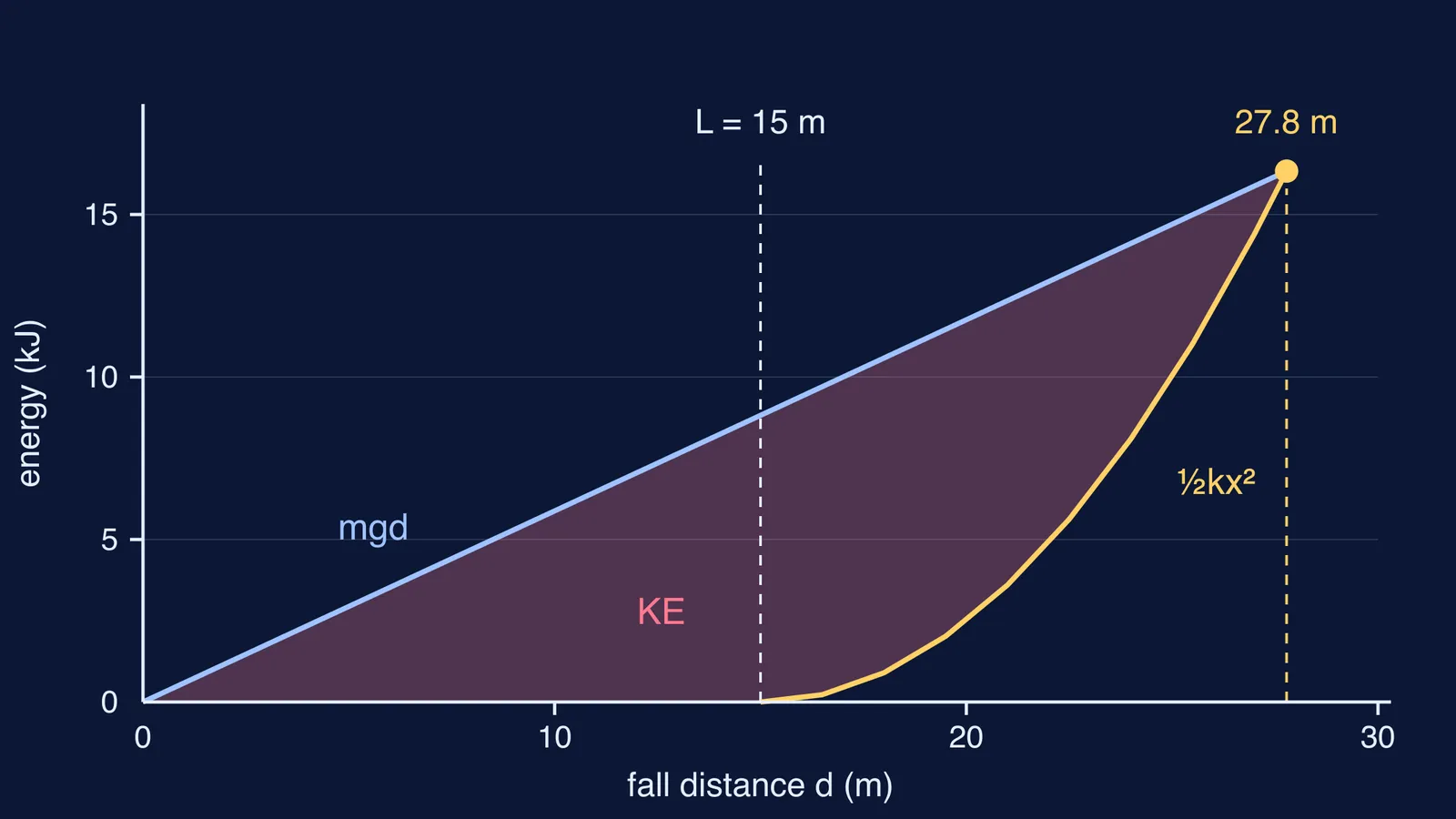
On the platform: the gravitational bar holds about 16.3 kJ. The kinetic and elastic bars are empty.
When the cord goes taut, 15 m down: the jumper has lost mgL = 8.8 kJ of gravitational energy, all of it now kinetic. Speed is √(2gL), about 17.1 m/s. The elastic bar is still empty.
At the lowest point: the formula gives x ≈ 12.8 m, so the drop is about 27.8 m. The kinetic bar is back to zero and the elastic bar holds ½ × 200 × 12.8², about 16.3 kJ.
Two surprises. The jumper is fastest not when the cord goes taut but where its pull equals the weight, mg/k ≈ 2.9 m past L. And at the bottom the cord pulls with kx ≈ 2,560 N, about 4.3 times the jumper's weight, so the jumper accelerates upward at roughly 3.3g.
What happens if you double the stiffness or add mass?
Predict each case first, then check it with the same equation (OpenStax section 8.1).
Double the stiffness to k = 400 N/m, same 60 kg jumper: the stretch falls to about 8.3 m and the drop to about 23.3 m. The stretch does not halve, because most of the energy the cord must absorb comes from the 15 m free fall, which does not change. The peak pull rises to about 5.6 times body weight.
Raise the mass to 90 kg, k back at 200 N/m: the stretch grows to about 16.7 m and the drop to about 31.7 m. Half again as much mass gives only about 31% more stretch, and the peak pull falls to about 3.8 times body weight.
For the spring on its own, try our Hooke's law spring extension simulation, then follow the bounce after the bottom with the mass-spring SHM simulation.
Why is a real bungee jump different from the model?
In a 2010 paper in Physics Education, André Heck, Peter Uylings and Ewa Kędzierska studied the first phase of a jump, while the cord is still slack, using sensor measurements, high-speed video and computer models (Physics Education). They note that teaching material often treats this phase as free fall, but once the mass of the rope is included, the jumper reaches an acceleration greater than g.
Our model also assumes a massless cord that follows Hooke's law at every stretch, and no air resistance. A real cord breaks these assumptions, so its lowest point differs.
To watch the energy bars move, the Fermi Simulation Lab has interactive simulations for the ideas that are easier to see than to read.
How do you run this as a predict-then-test session?
The "predict first" step matters. Catherine Crouch, Adam Fagen, Paul Callan and Eric Mazur found that students who only watched classroom demonstrations understood the concepts no better than students who did not see them at all, while students who predicted the outcome first showed better understanding (American Journal of Physics, 2004).
A 20-minute plan:
Predict the lowest point for the 60 kg, k = 200 N/m case.
Sketch the three energy bars at the top, at cord-taut and at the bottom, in kJ.
Run the simulation. Off by more than a metre? Check that you used L + x.
Predict, then test, the doubled stiffness and the 90 kg jumper.
Write down what surprised you.
See also our energy conservation problem method. If your algebra keeps landing on the wrong root, the Fermi Problem Library has worked problems with a step-by-step solver that explains the reasoning rather than printing an answer.
Start with step 1: write down your number before you touch the slider.