

On this page
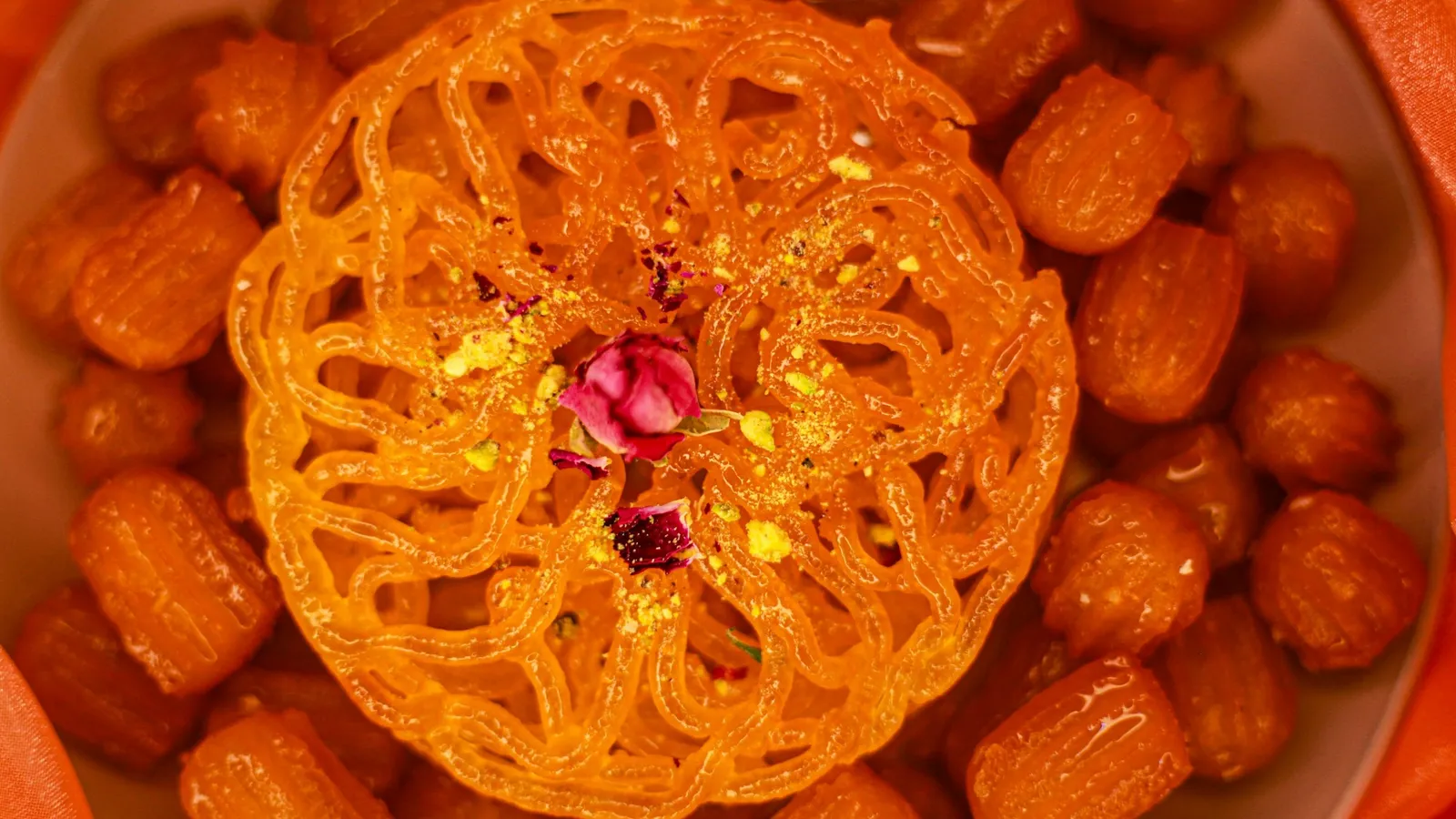
A plate of jalebi and a bowl of gulab jamun meet the same thing: hot sugar syrup. Yet one comes out crunchy, the other soft and dripping. It comes down to two ideas from chemistry and physics: how dry and rigid the fried structure is, and how fast water can move into it.
Why does jalebi stay crispy after soaking in syrup?
Start with the frying. Food scientists studied jalebi frying in detail; their Jilebi 3 paper in the Journal of Food Science and Technology describes the process as frying shaped batter strands "to obtain a crisp texture followed by absorption of sugar syrup". They found that moisture falls sharply at the start of frying and then levels off.
Frying also builds the structure. Under the microscope, the fried strands showed a porous structure of pores separated by thin cell walls only 10 to 15 micrometres thick (Chakkaravarthi and colleagues). Strands fried at 160 °C for 180 to 240 seconds were judged the best both straight from the oil and after soaking in syrup.
Thin, dry walls of cooked batter behave a lot like glass. A study of wafers found that water acts as a plasticiser: at moisture levels between 6 and 11% the wafer stayed in a "glassy" state and acceptably crisp, while above that range it became rubbery (Martínez-Navarrete and colleagues, 2004). Jalebi is usually soaked only briefly, so the likely picture is that syrup coats and fills the outer channels before enough water reaches the brittle walls to turn them rubbery.
Crispness is also what tasters look for. In a sensory study of nine market samples, crispness, sweetness, a glossy look and overall quality grouped together as the desirable attributes of jalebi (Prakash and colleagues, 2004).
Why does gulab jamun go soft when jalebi doesn't?
Gulab jamun starts in a different place. It is a thick ball of khoa dough, fried until brown but still moist and soft inside, and then usually left in syrup much longer. Our post on why gulab jamun soaks up syrup explains how capillary action pulls syrup through its open pores while sugar diffuses into the dough between them.
So the two sweets sit at opposite ends:
Jalebi: thin strands, fried to a dry, rigid network, short dip. Syrup decorates it.
Gulab jamun: thick, soft, still-moist ball, long soak. Syrup becomes part of it.
For more on frying, read why deep frying makes food crispy.
How does syrup strength change how fast water moves in?
Syrup strength is measured in degrees Brix, a measure of the dissolved solids in a liquid that is commonly used for the sugar content of a solution (Brix). Stronger syrup changes the traffic in two directions at once.
A 2026 study soaked gulab jamun under vacuum (a process called vacuum impregnation) in syrups of 40, 50 and 60 °Brix and modelled how moisture moved into the product (Sharanabasava and colleagues, Journal of Food Science and Technology). The moisture transfer coefficient fell from 1.075 × 10⁻⁴ m/s at 40 °Brix to 5.097 × 10⁻⁵ m/s at 60 °Brix, roughly half. Sugar did the opposite: its transfer coefficient rose from 3.179 to 5.257 × 10⁻⁵ m/s as the syrup got stronger. Kitchen soaking is slower than the vacuum process, but the direction is what matters here.
A study on khoa jalebi found the same pattern for sugar: diffusion followed Fick's law, and sugar moved in faster from more concentrated syrup (Singariya and Pagote, Indian Journal of Dairy Science).
Put together, a strong syrup loads a fried sweet with sugar while slowing the water that would soften it. It is the same push and pull you see in why salt makes salad watery, where a difference in concentration drives water across.
How can you test this at home?
Here is a 30-minute kitchen experiment for a Class 9 to 12 student. You need two jalebis from the same batch, two cups, sugar and water.
Make a thin syrup (roughly 1 part sugar to 2 parts water) and a thick syrup (roughly 2 parts sugar to 1 part water). Let both cool until warm.
Predict first: which jalebi will go soft sooner, and why? Write one sentence.
Put one jalebi in each cup. Every 5 minutes, lift each out and press gently with a spoon.
Note when each one stops snapping and starts bending.
Explain the result using two words from this post: glassy and diffusion.
What to expect: the jalebi in thin syrup will probably turn limp first, because water reaches its walls faster. Leave both long enough and both go soft, which is why jalebi tastes best fresh.
If particles moving from high to low concentration still feel abstract, the Fermi Concept Library covers every concept in physics, chemistry and biology, each with its own lesson, including diffusion and osmosis. The Fermi Simulation Lab has interactive simulations for the ideas that are easier to see than to read.
Next time you eat a jalebi, listen to the crunch: a dry, brittle structure holding out against water.


