On this page
Drop a freshly fried gulab jamun into syrup and within minutes it swells and darkens. Two ideas from your syllabus explain it: capillary action and diffusion.
What happens inside a gulab jamun when it fries?
The dough holds a lot of water. In hot oil, much of it escapes, leaving a network of small holes. Researchers who compared conventional and vacuum frying in the Asian Journal of Dairy and Food Research measured a porosity of 45.88% for gulab jamun fried at normal pressure and 43.61% for vacuum-fried ones.
So close to half of a fried gulab jamun is empty space. The conventionally fried balls also had more interconnected pores, which matters: syrup travels only through holes that join up.
Why does the syrup get pulled inside?
Those connected pores behave like a bundle of very thin, crooked tubes. OpenStax College Physics defines capillary action as "the tendency of a fluid to be raised or suppressed in a narrow tube". The rise height is h = 2γ cos θ / (ρgr), where γ is surface tension, θ the contact angle, ρ the density and r the tube radius.
Note the r in the denominator: the narrower the tube, the higher the liquid climbs. If you have read how a diya wick draws up oil, this is the same physics, just in a sweeter sponge.
Capillary rise is easier to picture than to read about. The Fermi Simulation Lab has interactive simulations for the ideas that are easier to see than to read.
Why does warm syrup soak in faster than cold syrup?
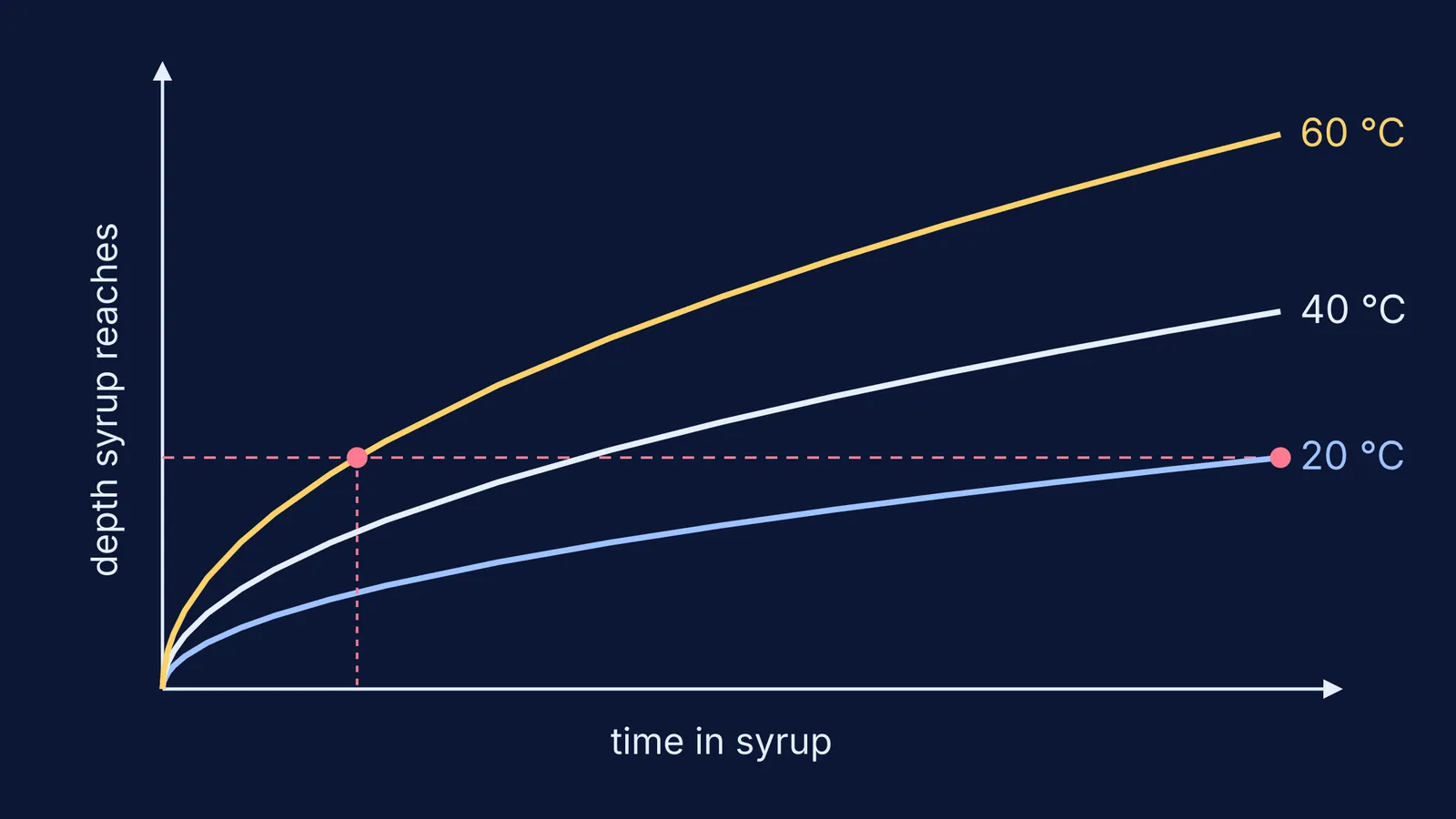
How fast a liquid creeps into a pore is described by Washburn's equation, from Edward Washburn's 1921 paper "The Dynamics of Capillary Flow" in Physical Review. As set out in this summary of Washburn's equation, the distance travelled is L = √(γrt cos θ / 2η), where t is time and η is the liquid's viscosity.
Depth grows with the square root of time, and viscous liquids move slowly. Here r sits on top: narrower pores pull harder but also drag more, so syrup moves through them more slowly. According to the Engineering ToolBox table for sugar solutions, a 60% sucrose solution has a viscosity of 56.7 cP at 20 °C but only 9.87 cP at 60 °C.
A worked example:
Viscosity ratio: 56.7 ÷ 9.87 ≈ 5.7, so the warm syrup is about 5.7 times runnier.
Depth in the same time: L scales with 1/√η, so √5.7 ≈ 2.4. Warm syrup gets about 2.4 times as deep in the same pore.
Time to reach the same depth: t scales with η, so warm syrup needs only about 1/5.7, roughly 17%, of the time. A depth that takes cold syrup 60 minutes takes warm syrup about 10 or 11.
This ignores the small change in surface tension with temperature and treats pores as neat tubes, so read it as a guide, not an exact timer.
Is it capillary action or diffusion?
Both. Capillary flow fills the open channels; then sugar has to move into the moist dough walls between them. OpenStax Biology describes diffusion as a substance moving "from a high concentration to a low concentration area until the concentration is equal across a space", and notes that higher temperature speeds it up while a longer distance slows it down.
So the centre, farthest from the syrup, sweetens last. To sharpen the difference, our explainer on osmosis vs diffusion sets them side by side.
How much sugar does a gulab jamun actually absorb?
It varies a lot. A study of six market brands in the Indian Journal of Dairy Science found absorbed sugar ranging from 12.24% to 37.65%, with ball diameters of 3.09 cm to 3.60 cm. A wider ball means syrup has farther to travel to reach the centre. How thick you boil the syrup matters too; see our piece on one-string sugar syrup consistency.
Try it: a two-bowl syrup experiment
Ask an adult to handle the hot oil and syrup.
Pick six fried balls of similar size and weigh each on a kitchen scale.
Split one batch of syrup into two bowls: keep bowl A warm, let bowl B cool to room temperature.
Put three balls in each bowl.
At 10, 20 and 40 minutes, lift one ball from each bowl, drain it for 30 seconds and weigh it.
Work out the gain: (new mass − old mass) ÷ old mass × 100.
Cut each weighed ball in half and look at how far the dark, syrupy ring has reached.
Plot gain against √t. If Washburn's equation holds, expect a roughly straight line in the early minutes, and a steeper one for the warm bowl.
If your results do not match, write down why: uneven ball sizes, or bowl A cooling down.
If viscosity or surface tension still feels hazy after this, the Fermi Concept Library has a lesson on every concept in physics and chemistry, each with its place in the map.