

On this page
In Indian kitchens and confectioneries, sweet makers rely on sugar syrup cooked to *ek taar*, or one-string consistency, to coat jalebis, soak gulab jamuns, and glaze pastries. While traditional cooks test this stage by cooling a drop of syrup between their thumb and forefinger and pulling them apart, the underlying phenomenon is pure solution thermodynamics. As documented in the NCBI PubChem sucrose compound record, pure sucrose (C12H22O11) has a molar mass of 342.3 g/mol and dissolves readily in water, reaching saturation at about 67% solute by mass at 25°C. When a cook dissolves sugar into heated water and leaves the pot to simmer, water continuously escapes as steam while the non-volatile sugar molecules stay behind.
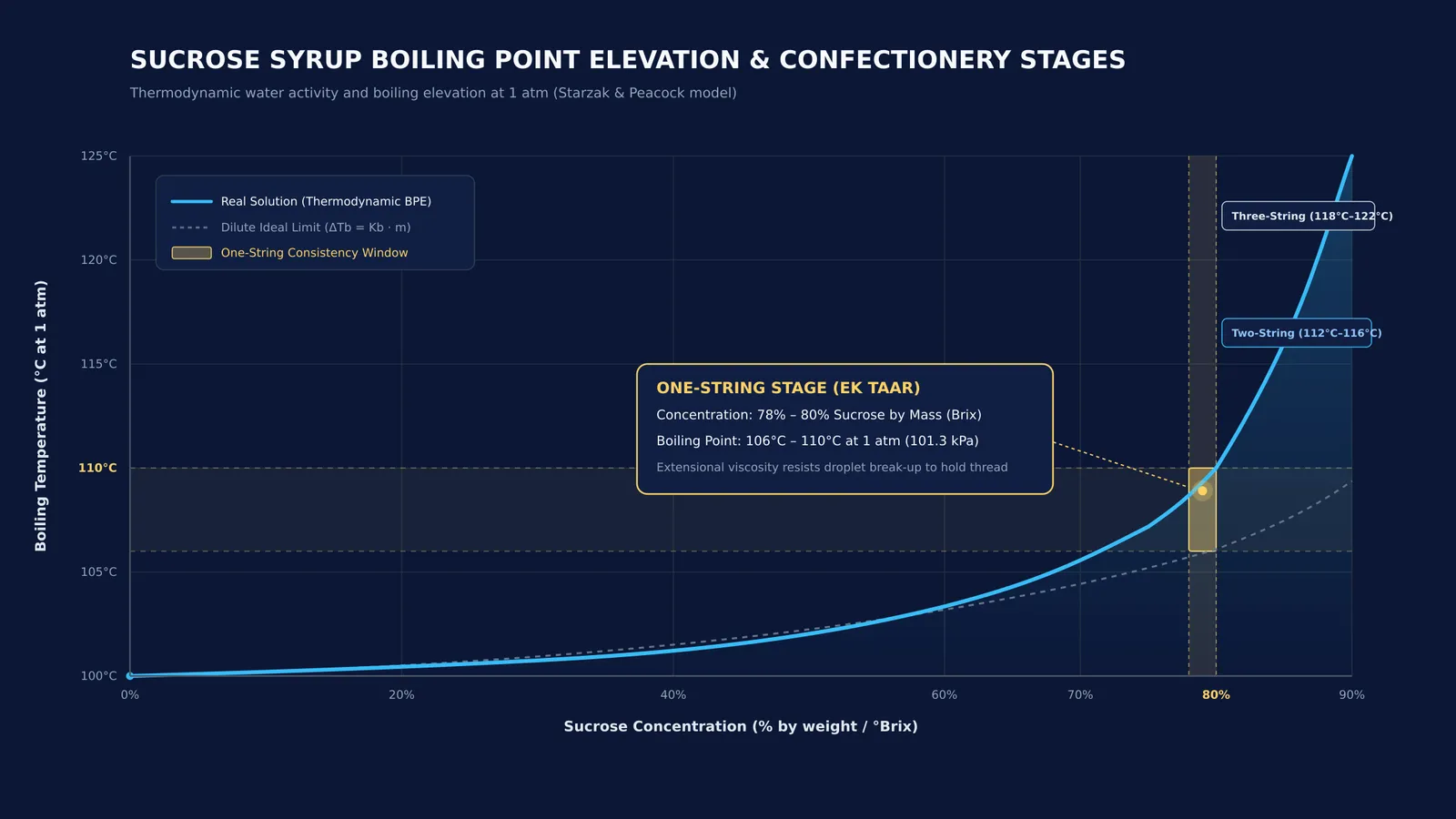
As water leaves the mixture, the solution reaches one-string consistency when the sucrose concentration climbs to roughly 78% to 80% by mass. At standard sea-level atmospheric pressure (1 atm, or 101.3 kPa), this concentration boils between 106°C and 110°C, a relationship mapped by thermodynamic models in Critical Reviews in Food Science and Nutrition. When you draw a droplet of this hot syrup apart after letting it cool for a few seconds, it forms a single, thin liquid thread that holds between the fingers before parting. Understanding how to track this stage connects everyday cooking directly with converting between molality and mass fraction.
Why does boiling point rise as sugar syrup cooks?
Under standard conditions, pure water boils at exactly 100.0°C because its vapor pressure matches the surrounding atmospheric pressure of 1 atm. When you add a non-volatile solute such as sucrose, the solute particles occupy positions at the liquid surface and form intermolecular bonds with water molecules, lowering the solution's vapor pressure. This relationship is described by Raoult's law and vapor pressure lowering. Because the vapor pressure of the solution is lower than that of pure water at any given temperature, the syrup must be heated to a higher temperature before its vapor pressure can equal atmospheric pressure, creating an elevation in boiling point detailed in LibreTexts Chemistry colligative properties/13%3A_Properties_of_Solutions/13.05%3A_Colligative_Properties).
In elementary physical chemistry, the boiling point elevation ΔTb for dilute solutions is calculated as ΔTb = Kb · m, where the ebullioscopic constant Kb for water is 0.52 K kg mol⁻¹ in the NCERT Class 12 chemistry curriculum. However, an open sugar pot is not a static dilute system. Every gram of water that boils away increases the molality of the remaining syrup. As the sucrose concentration climbs past 50% and approaches 80%, the simple linear approximation gives way to non-ideal behavior. Rigorous thermodynamic analysis published in Food Chemistry shows that water activity decreases sharply at high solute fractions, causing the boiling point to rise at an accelerating rate as the syrup concentrates.
When exploring how particle interactions alter physical states, the Fermi Simulation Lab provides interactive simulations for ideas that are easier to see than to read, helping you visualize how solute particles restrict solvent evaporation at the liquid boundary.
How does water loss change syrup viscosity and crystal formation?
The physical formation of a "string" is a competition between surface tension, which pulls liquids into spherical droplets, and extensional viscosity, which resists stretching. In dilute sugar solutions below 60% concentration, Rayleigh-Plateau instability quickly breaks a liquid column into tiny beads. But at 78% to 80% concentration, each sucrose molecule interacts with neighboring water molecules across eight hydroxyl groups, establishing a dense network of intermolecular hydrogen bonds verified in Critical Reviews in Food Science and Nutrition. As the syrup cools slightly between your fingertips to 40°C or 50°C, its viscosity rises by several orders of magnitude, providing the cohesive strength needed to sustain an unbroken filament.
What happens if you keep boiling past the one-string stage? If water continues to boil off until temperature reaches 112°C to 116°C, concentration rises to roughly 82% to 85% by mass, entering the "two-string" (*do taar*) stage used for dense sweets like burfi and kaju katli. Boiling further to 118°C–122°C drives sugar concentration past 87%, producing the "three-string" (*teen taar*) consistency whose steep boiling elevation is captured in Food Chemistry before crystallizing rapidly into a rigid lattice, as explored in colligative properties and boiling point elevation.
To master solution concentrations and colligative calculations, the Fermi Problem Library provides worked problems with a step-by-step solver that explains the reasoning rather than printing an answer, ensuring you can calculate molality and boiling shifts accurately under exam conditions.
How do you test and troubleshoot one-string syrup?
To test for one-string consistency accurately in a kitchen laboratory or practical project, follow this four-step diagnostic protocol:
Monitor boiling temperature with a calibrated digital thermometer, targeting the 106°C to 110°C window at sea level, which corresponds to the one-string threshold documented in Critical Reviews in Food Science and Nutrition.
Adjust your target temperature for altitude: because reduced atmospheric pressure lowers water's base boiling point, the boiling threshold shifts downward correspondingly at higher elevations.
Perform the finger pull test safely by letting a drop of hot syrup cool on a spoon to a comfortable warm temperature, then pressing it between your thumb and index finger before slowly drawing them apart to check for a single continuous thread.
Prevent premature crystallization by stirring in a few drops of lemon juice; the citric acid hydrolyzes a fraction of sucrose into glucose and fructose, creating invert sugars that disrupt crystal formation without altering syrup thickness.
Whether you are reviewing colligative derivations or troubleshooting an experimental setup, Fermi's AI tutor can work out what you already know and build a plan for the session, guiding you through solution chemistry step by step.


