

On this page
You swallow plant viruses with your food, and they don't make you sick. The reason is host specificity: a virus can only infect a cell whose surface it can grab and whose machinery it can use. Tobacco mosaic virus (TMV) and HIV show both sides of this, and the same idea explains why some animal viruses do reach humans.
Can humans get infected by plant viruses?
No plant virus has yet been shown to cause disease in humans or other animals, according to a 2015 review in *Viruses*, Can plant viruses cross the kingdom border and be pathogenic to humans? The same review notes that replication of a plant virus in mammalian cells has not been shown unless the cells were made to express a genuine host protein.
It isn't because we avoid plant viruses. A PLoS Biology study of human stool found that 97.1% of the virus-like RNA sequences it identified matched plant viruses. Pepper mild mottle virus was the commonest, at up to 10^9 virions per gram of dry stool. It turned up in 12 of 18 samples from healthy people on two continents, and pepper-based foods tested positive too. The virus from stool could still infect pepper plants: it came through the human gut intact and infectious.
Why can't a plant virus infect a human cell?
A virus has to clear three gates in a host, and each one needs a match.
Get in: cross the cell's outer layer.
Get copied: use the cell's machinery to build new viruses.
Spread: reach the next cell.
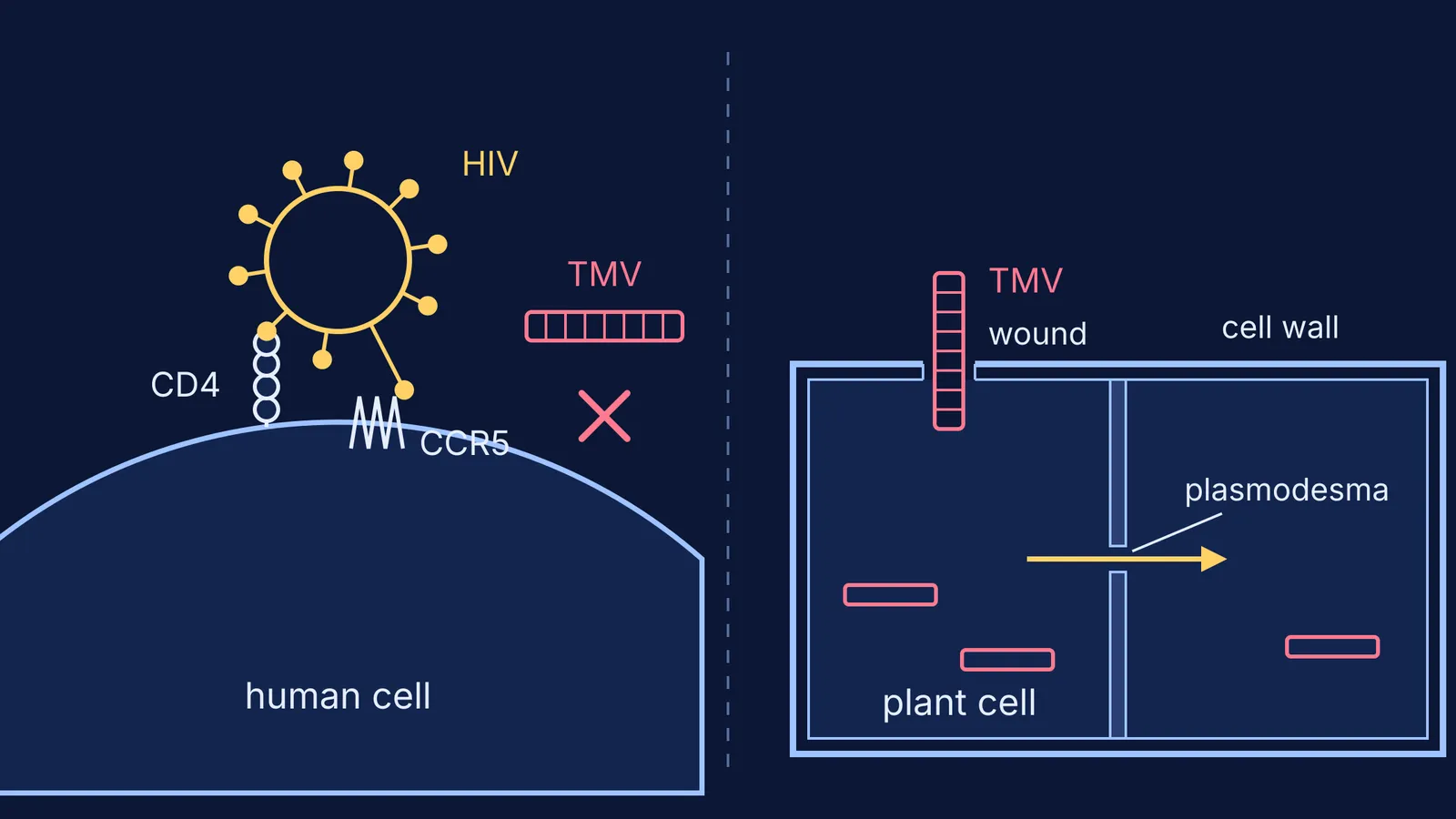
HIV clears all three in a human T cell. A review of HIV cell binding and entry explains that the HIV envelope protein first binds the receptor CD4, then a co-receptor, usually CCR5 or CXCR4. That exposes a fusion peptide that inserts into the cell membrane. The lock is strict: mouse cells given human CD4 let HIV bind, but not fuse or infect.
TMV plays by plant rules. Plant viruses enter plant cells through wounds made by insects, infected seed or farm handling. Crossing the plant cell wall this way does not depend on specific molecular interactions such as a receptor match (Balique et al., 2015). Inside the cell, the TMV genome is 6,395 nucleotides long and codes for at least four proteins. One of them, the movement protein, widens the plasmodesmata, the channels that link neighbouring plant cells, so the virus can pass through (Ibrahim et al., 2025). Human cells have no cell wall and no plasmodesmata. TMV's tools are built for a cell type you don't have.
Why do some viruses jump from animals to humans?
Animals and people share much of the same cell machinery, so the gap is smaller. An analysis of 335 emerging disease events from 1940 to 2004 found that 60.3% were zoonoses, meaning they came from animals. Of those, 71.8% came from wildlife.
HIV is the textbook case. A review of the origins of HIV shows that HIV-1 and HIV-2 arose from several separate spillovers of simian immunodeficiency viruses from African primates. Most of these spread only a little in people. One spillover, from chimpanzees in south-eastern Cameroon, became HIV-1 group M, the main cause of the AIDS pandemic. The authors describe host restriction factors as hurdles a virus must adapt to before it can spread in a new species.
SARS-CoV-2 likewise enters by binding the human receptor ACE2 (Lan et al., 2020). Viruses jump when the new lock is close enough to the old one. Plants and people are too far apart.
How do you answer a host-range question in an exam?
Use the three gates as a checklist. Worked example:"Can TMV infect humans? Could the chimpanzee virus SIVcpz?"
Gate 1, entry. TMV has no known human receptor to bind. SIVcpz, the ancestor of HIV-1, got into human cells, which HIV-1 now enters through CD4 and a co-receptor. TMV fails.
Gate 2, copying. Plant virus replication in mammalian cells hasn't been shown without adding a plant protein. Host restriction factors were hurdles SIVcpz had to adapt to, and it did. TMV fails.
Gate 3, spread. TMV needs plasmodesmata, which humans lack. Most primate spillovers spread little among people; one became HIV-1 group M.
Verdict. TMV: no. SIVcpz: yes, and it happened.
Viruses are not cells, which is also why antibiotics don't work against viruses. Our bacteria vs virus difference table puts the two side by side, and the story of how Wendell Stanley crystallised tobacco mosaic virus shows how simple a plant virus particle is.
If terms like receptor, co-receptor or plasmodesmata are still hazy, the Fermi Concept Library has a lesson for every concept in biology, each placed in a map so you can see what it connects to.


