

On this page
If your notes say bacteria and viruses are both just germs, that line will cost you marks. One is a living cell; the other is not a cell at all. That difference explains their size, how they reproduce and why antibiotics do nothing for a cold.
What is the difference between bacteria and viruses?
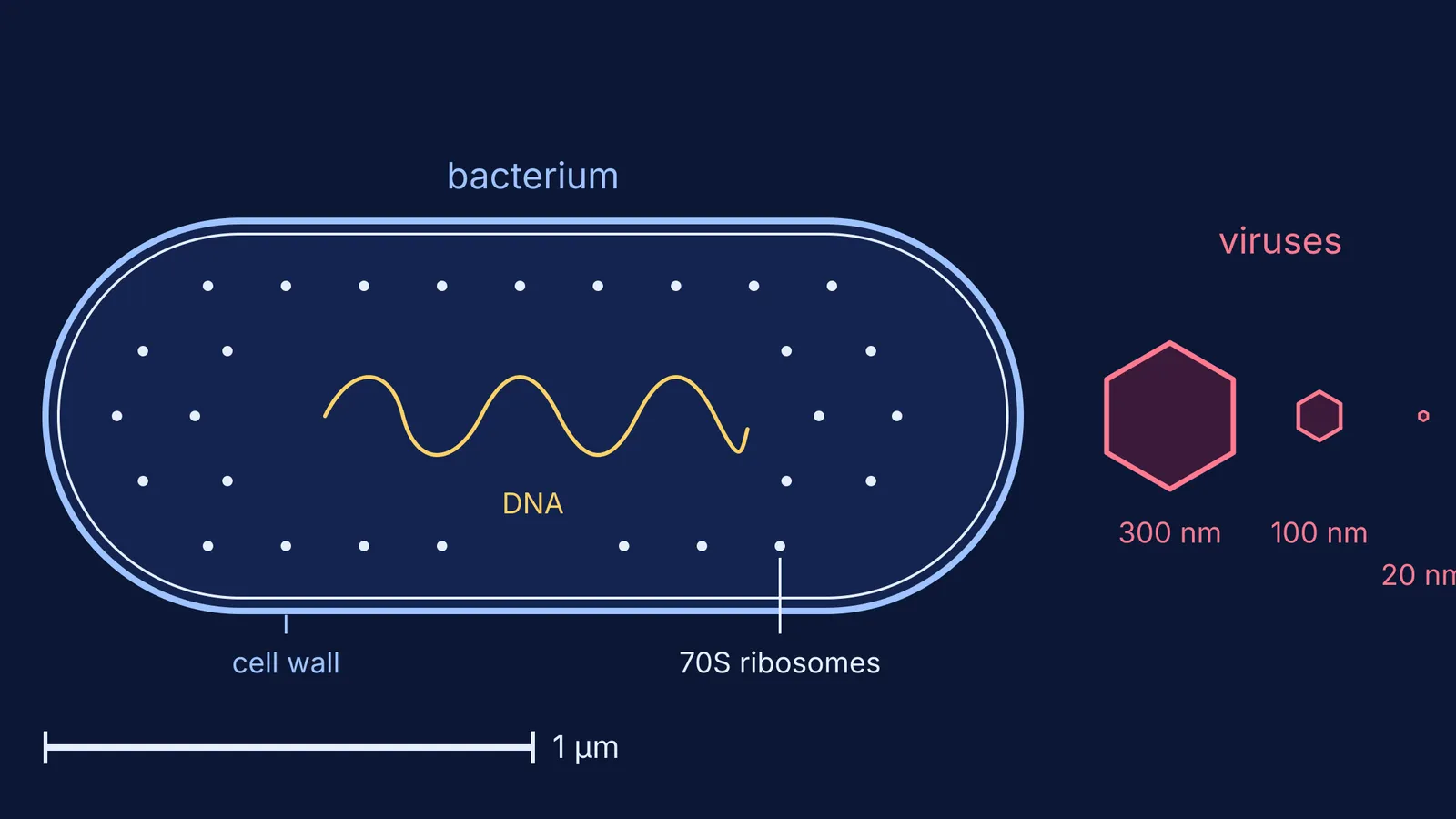
Bacteria are prokaryotic cells: they lack a nucleus and generally have a single, circular chromosome in a region called the nucleoid, according to OpenStax Microbiology. They carry their own 70S ribosomes, and peptidoglycan, the major component of their cell wall, is found only in bacteria (same source).
Viruses are acellular, meaning they are not made of cells, and they are obligate intracellular parasites that must infect a host cell to reproduce, as the OpenStax Microbiology chapter on viruses explains. A virus particle is a DNA or RNA genome, never both, inside a protein capsid, sometimes wrapped in a membrane.
Bacteria vs virus difference table
Here is the table, row by row, with the basis of comparison first.
Nature: bacteria are complete cells; viruses are acellular particles.
Size: prokaryotic cells are 0.1 to 5.0 µm in diameter (OpenStax Biology 2e); virions range from about 20 nm to 900 nm (OpenStax Microbiology).
Microscope: viruses are too small to be seen with a light microscope and are seen with electron microscopes (OpenStax Microbiology).
Genetic material: bacteria have DNA in a nucleoid, often with extra DNA in plasmids; viruses have DNA or RNA, never both.
Ribosomes: bacteria have their own 70S ribosomes; viruses have none and rely on the host cell's ribosomes to make viral proteins (OpenStax, the viral life cycle).
Outer layer: bacteria have a peptidoglycan cell wall (see our explainer on what cell walls are made of in plants, fungi and bacteria); viruses have a protein capsid, and some have an envelope.
Reproduction: bacteria most commonly divide by binary fission, one cell into two (OpenStax, how microbes grow); viruses are assembled inside a host cell through attachment, penetration, biosynthesis, maturation and release (OpenStax, the viral life cycle).
Life outside a host: bacteria grow on their own; viruses lack genes for many products they need and depend on host cells for reproduction and metabolism (OpenStax Microbiology).
Antibiotics: act on bacteria; do not treat viral infections.
Why do antibiotics work on bacteria but not on viruses?
A useful antibacterial drug has selective toxicity: it kills or inhibits the microbe while causing minimal or no harm to the host, as the OpenStax chapter on antibacterial drugs explains. Two bacterial features make that possible.
Ribosomes. Human cytoplasmic ribosomes are 80S and bacterial ones are 70S, and the structural difference gives drugs a target. Tetracyclines and aminoglycosides bind the 30S subunit; macrolides and chloramphenicol bind the 50S subunit (same source).
The cell wall. Beta-lactam drugs block a step in building new peptidoglycan in the bacterial cell wall, and human cells do not make peptidoglycan at all (same source).
A virus has no ribosomes of its own and no peptidoglycan, so there is nothing for an antibiotic to hit. The US CDC says antibiotics do not treat infections caused by viruses, listing colds and runny noses, flu, most sore throats (except strep throat) and most chest colds.
The WHO fact sheet on antimicrobial resistance lists antibiotics and antivirals as separate kinds of antimicrobial, and names taking antibiotics when they are not needed as one of the main drivers of resistance. Treatment decisions belong with a doctor.
One caveat for strong students: our mitochondria also carry 70S ribosomes, and OpenStax links this to the anaemia chloramphenicol can cause (OpenStax). If the numbers confuse you, read our explainer on why 70S and 80S ribosome subunits do not add up.
How do you write a bacteria vs virus answer in an exam?
Take a typical CBSE-style prompt: differentiate between bacteria and viruses, 3 marks.
Open with one line each: bacteria are unicellular prokaryotes; viruses are acellular obligate intracellular parasites.
Draw a table with a basis column. For a 3-mark answer, three clear rows is a sensible target, so pick the strongest: nature, ribosomes, reproduction.
Keep each row parallel: 70S ribosomes present versus ribosomes absent, host ribosomes used.
If space allows, add a consequence row: inhibited by antibiotics versus not affected by antibiotics.
Also read antigen, antibody and antibiotic: how to tell them apart before your next test.
Then cover the virus column and rebuild it from memory. If one row keeps slipping, it is usually a concept gap. The Fermi Concept Library gives every biology concept its own lesson and its place in the map, so you can see how ribosomes connect to antibiotics. For practice questions, the Fermi Problem Library has worked problems with a step-by-step solver that explains the reasoning rather than printing an answer.
Write the nine rows out by hand tonight, then cover a column and test yourself tomorrow.


