

On this page
A newborn foal can stand within hours. A human newborn can't hold up its own head. Yet humans carry babies for longer than our closest relatives do. So why nine months, and why does the baby still arrive so unfinished? Two research ideas compete to explain it, and comparing us with other mammals is the best way to see what each one claims.
How long is human pregnancy compared with other mammals?
Doctors count pregnancy from the first day of the last period, and the NHS says it normally lasts 37 to 42 weeks on that count. Measured from ovulation instead, the median was 268 days in a 2013 study in Human Reproduction. In the same study, natural pregnancies still ranged over 37 days even after preterm births were excluded.
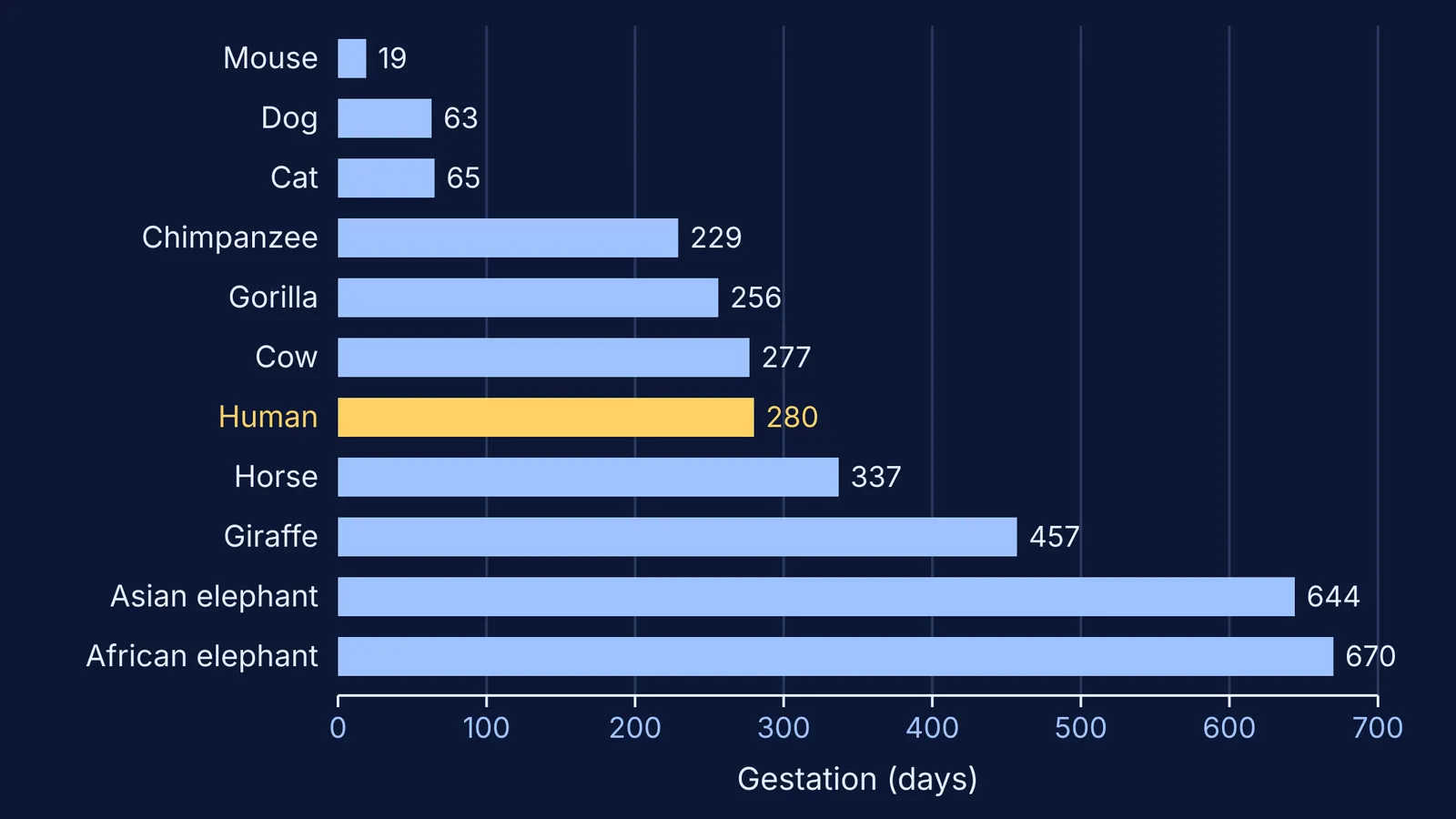
Here are average gestation lengths from the AnAge database of animal life-history traits:
House mouse: 19 days
Dog: 63 days
Cat: 65 days
Chimpanzee: 229 days
Gorilla: 256 days
Cow: 277 days
Human: 280 days
Horse: 337 days
Giraffe: 457 days
Asian elephant: 644 days
African elephant: 670 days
Bigger animals usually carry their young longer, which is why a cow and a human land so close together. The surprise is among primates. A 2012 PNAS study led by Holly Dunsworth reports that human gestation is 37 days longer than expected for a primate of our body mass.
Why are human babies born so helpless?
Length is only half the story; the other half is how developed the baby is at birth. Dunsworth's team notes that human newborns have brains less than 30% of adult size, while chimpanzees are born with brains about 40% of adult size (PNAS, 2012).
The same paper cites an earlier estimate by the zoologist Adolf Portmann: a gestation of 18 to 21 months would be needed for a human baby to be born at the developmental stage a newborn chimpanzee reaches. Biologists call a baby born this dependent "altricial".
What is the brain-size hypothesis?
The classic explanation is called the obstetrical dilemma. Walking on two legs favoured a narrow pelvis, while human evolution favoured a large brain. A big head has to pass through a tight birth canal, so the idea is that evolution "solved" the clash by cutting pregnancy short and delivering the baby before its head grows too large. That is the hypothesis as Dunsworth's team summarises it in their paper.
What is the maternal-energy hypothesis?
Dunsworth and colleagues argue the main limit is the mother's energy budget, not her pelvis. They call it the EGG hypothesis, for "energetics of gestation and growth" (PNAS, 2012).
The maximum metabolic rate a body can sustain is thought to be 2.0 to 2.5 times its basal (resting) metabolic rate, according to the same paper. By nine months, the fetus's demands threaten to push the mother's energy needs beyond 2.1 times her basal rate. On this view, labour begins when the fetus's energy demands overtake what the mother can supply. After birth, the baby's growth rate slows compared with its growth in the womb, which keeps both the baby's and the mother's energy needs in check.
The authors don't say the pelvis is irrelevant. They write that pelvic changes and bigger brains made human birth harder, but they found little evidence that the pelvis changed when birth happens.
How do you use this in a biology answer?
This kind of "why" question turns up in class tests, school projects and viva rounds. Try this worked example with the numbers above, from AnAge and the 2012 PNAS paper.
Compare. Human 280 days minus chimpanzee 229 days is 51 days. So we are pregnant for longer, not shorter.
Spot the puzzle. Chimps are born with about 40% of adult brain size and humans with under 30%. Longer pregnancy, less developed baby.
Give both hypotheses. Pelvis: birth is timed so the head still fits. Energy: birth comes as the fetus's demands push the mother towards the limit of what her body can sustain, about 2.0 to 2.5 times her resting metabolic rate.
Weigh the evidence. Human gestation is longer than expected for our body size, which Dunsworth's team argue is hard to square with a pregnancy "cut short". They see this as support for the energy view.
A four-line answer that compares, states the puzzle, names both ideas and weighs them will beat a memorised "because of the big brain".
If terms like placenta, gestation or basal metabolic rate are still fuzzy, the Fermi Concept Library has a lesson for every concept in biology, each with its place in the map. For the hormones behind early pregnancy, read how a pregnancy test detects hCG. To revise exam figures, see the key numbers in the NCERT human reproduction chapter, and for the long view of our big brains, human evolution from Australopithecus to Homo sapiens.
This post explains evolutionary biology, not medical care. Questions about a particular pregnancy belong with a doctor or midwife.


