

On this page
A home pregnancy test looks like a plastic stick, but inside is a paper strip running a small immunology experiment. Here is how the strip finds one hormone in urine, and why it shows two lines.
What is hCG, and why do tests look for it?
Human chorionic gonadotropin (hCG) is a hormone made mainly by syncytiotrophoblasts, cells of the placenta's outer layer, according to a 2017 review in the International Journal of Molecular Sciences. The NHS says hCG starts to be produced around 6 days after fertilisation.
hCG has two parts. The same review explains that its alpha (α) subunit shares homology with LH, FSH and TSH, three other hormones, while its beta (β) subunit has 145 amino acids and is 80-85% homologous to LH, apart from a 24-amino-acid tail that LH lacks. That detail matters: an antibody that only recognised the α part would struggle to tell hCG from LH. A test needs the β part to be specific.
How does a pregnancy test strip detect hCG?
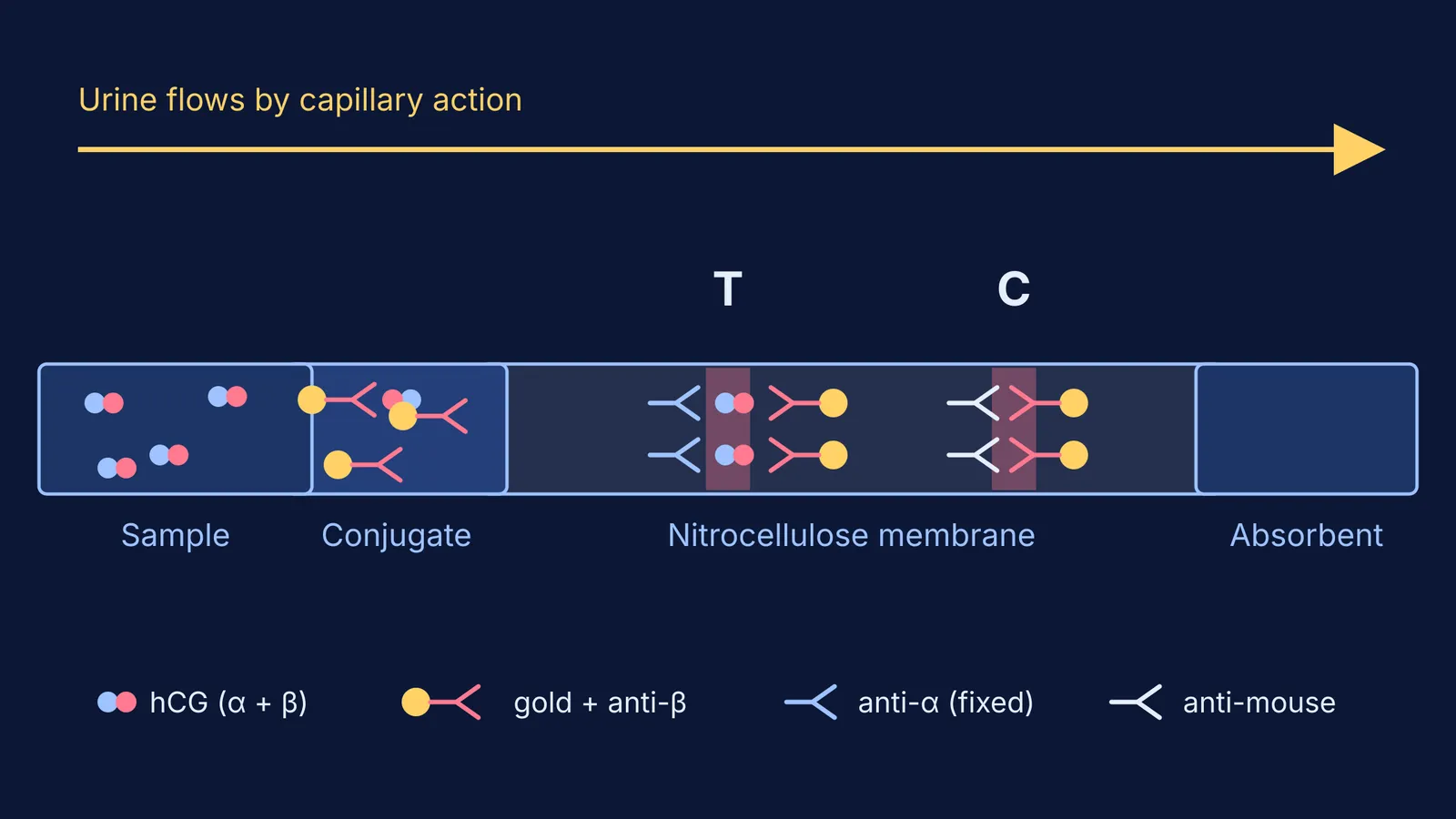
The strip is a lateral flow sandwich immunoassay. The US FDA's review of the Clearblue Early Pregnancy Test (K213379) describes it as using "monoclonal antibodies that are specifically directed against the alpha and beta sub-units of hCG", with the result read after 5 minutes. If hCG is present, the FDA review says, it is bound by a gold-labelled (conjugated) anti-β antibody, forming a visible red line. A 2020 study in Theranostics that built an hCG strip in the lab used the same sandwich design. Step by step:
Sample pad. Urine soaks in and is pulled along by capillary action, as water climbs a paper towel.
Gold-labelled antibodies. The urine meets monoclonal antibodies against hCG-β, each attached to a gold nanoparticle. The study notes that the 20-40 nm gold particles used in commercial strips have a characteristic reddish colour, which is where the line's colour comes from. If hCG is present, it binds to these gold-antibodies and travels on with them.
Test line (T). A second antibody, this one against hCG-α, is fixed to a nitrocellulose membrane in a thin stripe. It grabs any hCG passing by. Because that hCG is already holding a gold-antibody, red builds up into a visible line.
Control line (C). Further on, goat anti-mouse IgG antibodies are fixed in another stripe. They catch the gold-antibodies themselves, whether or not they carry hCG.
Absorbent pad. It soaks up the liquid at the end so the flow keeps moving.
Why does a pregnancy test show two lines?
The control line is a built-in check. Because it catches gold-antibody with or without hCG, it shows that liquid flowed past and the gold-antibodies reached the end of the strip. That gives the patterns:
C only: the strip ran and found no hCG above its cut-off. The FDA review describes a 'Not Pregnant' result as a red line in the control window and no line in the results window.
C and T: the strip ran and found hCG. The same review notes both lines must appear within five minutes.
No C line: the strip has not shown that it ran properly, so its result cannot be read.
If you want a refresher on how antigens and antibodies differ, our explainer on antigen, antibody and antibiotic covers it, and the H2L2 structure of IgG and other antibody classes shows the Y shape the strip relies on.
How sensitive is a home pregnancy test?
The test in the FDA review has a cut-off of 10 mIU/mL of hCG in urine. Detection is a curve, not a cliff. When technicians dipped 135 strips into pooled urine spiked with hCG at each concentration, these were the shares that turned positive:
2 mIU/mL: 0%
3 mIU/mL: 24.4%
5 mIU/mL: 68.1%
7 mIU/mL: 88.1%
10, 15 and 20 mIU/mL: 100%
Worked example. Suppose you dip 20 strips into urine with 5 mIU/mL of hCG. Expected positives = 0.681 × 20 = about 14 strips. The other 6 show only the C line, even though hCG is present. That is a false negative caused by low concentration, not a broken strip.
The same review reports 933 early-pregnancy urine samples. With the dip method, 76.5% of samples from six days before the missed period tested positive, 98.0% from four days before, and 100% from three days before onwards.
This fits the NHS advice that a positive result is almost certainly correct but a negative one is less reliable, and that tests are most reliable from the first day of a missed period.
Where else does this biotechnology show up?
The pregnancy strip is antigen-antibody detection built for speed. ELISA uses the same pairing in a lab plate, which you can compare in our post on transgenic animals and ELISA for molecular diagnosis.
If antibodies or hormones are a shaky topic for you, the Fermi Concept Library gives every biology and chemistry concept its own lesson, so you can fill the gap before your next exam.


