

On this page
Your cerebral cortex is the thin outer layer of the brain. Spread flat, it would cover far more area than the outside of your head. The wrinkles are how it fits, and you can check the numbers with paper and a ruler.
What are gyri and sulci?
A gyrus is a raised ridge on the brain's surface, and a sulcus is the groove between two ridges (plural: gyri and sulci).
Scientists call a folded brain gyrencephalic and a smooth one lissencephalic. A 2018 review by Víctor Borrell in the Journal of Neuroscience describes lissencephalic species as having "a completely smooth cerebral cortex", and notes that cortical folding is only found in mammals.
For what the cortex does, see our guide to the parts of the brain and their functions.
Why is the human brain wrinkled?
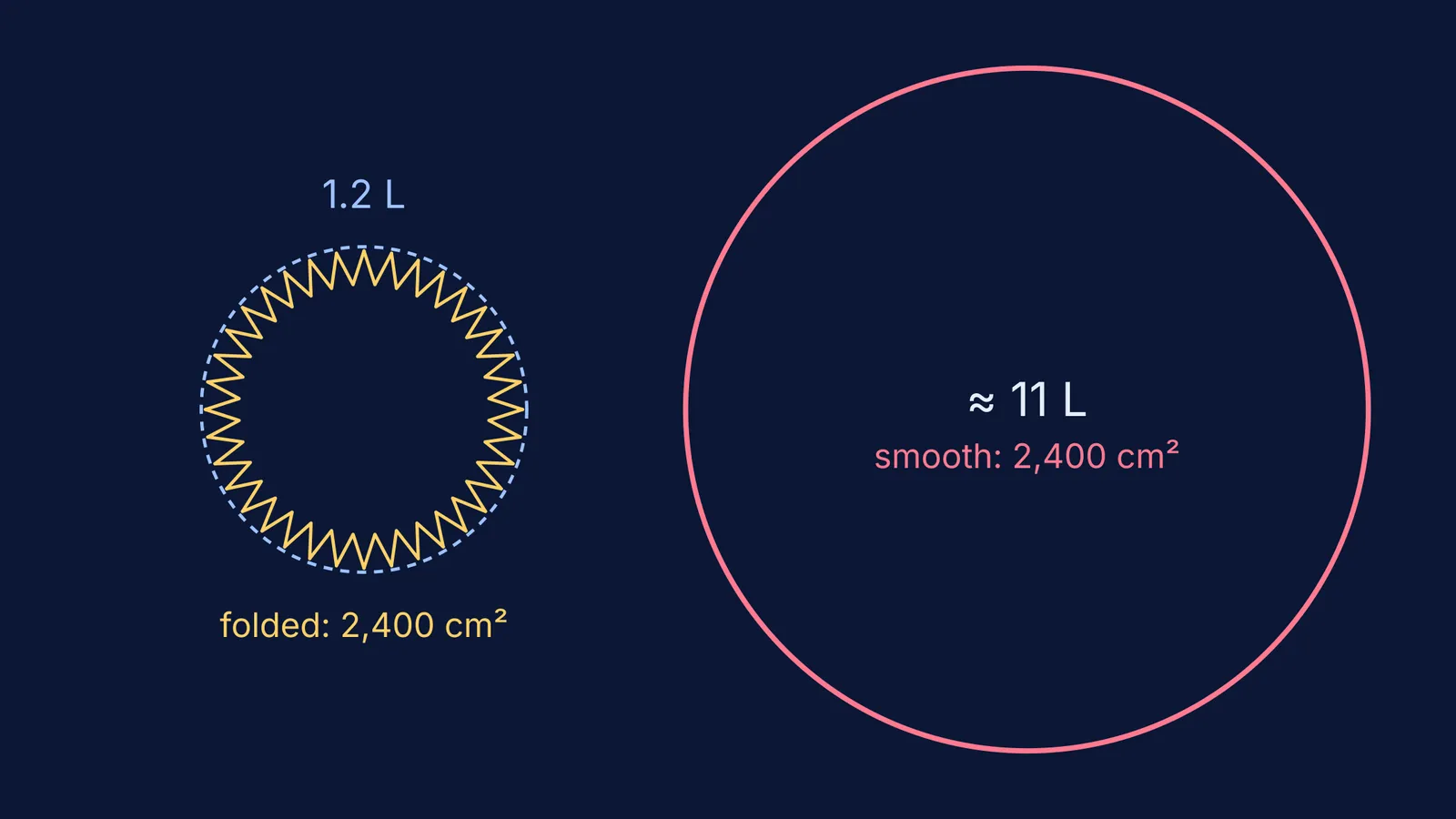
Because the sheet is too big for the box. In adults the cortex is about 3 mm thick with an area of roughly 2,400 cm², and the whole brain is about 1,200 ml, according to Tallinen and colleagues in Nature Physics (2016). The paper calls folding "an efficient way of packing a large cortex into a relatively small skull".
How much space would a smooth cortex need?
This Fermi-style estimate uses two numbers from the Nature Physics paper: 1,200 cm³ of brain and 2,400 cm² of cortex.
Treat the brain as a ball of 1,200 cm³. Its radius, r = (3V/4π)^(1/3), is about 6.6 cm.
The outside of that ball has an area of 4πr², about 550 cm².
The cortex has about 2,400 cm², so only about 1 part in 4.4 of the sheet can lie on the outside. The rest has to be tucked into grooves.
Now go the other way. A smooth ball with 2,400 cm² of surface needs a radius of √(2400/4π), about 13.8 cm.
That smooth ball would hold about 11,000 cm³, roughly 11 litres, or about nine times the brain you actually have.
A real brain is not a sphere, so this is rough, but it lands close to the paper's simulated adult brain, whose total cortical area was about four times its exposed area.
How does the brain get its folds?
The folds appear before birth. Tallinen and colleagues note that the cerebral surface is smooth before the sixth month of fetal life.
From gestational week 22 to adulthood, brain volume grows about 20-fold (from about 60 ml to 1,200 ml) while cortical area grows about 30-fold (from about 80 cm² to 2,400 cm²), according to the same paper. The outer layer grows faster than the tissue beneath it, gets squeezed, and buckles, like a rug pushed against a wall.
To test this, the team 3D-printed a model of a smooth fetal brain from an MRI scan, used it to cast a gel brain, coated that with a thin gel layer and placed it in a solvent. The outer layer swelled faster than the core and folded into ridges and grooves like those of real fetal brains.
Why do some animals have smooth brains?
Borrell's review puts the general rule this way: folding is found in species with a large brain, "such as cattle, monkeys, humans, elephants, and whales, whereas lissencephaly is typical of species with a small brain, such as rats or mice."
Size is not everything. The same review points out that species with similar brain volumes can be smooth or folded, such as the manatee and the chimpanzee, or the marmoset and the ferret.
Thickness matters too. A 2015 Science study by Bruno Mota and Suzana Herculano-Houzel found that the exposed surface of the cortex scales across mammals as a single power law of the total cortical area multiplied by the square root of cortical thickness. Science News reported that the researchers crumpled paper of different sizes and thicknesses and found the same relationship in the paper balls.
Try it: the paper-ball experiment
You need two sheets of the same paper, a ruler and two books.
Measure the length and width of one sheet and multiply them to get its area.
Crumple it into a tight ball.
Hold the ball between two books, push them together gently and measure the gap. That is the diameter, d.
Work out the outside area of the ball as πd² (the same as 4πr²).
Divide the sheet's area by the ball's area. That is your folding ratio; the brain estimate above, using the Nature Physics figures, gave about 4.4.
Repeat with both sheets stacked as one thicker sheet and compare.
If a 3D idea like this is hard to hold in your head, the Fermi Simulation Lab has interactive simulations for ideas that are easier to see than to read, and the Fermi Concept Library gives each biology concept its own lesson.
Next, find out how much energy that folded sheet of neurons uses.


