

On this page
Your brain never switches off. Whether you are solving a JEE Main rotation problem or staring at the ceiling, it draws power at a fairly steady rate. Below we turn the well-known "2 percent of the body, 20 percent of the energy" figure into watts and kilocalories, show you how to work it out for your own body, and explain where the energy goes.
How much energy does the brain use in watts and kcal?
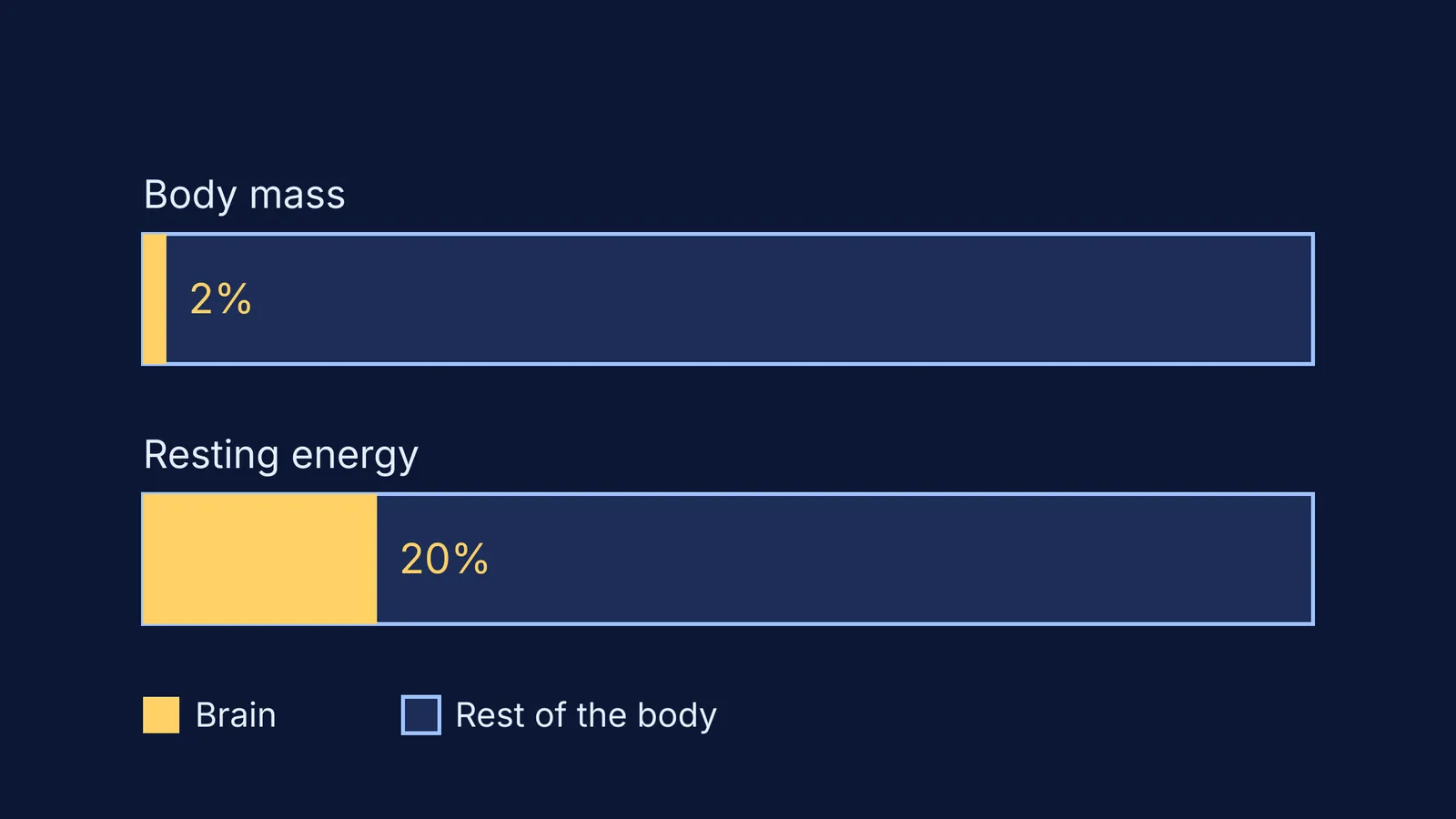
In a 2002 review in PNAS, neuroscientists Marcus Raichle and Debra Gusnard wrote that the adult brain is about 2% of body weight but accounts for about 20% of the oxygen, and hence calories, the body consumes.
In power terms, physicist Vijay Balasubramanian puts the human brain's budget at about 20 watts, or 17 to 20 W derived from glucose uptake, in a 2021 PNAS commentary.
A watt is one joule per second, so you can turn that into food energy with two numbers you already know:
Joules per day: 20 J/s × 86,400 s = 1,728,000 J, or 1,728 kJ.
Kilocalories: 1,728 kJ ÷ 4.184 kJ per kcal ≈ 413 kcal a day.
So a 20 W brain uses roughly 410 kcal of your daily food just to keep running.
How do you work out your own brain's share?
The 20 W figure is for a typical adult. You can estimate your own using the basal metabolic rate (BMR) equations in the FAO/WHO/UNU report on human energy requirements. BMR is the energy you use lying still and awake, 10 to 12 hours after a meal. For ages 10 to 18, the report gives BMR = 17.686 × mass in kg + 658.2 kcal/day for boys, and 13.384 × mass in kg + 692.6 kcal/day for girls. Then apply the adult rule that the brain takes about 20% of the body's resting energy.
Worked example for a 16-year-old boy of 55 kg:
BMR = 17.686 × 55 + 658.2 ≈ 1,631 kcal/day.
In watts: 1,631 × 4,184 J ÷ 86,400 s ≈ 79 W.
Brain share at 20%: 0.20 × 79 ≈ 16 W, or about 326 kcal/day.
For a 16-year-old girl of 50 kg: BMR = 13.384 × 50 + 692.6 ≈ 1,362 kcal/day, which is about 66 W, so the brain's share is about 13 W, or about 272 kcal/day.
These come out under 20 W partly because BMR in the equation grows with body mass, so a lighter body gives a smaller total. Treat the 20% as a rough adult rule; at 16 the true share is probably somewhat higher, so these are low-end estimates. In younger children the share is far larger: a 2014 PNAS study by Christopher Kuzawa and colleagues found the brain's metabolic needs peak in childhood, when it uses glucose at a rate equal to 66% of the body's resting metabolism.
If you like estimation questions like this, the Fermi Problem Library has worked problems with a step-by-step solver that explains the reasoning rather than printing an answer.
What do neurons spend all that energy on?
Mostly on sending signals. A 2001 energy budget for signalling in rodent grey matter by David Attwell and Simon Laughlin estimated that action potentials use about 47% of the energy, the effects of glutamate on the receiving neuron 34%, the resting potential 13% and glutamate recycling 3%.
Raichle and Gusnard summarise the same point: most of the brain's energy goes on propagating action potentials and restoring the ion flows across the membrane after receptors are stimulated. Each impulse lets ions rush down their gradients, and the cell then spends ATP pushing them back, which is the job of the sodium-potassium pump that moves 3 Na+ out and 2 K+ in.
Sending a signal also costs far more than processing it. William Levy and Victoria Calvert calculated that in the human cortex communication consumes 35 times more energy than computation. Summarising their work, Balasubramanian notes that cortical grey matter uses about 3 W of the brain's 17 to 20 W.
Does thinking hard burn more energy?
Only a little. Raichle and Gusnard report that local changes in blood flow, measured with PET scans during most thinking tasks, are often 5% or less, small next to the brain's steady background activity. So a hard mock test probably changes your brain's energy use only slightly compared with a quiet evening. The brain is also busy all the time, which is one reason the idea that we use only 10% of our brain does not hold up.
For a second estimate of the same kind, see how we worked out how much power the human heart produces, then set it beside your brain's figure. If action potentials, membrane potentials or ATP are still hazy, the Fermi Concept Library has a lesson on each concept in biology and physics, so you can fill the gap before your next numerical.


