On this page
You have probably heard it from a film, a forwarded message or a friend the night before an exam: humans use only 10 percent of their brains, so the trick is to switch on the rest. It is wrong, and the evidence against it is clear.
Do we really use only 10 percent of our brain?
No. Neurologist Barry Gordon of Johns Hopkins School of Medicine called the myth "so wrong it is almost laughable" in a 2008 Scientific American article, adding that "we use virtually every part of the brain".
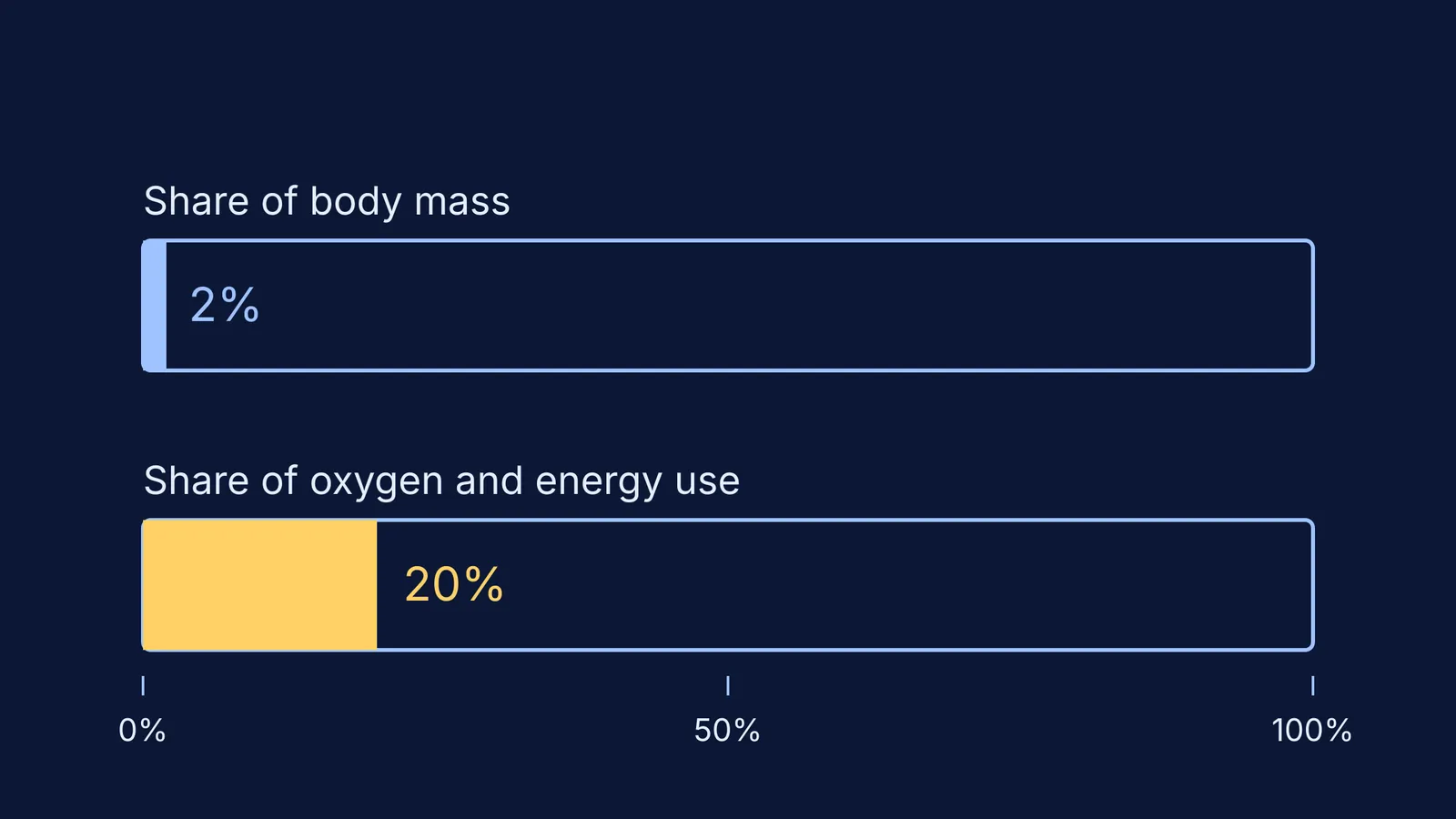
The strongest argument is cost. The brain is about 2% of an adult's body weight but accounts for about 20% of the oxygen and calories the body consumes, according to a review by Marcus Raichle and Debra Gusnard in PNAS (2002). An organ that expensive is not sitting 90% idle.
What does brain imaging actually show?
PET and functional MRI scans do not show a brain that is mostly dark with one small lit patch. When Raichle and colleagues used PET to measure, region by region, the fraction of delivered oxygen the brain uses in people resting quietly with their eyes closed, they found it remarkably uniform across the brain. They also described a group of areas whose activity drops during focused, goal-directed tasks, which they called a "default mode" of brain function (PNAS, 2001).
The coloured blobs in news pictures are differences, not the whole picture. They mark where activity rises a little above an already busy baseline during a task. Local changes in blood flow measured with PET during most thinking tasks are often 5% or less, Raichle and Gusnard note in PNAS. So a scan where one area "lights up" is not showing the only part in use; it shows the part that changed most.
John Henley, a neurologist at the Mayo Clinic, told Scientific American: "Evidence would show over a day you use 100 percent of the brain." Even in sleep, he explained, areas such as the frontal cortex stay active.
What are your neurons doing all day?
The human brain has about 86 billion neurons, according to a count by Suzana Herculano-Houzel in Frontiers in Human Neuroscience (2009). About 16 billion of them are in the cerebral cortex and about 69 billion in the cerebellum.
They do not all fire at once, and that is the grain of truth the myth twists. Peter Lennie estimated in Current Biology (2003) that a single nerve impulse costs so much energy that possibly fewer than 1% of neurons in the human cortex can be substantially active at the same moment. His conclusion: the brain must use codes that rely on very few active neurons, and allocate its energy flexibly among cortical regions according to the task.
Why does the 10 percent myth persist?
It flatters us. Gordon's explanation in Scientific American is that people see their own shortcomings as evidence of untapped grey matter.
It sounds like it has a respectable source. The same article notes it has been linked to psychologist William James, who argued in The Energies of Men that we use only a small part of our possible mental and physical resources.
Scan pictures are easy to misread. A few bright spots look like a few working parts.
Even teachers believe it. In a survey of teachers in the UK and the Netherlands, 48% and 46% respectively agreed that "we only use 10% of our brain", and on average teachers agreed with 49% of the statements promoting neuromyths (Dekker and colleagues, Frontiers in Psychology, 2012).
How can you check a brain claim before you believe it?
Ask four questions when an advert, video or forward makes a brain claim:
Who measured it? Real findings name authors and a journal you can look up.
Does it confuse "active at the same moment" with "used at all"? That single mix-up drives the 10 percent myth.
Is a scan picture offered as proof? Ask what was compared with what.
Is someone selling the fix? A pill, app or course that promises to "activate" the rest of your brain is selling against a myth.
If a relative brings it up at dinner, here is a one-line reply: "The brain is about 2% of our weight but uses about 20% of our energy, and over a day we use all of it, so there is no idle 90% to switch on." The energy figures are from Raichle and Gusnard.
If the nervous system chapter in biology still feels like a list of terms, the Fermi Concept Library covers every concept in physics, chemistry, biology, mathematics and computing, each with its own lesson and its place in the map, so you can see how neurons connect to the rest of what you study.
Next time someone says you only use a tenth of your brain, ask them which 90% they would like to remove.