

On this page
Your NCERT chapter on body fluids says red blood cells carry haemoglobin. So why bother with cells at all, when the earthworm manages with haemoglobin dissolved straight into its plasma? The answer comes down to particle number, molecule size and the kidney's filter. Viscosity, a popular textbook reason, is shakier than you might expect.
Why is haemoglobin inside RBCs and not in plasma?
Packing haemoglobin into cells solves three problems at once.
Osmotic pressure. Osmotic pressure depends on the number of dissolved particles, not their mass, and releasing haemoglobin would flood plasma with particles that pull in water.
Kidney loss. Free haemoglobin splits into halves small enough to be filtered into the urine.
Chemistry. Inside the cell, haemoglobin sits at high concentration alongside 2,3-DPG, and both help keep the four-chain molecule stable, according to a 2025 review in Transfusion. Free haemoglobin can leak through vessel walls and mop up nitric oxide, which relaxes blood vessels, so they narrow (2025 review in the International Journal of Molecular Sciences).
How much would free haemoglobin raise osmotic pressure?
Use the van 't Hoff equation from Class 12 chemistry.
WHO's 2024 guideline defines anaemia as haemoglobin below 120 g/L in non-pregnant women and below 130 g/L in men aged 15 to 65 (WHO guideline on haemoglobin cutoffs). Take 140 g/L as a round healthy value. One human haemoglobin tetramer weighs about 64.5 kDa, or 64,500 g/mol (Frontiers in Medicine review, 2026).
Concentration: 140 ÷ 64,500 = 0.00217 mol/L.
Van 't Hoff at body temperature: π = cRT = 0.00217 × 0.0821 × 310 = 0.0552 atm.
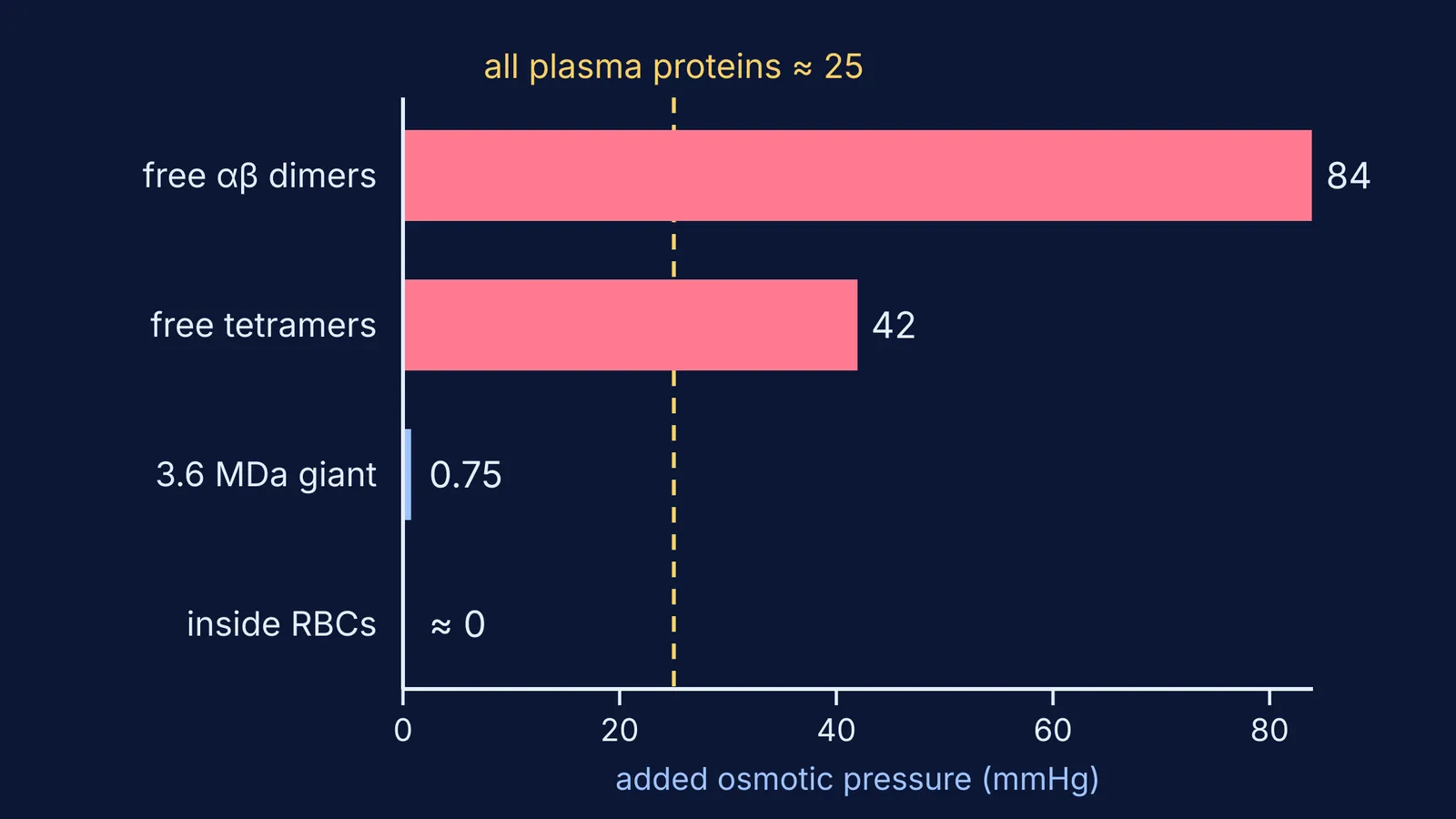
Convert: 0.0552 × 760 ≈ 42 mmHg.
Normal plasma's whole colloid osmotic pressure is only about 25–30 mmHg, about three-quarters of it from albumin (Deranged Physiology on oncotic pressure). Releasing your haemoglobin would add roughly 42 mmHg on top, more than all the plasma proteins put together. If every tetramer split into two αβ dimers, the particle count would double and the estimate would reach about 84 mmHg. The same page notes that measured plasma oncotic pressure differs from the simple van 't Hoff figure, so treat these as rough estimates.
Oncotic pressure helps hold water inside capillaries, so a rise this large would tend to draw water out of the tissues and into the blood.
If unit conversions like atm to mmHg are where you lose marks, the Fermi Problem Library has worked problems with a step-by-step solver that explains the reasoning rather than printing an answer.
Would free haemoglobin be filtered by the kidneys?
Yes. The haemoglobin tetramer (α2β2, about 64.5 kDa) spontaneously splits into αβ dimers of about 32 kDa, which are readily filtered through the glomerular filtration barrier and can damage the kidney (Frontiers in Medicine review). A plasma protein called haptoglobin binds free dimers first; once it is saturated, the extra dimers are filtered, leading to haemoglobinuria and possible kidney damage (IJMS review).
Does free haemoglobin really make blood thicker?
Many books say it would. In 1968, Knut Schmidt-Nielsen and C. Richard Taylor of Duke University tested the claim: they broke open dog and goat red cells with ultrasound, and the resulting solution, at the same haemoglobin concentration, had a drastically lower relative viscosity (Science, 1968). A paper by Giles Cokelet and Herbert Meiselman in the same issue found that human haemoglobin solutions were less viscous than red-cell suspensions with the same oxygen-carrying capacity (Science, 1968).
How does an earthworm get away with haemoglobin in plasma?
By making the molecule enormous. Earthworm haemoglobin, called erythrocruorin, is a single complex of more than 3.5 million daltons, built from 144 haemoglobin subunits and 36 linker subunits, and it is freely dissolved in the blood (Royer and colleagues, PNAS 2000).
Run the same sum. At 3.6 MDa, the IJMS review figure, 140 g/L of erythrocruorin would be only 0.0000389 mol/L, which works out to about 0.75 mmHg. Same mass of oxygen carrier, about 56 times fewer particles. For the earthworm's side of the story, read why earthworm blood is red without red blood cells.
How to answer this in an exam
A four-point answer:
Osmotic pressure depends on particle number; free haemoglobin would add more colloid osmotic pressure than all plasma proteins.
Free haemoglobin splits into αβ dimers that the glomerulus filters, harming the kidney.
Inside the cell, haemoglobin stays stable with 2,3-DPG and cannot leak out to scavenge nitric oxide.
Contrast: many annelids, such as the earthworm, dissolve one giant haemoglobin in plasma, keeping particle count tiny.
That question is answered in why fetal haemoglobin has a higher affinity for oxygen, and the rest of the chapter is covered in our body fluids and circulation mnemonics. To see where osmotic pressure, the glomerulus and haemoglobin connect, the Fermi Concept Library gives every concept in biology and chemistry its own lesson and its place in the map.


