

On this page
Earthworm blood is red for the same reason yours is: haemoglobin, the iron-containing pigment that carries oxygen. The difference is where it sits. Yours is packed inside red blood cells; an earthworm's floats loose in the plasma.
Why is earthworm blood red if it has no red blood cells?
The earthworm's oxygen carrier "is not packaged safely inside a blood cell, like our hemoglobin is. Instead, it floats freely in the liquid that flows through their vascular system," as the Protein Data Bank's Molecule of the Month on erythrocruorin puts it. Erythrocruorin is the name for this giant, cell-free haemoglobin.
The earthworm *Lumbricus terrestris* builds its erythrocruorin from 144 haemoglobin chains and 36 linker chains, for a total mass of about 3.6 million daltons, according to the crystal structure solved by Royer and colleagues in Structure (2006).
Human haemoglobin has just four chains and a molar mass of about 64,500 g/mol (Hemoglobin, Wikipedia). So one earthworm molecule weighs about 56 times as much as one of ours.
The worm moves this blood through a closed system of vessels (see open versus closed circulation) and picks up oxygen through its skin, which is why an earthworm's skin has to stay moist.
Why does a giant dissolved molecule work for an earthworm?
The key idea is osmotic pressure, which is generated by the number of solute particles dissolved in the body water (Deranged Physiology). Count matters, not mass: a few huge molecules pull far less water than many small ones of the same total weight.
A giant molecule gets round this. Each globin chain has its own haem group, so one particle carries 144 oxygen-binding sites. PDB-101 notes that packing many sites into one particle helps keep viscosity manageable at a high concentration of sites (PDB-101).
PDB-101 adds that the large size may help reduce leakage. Researchers testing earthworm haemoglobin as a possible blood substitute describe its high molecular weight (3.6 MDa) and an "extremely low rate of NO scavenging" (Elmer, Palmer and Cabrales, Life Sciences, 2012).
Why can't humans keep haemoglobin loose in plasma?
The same 2012 paper explains what went wrong when doctors first tried transfusing cell-free human haemoglobin. The haemoglobin tetramer quickly broke apart in the bloodstream, passed out through the blood vessel wall and caused kidney failure (Elmer et al., 2012). These cell-free carriers also mopped up nitric oxide, a signal that relaxes blood vessels, and caused vasoconstriction and high blood pressure.
The third problem is osmotic, and you can calculate it yourself.
Worked example: the same haemoglobin, packaged two ways
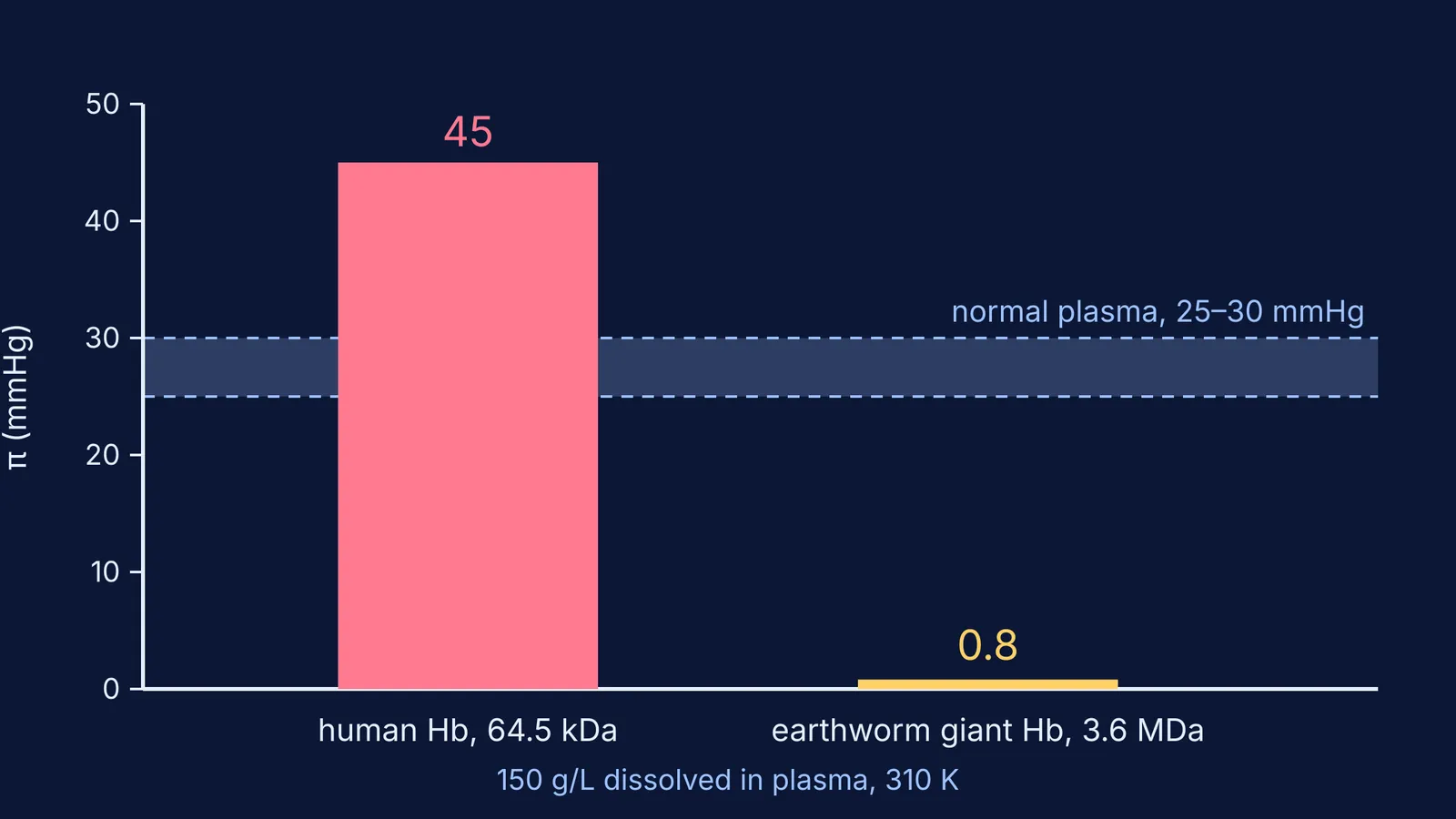
Normal human haemoglobin is 13.8 to 17.2 g/dL in men and 12.1 to 15.1 g/dL in women (MedlinePlus). Take a round 15 g/dL, which is 150 g per litre, and imagine it all dissolved in plasma at body temperature (310 K). Use the van't Hoff equation, π = cRT, with R = 0.0821 L atm per mol per K.
As human tetramers: c = 150 ÷ 64,500 = 0.00233 mol/L.
π = 0.00233 × 0.0821 × 310 = 0.0592 atm, which is about 45 mmHg.
As earthworm-sized giants: c = 150 ÷ 3,600,000 = 0.0000417 mol/L.
π = 0.0000417 × 0.0821 × 310 = 0.00106 atm, which is about 0.8 mmHg.
For comparison, the whole oncotic pressure of normal human plasma is only about 25 to 30 mmHg (Deranged Physiology). Loose human haemoglobin would add more pull than all your plasma proteins together. The same mass bundled into giants adds almost nothing.
Real measurements point the same way. In the 2012 study, a 10 g/dL earthworm haemoglobin solution had a colloid osmotic pressure of 6 mmHg, against 44 mmHg for 10 g/dL human albumin (Elmer et al., 2012).
Red blood cells solve all three problems at once. Inside a membrane, our small haemoglobin cannot leak, cannot reach the kidneys and does not add to plasma oncotic pressure. Our explainer on why a red blood cell has no nucleus covers the other half of that container story.
How do you write this answer in an exam?
A board or NEET-UG question might ask why earthworm haemoglobin is dissolved in plasma. A full answer makes four points:
Earthworm haemoglobin (erythrocruorin) is extracellular, dissolved in plasma.
It is a giant molecule with many haem groups, so few particles carry a lot of oxygen.
Few particles means low osmotic pressure; large size helps keep it inside the vessels.
Human haemoglobin is small, so it needs red blood cells to stay in circulation.
If osmotic pressure is the shaky part, the Fermi Concept Library has a lesson for every concept in chemistry and biology, each with its place in the map. To practise π = cRT numericals, the Fermi Problem Library has worked problems with a step-by-step solver that explains the reasoning rather than printing an answer.
Next time you see a worm after rain: same oxygen carrier as yours, opposite packaging.


