

On this page
Most NEET biology students meet the line "fetal haemoglobin has a higher affinity for oxygen". The reason is not a stronger haem group. It is one small molecule that adult haemoglobin binds and fetal haemoglobin mostly ignores.
What is fetal haemoglobin made of?
Adult haemoglobin (HbA) is built from two α chains and two β chains (α2β2), while fetal haemoglobin (HbF) swaps the β chains for γ chains (α2γ2), according to a 2026 review in the Mediterranean Journal of Hematology and Infectious Diseases. The same review notes that HbF becomes the main haemoglobin after about 8 weeks of gestation and makes up less than 1% of haemoglobin in healthy adults.
The haem groups are the same in both; what changes is a pocket between the two non-α chains.
Why does fetal haemoglobin have a higher affinity for oxygen?
Red blood cells contain 2,3-bisphosphoglycerate (2,3-BPG; older books call it 2,3-DPG). It sits in the central pocket of deoxygenated haemoglobin and holds it in its low-affinity shape: a brake on oxygen binding.
In 1970, Bunn and Briehl, in the Journal of Clinical Investigation, stripped organic phosphates from purified human haemoglobins, then added 2,3-DPG back. The P50 of HbA increased about twofold, while HbF was "less reactive with 2,3-DPG".
The structural reason is a single amino acid. Position 143 is histidine in the β chain of HbA but serine in the γ chain of HbF, and this swap reduces HbF's binding of 2,3-BPG, as a 2025 review in Clinical Epigenetics summarises. The swap removes two positively charged residues from the cavity that holds the negatively charged 2,3-BPG, as this physiology exam resource explains.
How do you read the two-curve sketch?
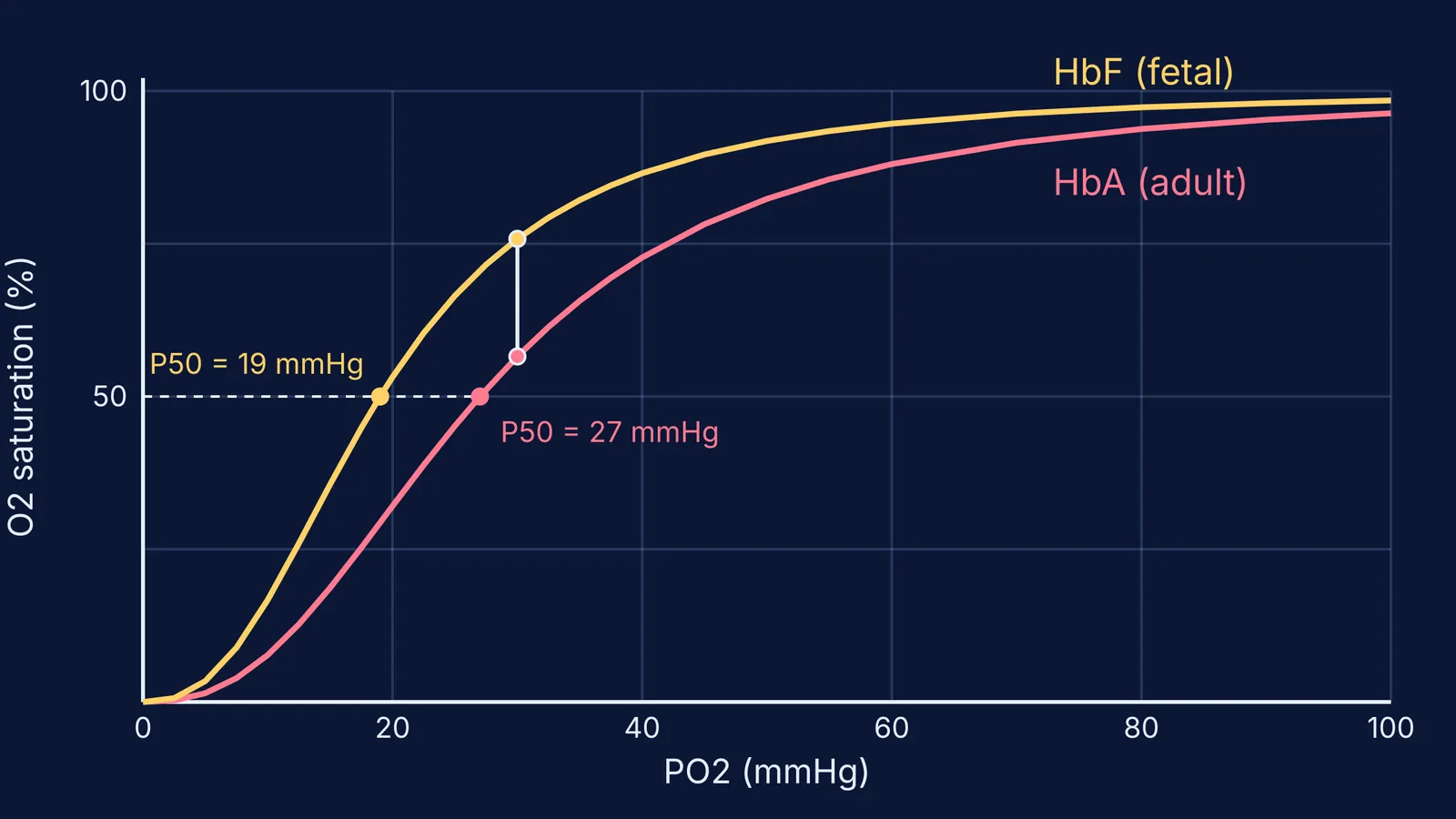
P50 is the oxygen pressure at which haemoglobin is half saturated, and a lower P50 means a higher affinity. HbF has a P50 of about 19 mmHg and HbA about 27 mmHg, according to the 2026 haemoglobin review. A 2022 study of 30 healthy adults in Frontiers in Medicine measured a mean adult P50 of 27.1 mmHg and a Hill coefficient, the steepness of the S-shape, of about 2.5. We used those values to draw both curves in the sketch at the top of this page, assuming the same steepness for HbF.
Read it in two moves:
Start at 50% on the vertical axis and move right. You hit the fetal (yellow) curve first, at 19 mmHg, then the adult (pink) curve at 27 mmHg. The curve you meet first has the higher affinity.
Pick any oxygen pressure and move straight up. The fetal curve is always higher, so at the same pressure fetal haemoglobin is more saturated.
How much more saturated is HbF at 30 mmHg?
Use the Hill equation, S = P^n / (P^n + P50^n), with n = 2.5 and the P50 values from the 2026 review. The 30 mmHg is a teaching number, not a measured placental value.
Adult HbA (P50 = 27 mmHg): S = 30^2.5 / (30^2.5 + 27^2.5), about 57%
Fetal HbF (P50 = 19 mmHg): S = 30^2.5 / (30^2.5 + 19^2.5), about 76%
At the same pressure, fetal haemoglobin is about a third more saturated in this model; the white bar in the sketch marks this gap. That is what textbooks mean by HbF "pulling" oxygen from the mother. Oxygen still diffuses from higher to lower pressure across the placenta; HbF lets fetal blood load more of it at the low pressures on the fetal side. For the other factors that move the curve, see our explainer on what shifts the oxygen dissociation curve to the right.
What happens to fetal haemoglobin after birth?
In a 1971 Pediatric Research study that followed 48 term infants, the oxygen curve shifted gradually to the right and became similar to an adult's between 4 and 6 months of age. The shift tracked red-cell 2,3-DPG combined with the share of adult haemoglobin, not either alone, which fits the mechanism: 2,3-DPG mainly brakes the haemoglobin that binds it well.
Which exam traps should you watch for?
"HbF has a different haem." No: the haem is the same; the γ chain changes 2,3-BPG binding.
"2,3-BPG raises oxygen affinity." Reverse it: 2,3-BPG lowers affinity and shifts the curve right.
"A left shift helps tissues get oxygen." A left shift helps loading; unloading to tissues is helped by a right shift.
Mixing up binding sites: CO2 does not compete with oxygen at the haem iron, as our post on whether CO2 binds the same site as oxygen on haemoglobin explains.
For more slips from the same chapter, see breathing and exchange of gases: 9 common mistakes in NEET.
If oxygen transport still feels like a list of facts, the Fermi Concept Library gives every concept in biology, chemistry and physics its own lesson and its place in the map. To practise curve-reading numericals, the Fermi Problem Library has worked problems with a step-by-step solver that explains the reasoning rather than printing an answer.
Next time two S-curves appear on a question paper, find 50% first and see which curve you meet first.


