

On this page
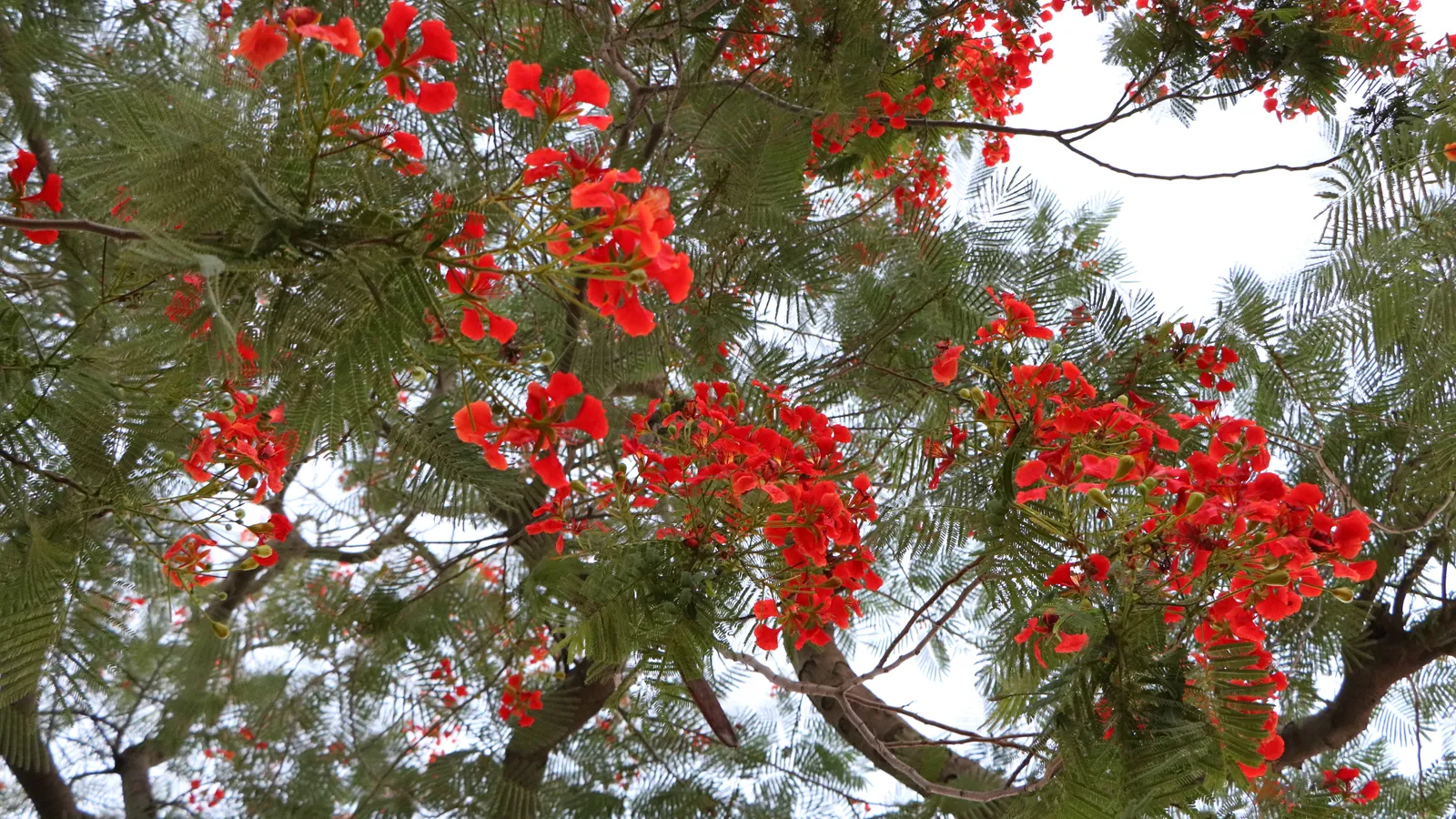
In late April two Indian street trees stop you: gulmohar, a blaze of scarlet, and amaltas, hanging chains of yellow. Both peak when the last good rain was months ago. That looks backwards: flowers cost water and food.
Why do gulmohar and amaltas flower in the hottest months?
For Indian trees, summer flowering is the norm, not the exception. Botanists K. P. Singh and C. P. Kushwaha of Banaras Hindu University pulled together records for 119 Indian tropical trees and found that summer-flowering species were the largest group, at 56% of the total (Annals of Botany, 2006). They suggest that summer flowering, paired with a summer flush of new leaves, is an adaptation that lets trees survive a strongly seasonal tropical climate.
Amaltas (*Cassia fistula*) is native to the Indian subcontinent and nearby parts of Southeast Asia, and blooms in hot, dry weather (Cassia fistula overview). Gulmohar (*Delonix regia*) comes from Madagascar's dry deciduous forests; in India it is bare in winter, leafs out in March and April and reaches full bloom in May (Delonix regia overview).
How can a tree flower in the dry season without rain?
It drops its leaves first. Leaves lose water through tiny pores called stomata. Ecologist Rolf Borchert followed more than 150 trees of 37 species through two dry seasons in Costa Rica's dry forest (Ecology, 1994). Once the leaves fell, that water loss stopped, the stems rehydrated using leftover water, and many trees then flowered or put out new shoots while it was still dry.
The trunk is a water tank too. Borchert concluded that stored water “buffers the impact of seasonal drought and enables flowering and flushing during the dry season.” Only hardwood trees at dry upland sites, with no stem water store and no access to water deep in the soil, dried out and stayed inactive.
Day length can act as a cue as well. Borchert and colleagues reported that it can trigger synchronised flowering in trees near the Equator (Nature, 2005) and new leaves in dry forest trees with no rain (Trees, 2002). For the leaf-drop side of the story, see why many Indian trees drop their leaves in summer.
Where does a bare tree get the food to make flowers?
Partly from savings. Trees store sugars and starch in their branches, trunks and roots. In a seasonally dry forest in Panama, Newell and colleagues found that branch wood of two fully drought-deciduous species held about four times as much stored carbohydrate at the dry-season peak as at the wet-season low (Oecologia, 2002). Those were Panamanian species, not gulmohar, and the swings tracked photosynthesis more than reproduction. Still, such trees enter the dry season with full stores to draw on.
Why finish flowering before the monsoon?
Because the rains are a deadline. The southwest monsoon normally sets in over Kerala around 1 June (India Meteorological Department). In the BHU study, every flowering type finished fruiting in the late dry season, “ensuring that some, if not all, seeds are available for germination when the soil is sufficiently moist” (Annals of Botany, 2006). Dry-season flowering may also help pollination, they add.
Pollinators fit the plan. Amaltas flowers have no nectar; pollen is the only reward, and in a study of amaltas in Brazil, large carpenter bees and bumblebees collected it from the anthers by buzzing (AoB PLANTS, 2021). More on how flowers attract insect pollinators.
Timing shifts with place. Using citizen-science and social-media photos from across India, Kriti and colleagues found that amaltas flowering begins earlier and lasts longer in the south than in the north (bioRxiv preprint), in a country where the season is set by the winds that drive the Indian monsoon.
How do you keep a tree-watching log?
SeasonWatch, an India-wide citizen-science programme, tracks flowering, fruiting and leaf flush on 130+ common trees, with volunteers observing each week (SeasonWatch). It scores leaves as none, few (less than about a third of branches) or many (more than about a third). Borrow that scale for flowers and fruits too.
Pick a gulmohar and an amaltas you pass daily. Code them (G1, A1) and note if each is roadside or in a watered garden.
Observe on the same day and time each week, one line per tree.
Score leaves (fresh, mature, dying), flowers (buds, open) and fruits (unripe, ripe) as none, few or many.
Watch the flowers for five minutes and list the visitors: bees, birds, butterflies.
Note the weather, and the date of the first proper rain when it comes.
Here is a made-up line to show the format: “12 April, 7.30 am, A1 roadside. Leaves: fresh few, dying few. Flowers: buds many, open few. Fruits: none. Visitors: 2 large black bees. Hot, dry.”
By June, look for patterns. Did the watered tree flower earlier or longer? Did pods appear before the first rain?
If transpiration still feels hazy when you write up your findings, the Fermi Concept Library has a lesson for every concept in biology, each with its place in the map.
Start your log in March, before the first buds open, to catch the whole season.


