

On this page
NCERT's Animal Kingdom chapter says Platyhelminthes "have dorso-ventrally flattened body, hence are called flatworms" (NCERT Class 11 Biology, Chapter 4). Here is why, with numbers you can check on a calculator.
Why don't flatworms need lungs, gills or blood?
Flatworms have no circulatory or respiratory system, so gas and nutrient exchange depends on diffusion, and that "necessarily limits the thickness of the body" (OpenStax Concepts of Biology).
Diffusion is the spreading of molecules from where they are more concentrated to where they are less concentrated. Gas exchange by direct diffusion across the body surface is efficient for organisms less than 1 mm in diameter (LibreTexts General Biology/39%3A_The_Respiratory_System/39.01%3A_Systems_of_Gas_Exchange_-_The_Respiratory_System_and_Direct_Diffusion)).
Instead of a pump-and-pipe system, flatworms keep every cell close to the water. NCERT's examples are *Taenia* (tapeworm) and *Fasciola* (liver fluke). Waste is handled by a separate system, explained in how flame cells work in Platyhelminthes.
How thick can a flatworm be before oxygen runs out?
A Florida State University calculus lecture models a flatworm as a flat sheet that takes in oxygen through its upper and lower faces, using figures from R. M. Alexander's 1990 book *Animals* (FSU lecture notes, PDF). The inputs:
Flatworm tissue uses more than 0.1 cm³ of oxygen per hour per gram.
Oxygen moves through the tissue with a diffusion coefficient of about 2 × 10⁻⁵ mm² atm⁻¹ s⁻¹.
Oxygen at the body surface is at 0.21 atm, the share of oxygen in air.
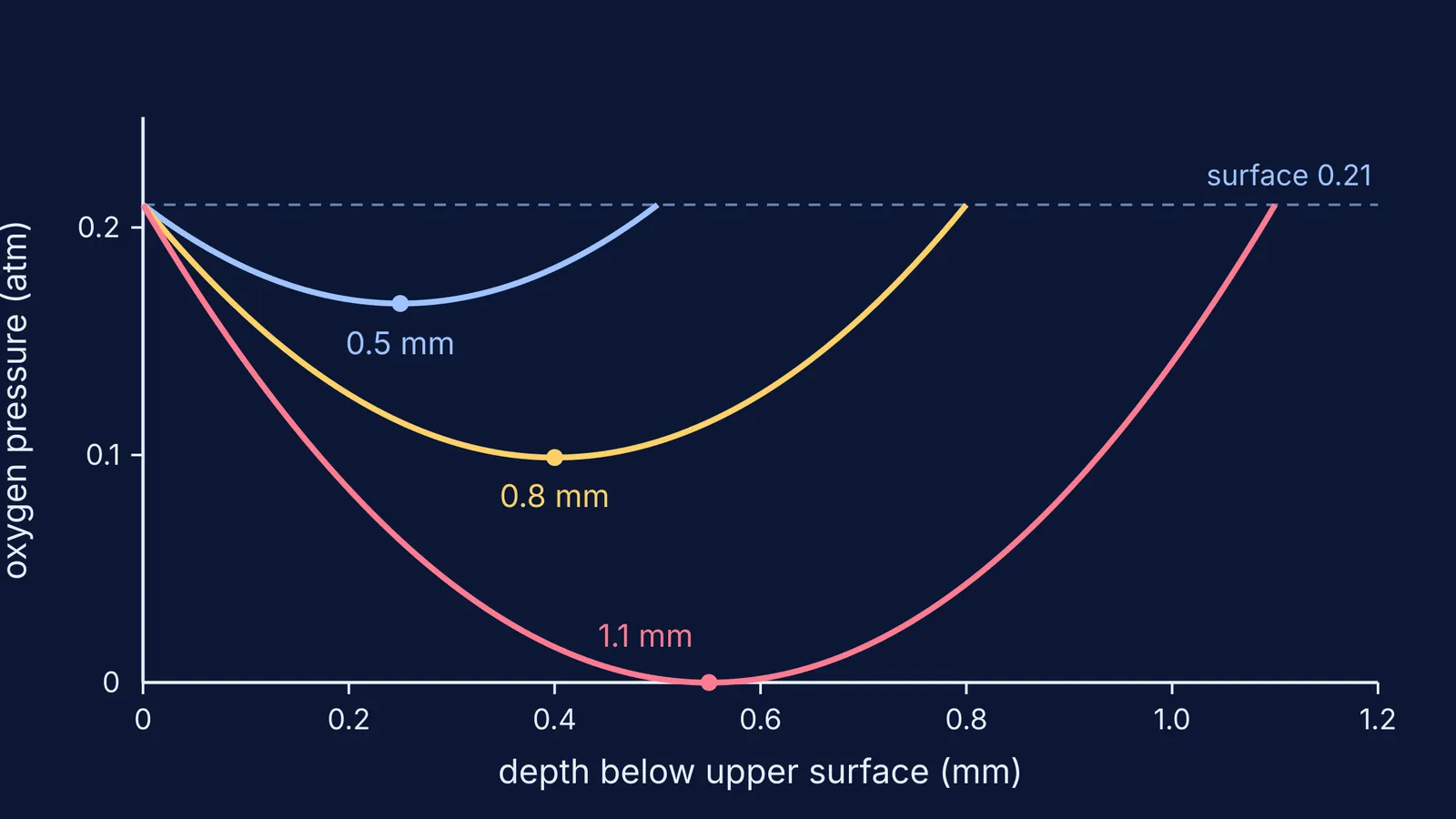
Fick's law says oxygen flows down a pressure gradient at a rate proportional to how steep the gradient is. Each layer of cells uses some oxygen, so pressure falls in a parabola from surface to middle. If the body is too thick, the curve hits zero before the centre and the middle cells suffocate.
Setting the centre pressure to zero gives a maximum flatworm thickness of about 1.1 mm, according to the FSU model. In practice, the same lecture notes, a flatworm is never more than about 0.5 mm thick, less than half that limit.
The diagram at the top plots those curves: with the minimum oxygen-use figure, the centre of a 0.5 mm sheet still has about 0.17 atm of oxygen; at 1.1 mm it has none.
Worked example: why does flat beat round?
Shape 15 mm³ of tissue two ways.
A sheet, 10 mm long, 3 mm wide and 0.5 mm thick:
Volume = 10 × 3 × 0.5 = 15 mm³.
Surface area = 2(10 × 3 + 10 × 0.5 + 3 × 0.5) = 2(30 + 5 + 1.5) = 73 mm².
SA:V = 73 ÷ 15 ≈ 4.9 per mm.
Deepest cell: 0.25 mm from the surface.
A ball with the same volume:
(4/3)πr³ = 15, so r ≈ 1.53 mm.
Surface area = 4πr² ≈ 29.4 mm².
SA:V = 29.4 ÷ 15 ≈ 2.0 per mm.
Deepest cell: 1.53 mm from the surface.
The sheet has about 2.5 times as much surface for each cubic millimetre, and its deepest cell is about six times closer to the water.
Now the time cost. The University of Maryland's MathBench module estimates diffusion time as t = x² ÷ 2D, with D = 10⁻⁵ cm²/s, which is 10⁻³ mm²/s (MathBench, University of Maryland). Using that:
Sheet: t = 0.25² ÷ 0.002 ≈ 31 seconds.
Ball: t = 1.53² ÷ 0.002 ≈ 1,170 seconds, about 20 minutes.
Six times the distance costs about 37 times the time. The same module works out that oxygen would need about 13 hours to diffuse 1 cm into a mouse.
Run the Fick's-law argument for a ball with the same Alexander figures and the largest workable radius comes out at about 0.95 mm (our own working, using the inputs from the FSU lecture notes). A 1.53 mm ball would have a core with no oxygen.
To watch the ratio fall as an object grows, see how surface-area-to-volume ratio limits cell size. Your lungs solve the same problem the other way round, by folding a huge thin surface inside the chest: read how much surface area your alveoli have.
How do you write this in a NEET or board answer?
Flatworms have no respiratory or circulatory organs; gas exchange is by diffusion across the body surface (OpenStax).
Diffusion works only over short distances, roughly under 1 mm (LibreTexts/39%3A_The_Respiratory_System/39.01%3A_Systems_of_Gas_Exchange_-_The_Respiratory_System_and_Direct_Diffusion)).
A dorso-ventrally flattened body gives a high surface-area-to-volume ratio and keeps every cell close to the surface.
A common slip is writing that flatworms have a large surface area. What matters is surface area per unit volume, and how far the deepest cell sits from the surface.
If ratio numericals like the one above trip you up, the Fermi Problem Library has worked problems with a step-by-step solver that explains the reasoning rather than printing an answer. If the gap is the idea itself, the Fermi Concept Library gives diffusion and every other biology concept its own lesson and its place in the map.
Try it yourself: rework the sheet at 1.2 mm thick and check it against the 1.1 mm limit from the FSU flatworm model.


