

On this page
Your arm aches, and by evening you feel warm. That fever is a chain of chemical messages from your arm to your brain that turns up your body's thermostat.
What happens in your arm right after a vaccine?
Your innate immune system, the fast first line of defence, reacts first. According to a 2019 review in npj Vaccines by Hervé and colleagues, resident cells at the injection site, in particular macrophages and mast cells, start the response within minutes of vaccination by releasing pro-inflammatory cytokines.
These cells carry pattern-recognition receptors, such as Toll-like receptors, that detect molecular patterns typical of germs or damaged tissue, the same review explains. Our post on the four barriers of innate immunity covers the basics.
Cytokines are small proteins that immune cells use to signal to other cells. The cytokines that cause fever, called pyrogenic cytokines, include interleukin-1 (IL-1), interleukin-6 (IL-6) and tumour necrosis factor-alpha (TNF-α), as listed in the Hervé review.
How do cytokines reset the body's thermostat?
Your hypothalamus, at the base of the brain, holds a target temperature, often called the set point, and adjusts your body to match it.
Cytokines act in the brain to increase an enzyme called COX-2, which makes prostaglandin E2 (PGE2), explains a 2015 review in Nature Reviews Immunology by Evans, Repasky and Fisher. PGE2 then binds to receptors on temperature-control neurons in the preoptic area of the hypothalamus. The Hervé review calls PGE2 the critical terminal mediator of raised body temperature.
So in a fever, the brain has not lost control. It has chosen a new, higher target. Fever raises core body temperature by 1 to 4 °C, according to Evans and colleagues, who also note that fever has been conserved in vertebrates for over 600 million years of evolution.
Why do you feel cold first and hot later?
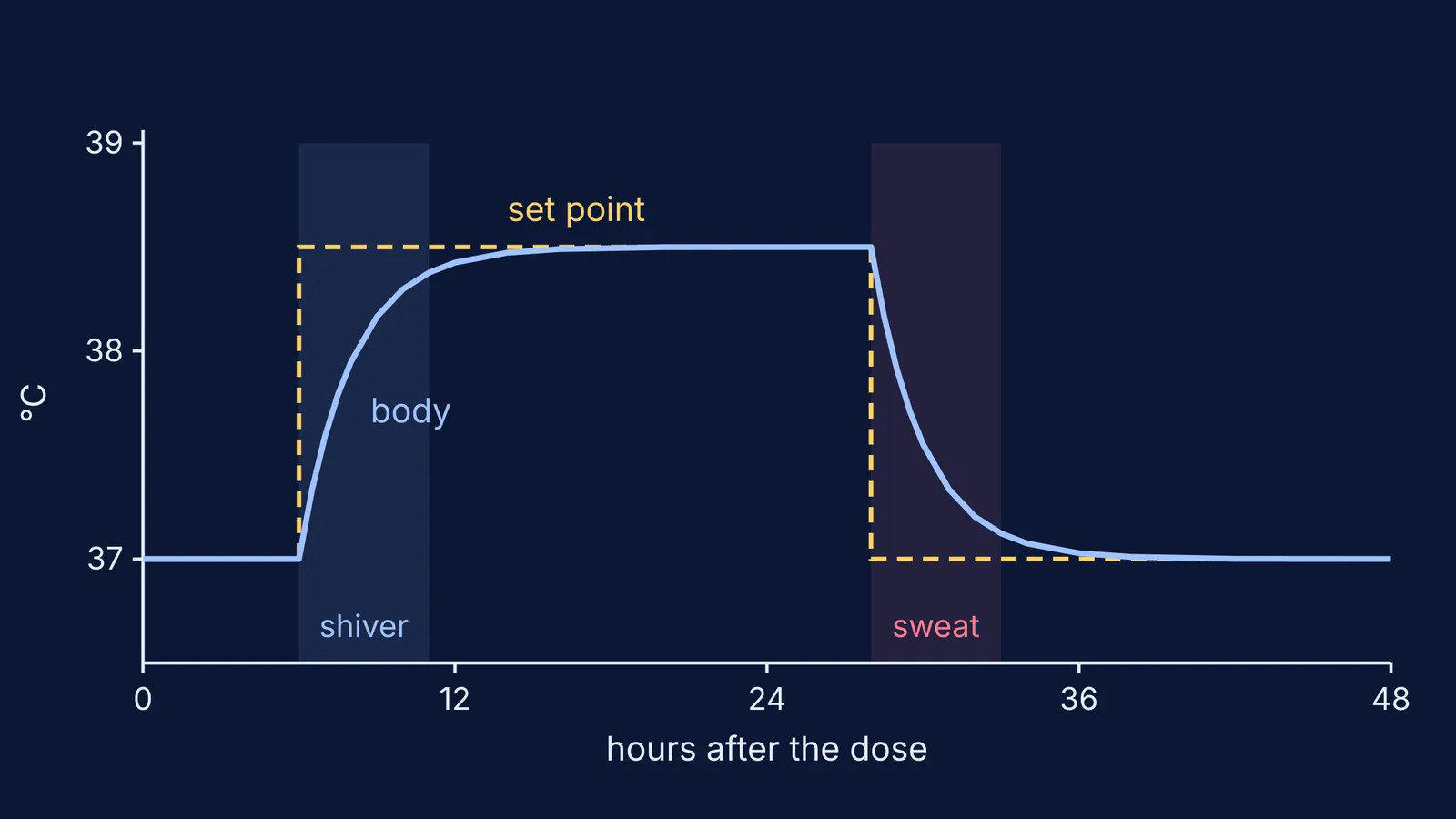
Walk through it like a thermostat problem, using the curve at the top of this post:
The set point jumps up. Your body is still at its old temperature, so the brain reads it as too cold. You feel chilly, skin blood vessels narrow, and you may shiver to make heat.
Your temperature climbs until it reaches the new set point. You feel hot to the touch, but the chills stop.
The cytokine signal fades and the set point drops back. Now your body is too hot for the target, so you sweat and flush until it cools down.
The signal is short-lived. In mouse muscle injected with adjuvanted vaccines, most cytokines fell rapidly within 24 hours and were back to baseline after 72 hours, the Hervé review reports. The same thermostat explains why we shiver when cold.
Does a fever after a vaccine mean it is working?
Writing about COVID-19 vaccines, the World Health Organization says mild side effects such as a low-grade fever are signs that your immune system is responding to the vaccine's antigen. WHO also states that experiencing no side effects doesn't mean the vaccine is ineffective, because everybody responds differently.
The Hervé review notes that studies have not shown a predictive link between how strong the reactions were and the later adaptive response, and says the "no pain, no gain" idea may not be valid, at least for individuals. It also notes that infants and toddlers, though they have fewer injection-site reactions than adults, are more prone to fever episodes after vaccination.
Our explainer on how vaccination builds memory cells covers that second half.
How do you write this in a biology answer?
Use this five-link sequence:
Sense: macrophages at the injection site detect vaccine components through pattern-recognition receptors such as Toll-like receptors.
Signal: they release pyrogenic cytokines, IL-1, IL-6 and TNF-α.
Relay: in the brain, cytokines increase COX-2, which makes prostaglandin E2.
Reset: PGE2 acts on the hypothalamus and raises the temperature set point.
Respond: shivering and narrowed skin blood vessels raise body temperature to the new set point.
A three-line model answer: "Vaccine antigens are detected by innate immune cells, which release pyrogenic cytokines such as IL-1, IL-6 and TNF-α. These increase prostaglandin E2 in the brain, which raises the hypothalamic set point. The body then conserves and produces heat until it reaches the new set point, causing fever."
If one link in that chain feels shaky, the Fermi Concept Library has a lesson for every concept in biology, each with its place in the map, so you can see how innate immunity connects to the hypothalamus.
When should you ask a doctor about a fever after a vaccine?
For COVID-19 vaccines, the World Health Organization says side effects usually go away on their own within a few days. WHO advises telling your local health provider about any unexpected side effects or health events, such as side effects lasting more than three days.
Next time someone at home feels feverish after a shot, you can trace the whole chain, from a macrophage in the arm to a thermostat in the brain.


