

On this page
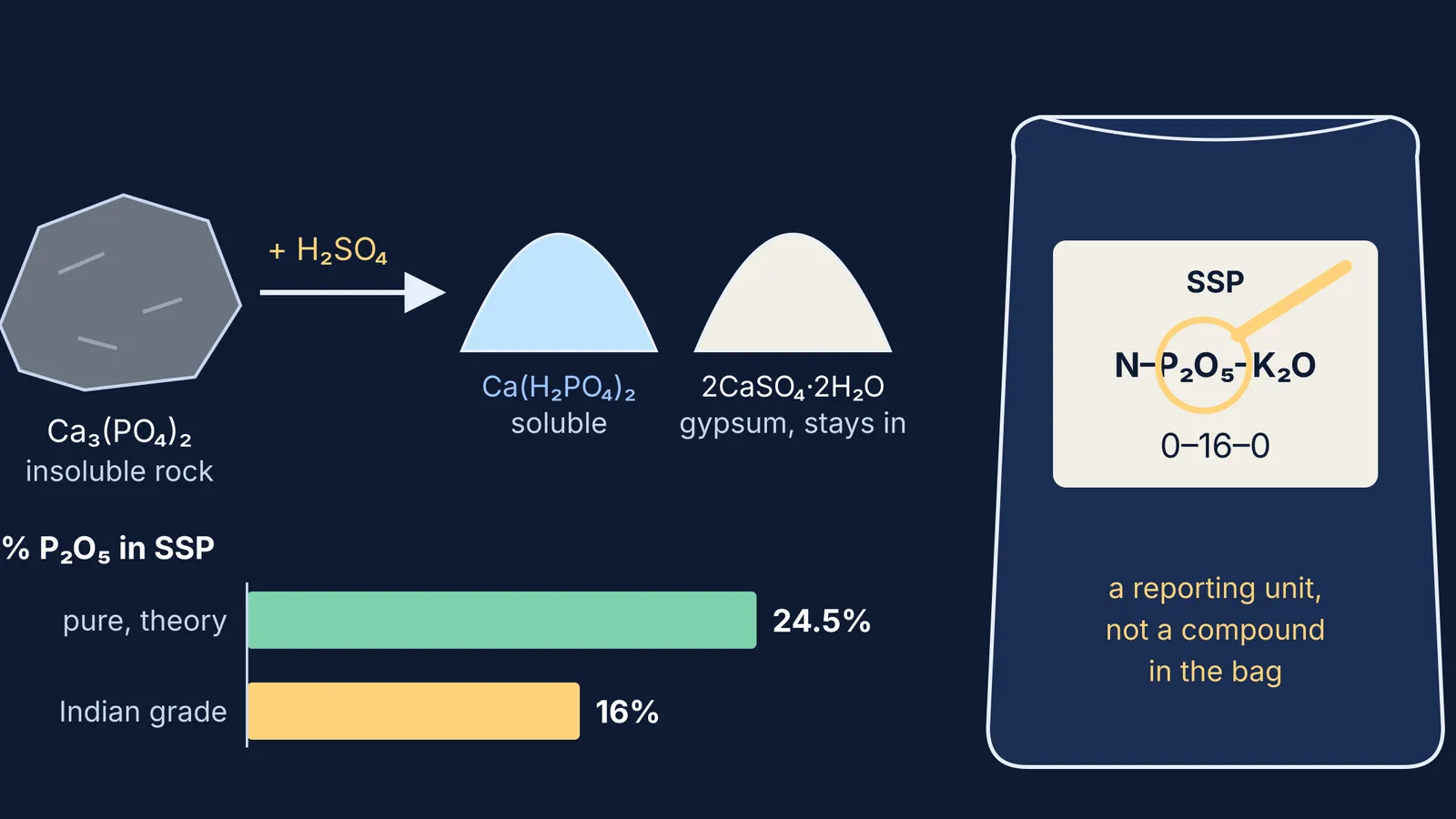
Pick up any bag of phosphate fertiliser in India and the label gives its phosphorus as "% P₂O₅". Yet there is no P₂O₅ in the bag. Phosphorus pentoxide reacts violently with water and would never survive in a fertiliser. The bag holds calcium or ammonium phosphates, and the label reports them as if they were the oxide. This post explains how insoluble rock phosphate is turned into single superphosphate (SSP) and why acid is needed. It also shows how to do the label maths that boards and JEE like to test.
Why can't plants use rock phosphate directly?
Rock phosphate is written in textbooks as Ca₃(PO₄)₂. The real mineral is mostly fluorapatite, Ca₅(PO₄)₃F, mixed with silica, carbonates and other impurities. Either way, it is very sparingly soluble in water. A root can only take up phosphate that is dissolved in soil water, so the rock acts almost like a locked store.
Acid unlocks it. Phosphate is the conjugate base of a weak acid, so H⁺ removes it from solution:
PO₄³⁻ + H⁺ → HPO₄²⁻, and HPO₄²⁻ + H⁺ → H₂PO₄⁻
Each protonation lowers [PO₄³⁻]. The ionic product [Ca²⁺]³[PO₄³⁻]² then falls below Ksp, so more solid dissolves. This is the NCERT idea that salts of weak acids are more soluble at low pH. The three ionisation steps of H₃PO₄ behind it are worked in titrating phosphoric acid with NaOH: why only two end points. The product plants want is the dihydrogen phosphate salt, Ca(H₂PO₄)₂, which dissolves readily in water.
How is single superphosphate made?
SSP is made by mixing ground rock phosphate with sulphuric acid. In textbook form:
Ca₃(PO₄)₂ + 2H₂SO₄ + 4H₂O → Ca(H₂PO₄)₂ + 2CaSO₄·2H₂O
Check the balance:
Ca: 3 on the left; 1 + 2 = 3 on the right.
P: 2 and 2. S: 2 and 2.
H: 4 + 8 = 12 on the left; 4 + 2 × 4 = 12 on the right.
O: 8 + 8 + 4 = 20 on the left; 8 + 2 × 6 = 20 on the right.
The gypsum is not filtered out. It stays in the product, which is why SSP is a fairly dilute phosphate fertiliser. It also brings sulphur, a nutrient in its own right. The government's nutrient-based subsidy list gives SSP the grade 0-16-0-11, meaning 16% P₂O₅ and 11% sulphur.
With real fluorapatite, the fluoride leaves as HF:
2Ca₅(PO₄)₃F + 7H₂SO₄ → 3Ca(H₂PO₄)₂ + 7CaSO₄ + 2HF
(Ca 10 = 3 + 7, P 6, S 7, F 2, H 14 = 12 + 2, O 52 = 24 + 28.) HF attacks the silica in the rock to give SiF₄, and the gas is scrubbed with water, forming fluorosilicic acid, H₂SiF₆. Why silicon forms the SiF₆²⁻ ion while carbon cannot is explained in why SiF₆²⁻ exists but CF₆²⁻ does not.
What is triple superphosphate?
If you use phosphoric acid instead of sulphuric acid, no gypsum forms:
Ca₃(PO₄)₂ + 4H₃PO₄ → 3Ca(H₂PO₄)₂
(Ca 3, P 6, H 12, O 24 on each side.) The acid itself brings phosphorus, so the product is much richer. The same subsidy list gives TSP the grade 0-46-0-0. The name reflects its roughly threefold P₂O₅ content compared with SSP (46 against 16), not anything in the formula.
Why do labels say P₂O₅ and K₂O instead of P and K?
By convention, fertiliser grades report phosphorus as if it were all P₂O₅ and potassium as if it were all K₂O. Nitrogen is reported as the element. A grade like 18-46-0 means 18% N, 46% "P₂O₅" and 0% "K₂O" by mass. India's Fertiliser (Control) Order, 1985 writes its specifications this way. For powdered SSP, for example, it requires at least 16.0% water-soluble phosphate "as P₂O₅" and allows up to 12.0% moisture.
The oxide basis is just a unit. You convert it to the element with a fixed factor:
%P = %P₂O₅ × (2 × 30.97 / 141.94) = %P₂O₅ × 0.436
%K = %K₂O × (2 × 39.10 / 94.20) = %K₂O × 0.830
So the 46 on a DAP bag is only about 20% actual phosphorus by mass. Comparing a "P₂O₅" number with an "N" number on the same bag compares two different kinds of unit.
Worked example: what is the most P₂O₅ that SSP can contain?
Molar masses (g/mol): Ca(H₂PO₄)₂ = 234.05, CaSO₄·2H₂O = 172.16, P₂O₅ = 141.94, (NH₄)₂HPO₄ = 132.06, KCl = 74.55, K₂O = 94.20.
Find the product mass per formula. From the equation, one Ca(H₂PO₄)₂ comes with two CaSO₄·2H₂O. Mass = 234.05 + 2 × 172.16 = 578.38 g.
Count the phosphorus as P₂O₅. Ca(H₂PO₄)₂ has 2 P, which is exactly one P₂O₅ (141.94 g).
Divide. 141.94 / 578.38 × 100 = 24.5% P₂O₅. That is the ceiling for perfectly pure SSP made from pure Ca₃(PO₄)₂.
Check the effect of water of crystallisation. Commercial SSP holds the salt as the monohydrate, Ca(H₂PO₄)₂·H₂O (252.07). Redo step 3: 141.94 / (252.07 + 344.33) = 23.8%. Starting from pure fluorapatite instead, the ceiling drops to about 22%.
Compare with the label. The legal minimum is 16% water-soluble P₂O₅. Real rock carries impurities, and the product carries moisture and some unreacted rock, so a real bag sits well below the theoretical ceiling.
Check the sulphur. S = 2 × 32.06 / 578.38 = 11.1%, which matches the 11 in the 0-16-0-11 grade.
Convert a label to phosphorus. 16% P₂O₅ × 0.436 = 7.0% P. A 50 kg bag holds 8.0 kg of "P₂O₅", which is 3.5 kg of phosphorus.
Try DAP and potash. DAP, (NH₄)₂HPO₄: N = 28.01 / 132.06 = 21.2%, and P₂O₅ = (141.94 / 2) / 132.06 = 53.7%. The trade grade is 18-46-0. Commercial DAP is made from impure wet-process phosphoric acid, so it sits below the pure-compound figures. That is not adulteration. KCl: K₂O = (94.20 / 2) / 74.55 = 63.2%, against the 0-0-60-0 grade for muriate of potash in the same subsidy list.
The percentage method is the same one used for nitrogen in how to calculate nitrogen percentage in urea and ammonium sulphate. If the idea of counting by an oxide still feels odd, the Concept Library gives percentage composition its own lesson. The Fermi Problem Library has a step-by-step solver that explains the reasoning on problems like steps 1 to 8.
Quick checklist
Rock phosphate (Ca₃(PO₄)₂, really Ca₅(PO₄)₃F) is insoluble; acid protonates phosphate and makes soluble Ca(H₂PO₄)₂.
SSP: Ca₃(PO₄)₂ + 2H₂SO₄ + 4H₂O → Ca(H₂PO₄)₂ + 2CaSO₄·2H₂O. The gypsum stays in and supplies sulphur.
TSP: Ca₃(PO₄)₂ + 4H₃PO₄ → 3Ca(H₂PO₄)₂. No gypsum, about 46% P₂O₅.
Labels report P as P₂O₅ and K as K₂O. Multiply by 0.436 or 0.830 to get the element.
Pure SSP tops out at 24.5% P₂O₅; the Indian grade is 16%.


