

On this page
Stand on the deck of a ferry as it swings round in a wide turn and you feel the floor tilt. It tilts outward, away from the centre of the turn, the opposite of a cyclist. The reason is where the forces act, and the ship's stability decides how far it leans.
Why does a ship lean outward in a turn?
To move in a circle of radius R at speed v, a ship of mass m needs a sideways force mv²/R towards the centre. A ship gets it from the water: as the ship turns, its hull meets the water at a small angle, and the water pushes sideways on the whole underwater hull.
That push acts roughly at the middle of the underwater hull, near half the draught (the draught is how deep the hull sits). The ship's centre of gravity G is usually well above that, because the decks, the superstructure and the passengers are all high up.
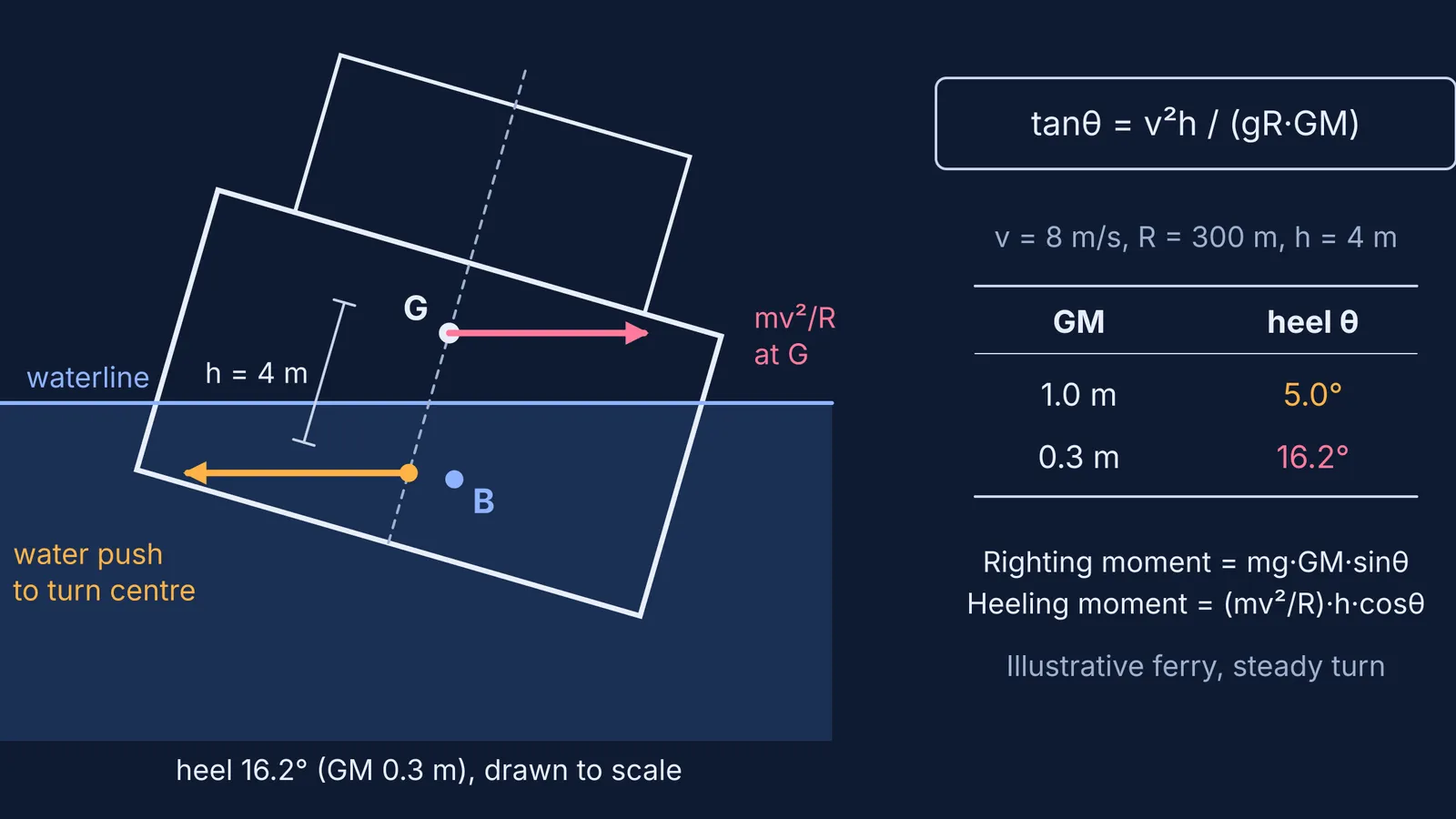
Work in the ship's frame, which is turning. Here you add a centrifugal force mv²/R acting outward at G. Now there are two equal, opposite, horizontal forces: the water's push inward at the bottom, and the centrifugal force outward at G. They do not act along the same line, so they form a couple. A couple with the top force pointing outward rolls the top of the ship outward. That is the outward heel.
A three-wheeler on a road faces the same couple, with friction at the road and G above it, which is why it can topple; that case is in why three-wheelers topple on sharp turns. A ship instead heels until its own righting moment balances the couple.
What stops the ship from heeling over?
When a ship heels by θ, its centre of buoyancy B moves towards the low side. The buoyant force (equal to mg, acting up through B) and the weight (mg, acting down through G) now form a righting couple. For small angles its moment is
righting moment = mg × GM × sinθ
where GM is the metacentric height, the distance from G up to the metacentre M. Where M comes from and how it is measured is covered in how container ships stay stable, so here we take GM as given.
How do you calculate the angle of heel in a turn?
Let h be the height of G above the point where the water's sideways push acts. The two horizontal forces are h apart along the ship's centreline, so when the ship is heeled by θ, the perpendicular distance between their lines is h cosθ.
heeling moment = (mv²/R) × h × cosθ
In a steady turn the ship stops rolling, so the two moments balance:
mg × GM × sinθ = (mv²/R) × h × cosθ
tanθ = v²h / (gR × GM)
The mass cancels. The heel grows as v², so doubling the speed on the same circle roughly quadruples tanθ. It grows with h, the height of G above the water's push, and it shrinks as GM grows.
Worked example: a ferry at 8 m/s on a 300 m circle
All values here are illustrative round numbers, not those of a real ship. Take a ferry turning at 8 m/s (about 15.6 knots) on a circle of radius 300 m, with G 4 m above the centre of the water's push. Use g = 9.8 m/s².
Centripetal acceleration. v²/R = 64/300 = 0.213 m/s².
Numerator. v²h/R = 0.213 × 4 = 0.853 m²/s².
Stable ferry, GM = 1.0 m. tanθ = 0.853/(9.8 × 1.0) = 0.0871, so θ = 5.0°.
Ferry with too little stability, GM = 0.3 m. tanθ = 0.853/(9.8 × 0.3) = 0.290, so θ = 16.2°.
Check units. (m/s)² × m / (m/s² × m × m) has no units, as tanθ must.
The same turn heels the second ship more than three times as far. Only GM changed. A ship can lose GM when weight is added high up, for example when passengers crowd onto an upper deck, because that raises G and brings it closer to M.
How do stability rules check heel in a turn?
The International Maritime Organization's 2008 Intact Stability Code (resolution MSC.267(85)) has a criterion for exactly this. For passenger ships, section 3.1.2 says the angle of heel on account of turning shall not exceed 10° when calculated with the heeling moment
M_R = 0.200 × (V₀²/L_WL) × Δ × (KG − d/2)
where M_R is in kN·m, V₀ is the service speed in m/s, L_WL is the waterline length in m, Δ is the displacement in tonnes, d is the mean draught and KG is the height of G above the keel. Section 3.1.1 of the same code sets a 10° limit for heel caused by passengers crowding to one side.
You can read the physics straight off this formula:
KG − d/2 is the height of G above half the draught. That is the lever h from our model.
Δ × V₀²/L_WL has units of t·m/s², which is kN. With the factor 0.200, it equals Δv²/R for a turning radius R = 5 L_WL.
Try it on an illustrative ferry with L_WL = 100 m, V₀ = 8 m/s, KG = 7 m and d = 4 m, so the lever is 5 m. Dividing M_R by the weight Δg gives a heeling lever of 0.200 × 64/100 × 5/9.8 = 0.0653 m. Setting GM sinθ equal to this:
with GM = 1.0 m, sinθ = 0.0653 and θ = 3.7°, inside the 10° limit;
with GM = 0.3 m, sinθ = 0.218 and θ = 12.6°, outside it;
the smallest GM that keeps this ship within 10° is 0.0653/sin 10° = 0.38 m.
This is why loading rules matter: they keep G low enough that a normal turn stays a gentle lean. If you would like more problems that combine torque balance with circular motion, the Fermi Problem Library has a step-by-step solver that explains the reasoning.
Does a ship ever heel inward in a turn?
Yes, briefly. When the rudder is first put over, the rudder force acts low and pushes the stern sideways before the turn has built up. For a short time the ship can lean slightly inward. Once the ship settles into the turn, the water's push on the whole hull takes over and the steady outward heel follows. Our formula is for that steady state only, and for small angles. A sailing boat is different again: its heel comes from wind on the sails, balanced by the keel, as in how a sailing boat moves towards the wind.
Quick checklist
A turning ship needs mv²/R towards the centre, supplied by the water low on the hull.
In the ship's frame, mv²/R acts outward at G, above the water's push: a couple that heels the ship outward.
Balance: mg·GM·sinθ = (mv²/R)·h·cosθ, so tanθ = v²h/(gR·GM).
Heel grows with v² and h, and falls as GM grows.
The IMO criterion for passenger ships limits heel in a turn to 10°, using the lever KG − d/2.
A brief inward heel can appear as the rudder is first put over.


