

On this page
Every Indian voter leaves the booth with a dark line on the left forefinger. You can scrub it with soap, wipe it with sanitiser and wash dishes all evening, and it is still there the next week. The reason is a reaction you meet in Class 12 and JEE: silver nitrate turning into silver metal inside the outer layers of your skin and nail.
What is election ink made of?
India's indelible ink was developed at CSIR's National Physical Laboratory in New Delhi and is made by The Mysore Paints and Varnish Ltd, a Karnataka government company that entered the business in 1962. A MyGov article on CSIR's indelible ink says the ink contains silver nitrate, "which on reaction with the nail and on exposure to light gets darker". The same page says the exact formula and the quantity of each ingredient are not widely known.
So be careful with any number you see for the strength. Figures quoted in news reports range from under 10% to about 25% silver nitrate, and none of them is an official specification. In this post, 15% w/v is an illustrative value, chosen only to make the arithmetic concrete.
Why does silver nitrate stick to skin?
Silver nitrate, AgNO₃, is a soluble salt, so when the ink goes on, your skin meets free Ag⁺ ions. Two things grab them almost at once.
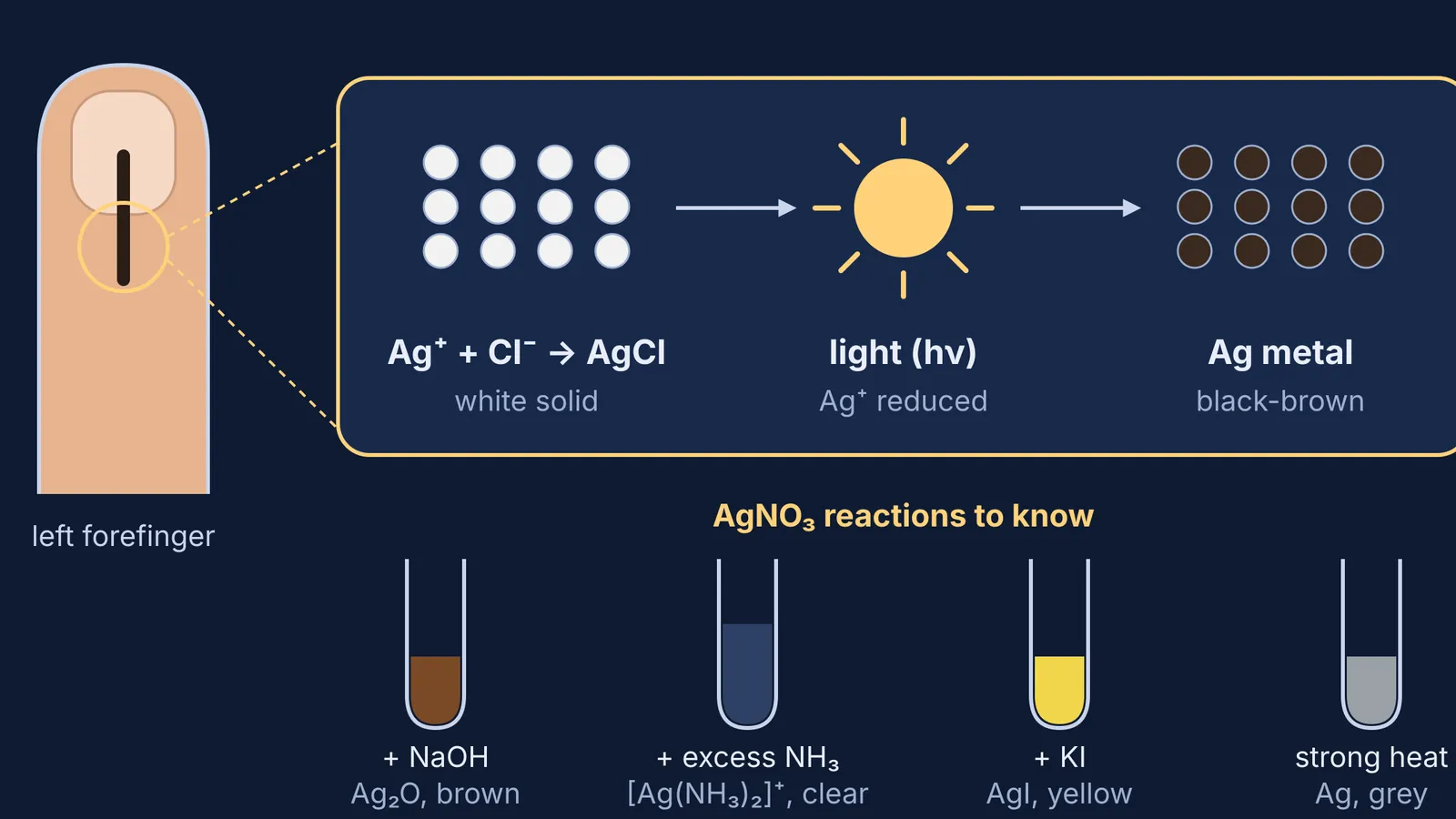
Chloride. Skin always carries a film of salt from sweat. Ag⁺ + Cl⁻ → AgCl(s), a white solid that does not dissolve in water.
Proteins. The outer skin and the nail are made largely of keratin, which is rich in sulphur-containing groups. Ag⁺ is a soft metal ion and binds strongly to soft donor atoms such as sulphur, as the HSAB principle predicts. The silver ends up held in the protein, not just lying on top of it.
The ink looks fairly light when it goes on. It darkens over the next minutes to hours.
Why does the mark turn black?
Light and the organic matter of skin reduce the silver: Ag⁺ + e⁻ → Ag. The product is finely divided silver metal, and finely divided silver looks black or dark brown, not shiny, because the tiny particles absorb and scatter light instead of reflecting it like a mirror.
This is the same photoreduction you meet with silver chloride on a windowsill, written in NCERT as 2AgCl(s) → 2Ag(s) + Cl₂(g) in sunlight. Our post on why silver chloride turns grey in sunlight works out how much photon energy that needs. On skin, the electrons can also come from reducing groups in the skin itself, so the reaction does not need strong sunlight to get going.
The important point for exams: the black colour is mainly silver metal, not AgCl. Silver chloride is white.
Why can't you wash election ink off?
Washing works by dissolving something or lifting it off the surface. Neither happens here.
Silver metal does not dissolve in water, soap solution or alcohol.
AgCl does not dissolve in them either.
The silver is held inside the outer layer of skin and the surface of the nail, bound to protein.
So the mark leaves the way the skin and nail do. The outer skin sheds a little at a time, and the stain on the nail moves out as the nail grows and is cut. The MyGov page says the mark remains on the nail for at least two days and up to a month, depending on conditions. That is why "permanent ink" is the wrong name. It is long-lasting, then it grows out.
Do not try lab chemistry on your finger to remove it. The reagents that dissolve silver compounds in a lab are not meant for skin, and some of them injure it.
Worked example: how much silver is in one mark?
Part 1: will the silver stay dissolved? Use Ksp(AgCl) = 1.8 × 10⁻¹⁰ at 25 °C. Sweat chloride varies a lot from person to person; take [Cl⁻] = 0.04 M as an illustrative value.
At the point of precipitation, [Ag⁺][Cl⁻] = Ksp.
[Ag⁺] = 1.8 × 10⁻¹⁰ / 0.04 = 4.5 × 10⁻⁹ M.
The ink brings in Ag⁺ at roughly 1 M (see Part 2), about 10⁸ times more than this. So practically every Ag⁺ that meets chloride comes out of solution as AgCl.
Part 2: stoichiometry (all values illustrative). Suppose a 10 mL vial of ink is 15% w/v AgNO₃ and is enough for 700 voters. Molar mass of AgNO₃ = 107.87 + 14.01 + 3 × 16.00 = 169.87 g mol⁻¹.
Mass of AgNO₃ = 0.15 g mL⁻¹ × 10 mL = 1.5 g.
Moles = 1.5 / 169.87 = 8.83 × 10⁻³ mol, or 8.83 mmol.
Mass of silver = 8.83 × 10⁻³ × 107.87 = 0.95 g.
Per voter = 0.95 g / 700 ≈ 1.4 mg of silver.
Concentration check: 8.83 mmol in 10 mL is 0.88 M, which is the "roughly 1 M" used in Part 1.
About a milligram of silver per finger, spread through a thin layer of skin. The dose in one mark is small. Silver nitrate itself is corrosive and stains, which is why it is handled carefully in the lab and why the ink is applied by trained staff.
Which AgNO₃ reactions should you know for JEE?
AgNO₃ is on the list of important compounds for JEE, and these four reactions come up again and again.
With NaOH: brown Ag₂O. 2AgNO₃ + 2NaOH → Ag₂O + 2NaNO₃ + H₂O. Silver hydroxide is not isolated; it loses water at once. Details in silver oxide reactions and Tollens' reagent.
With excess NH₃: a clear solution. AgNO₃ + 2NH₃ → [Ag(NH₃)₂]NO₃. With a little ammonia you first see brown Ag₂O, which dissolves as more NH₃ forms the linear diammine complex.
With KI: yellow AgI. AgNO₃ + KI → AgI + KNO₃. AgI is the least soluble of the common silver halides.
On strong heating: silver metal. 2AgNO₃ → 2Ag + 2NO₂ + O₂. Silver oxide is unstable at that temperature, so the metal is left behind.
Check each equation: atoms and charges balance on both sides. If balancing redox or complex equations keeps tripping you, the Fermi Problem Library has a step-by-step solver that explains the reasoning, not just the answer.
Quick checklist
Election ink in India contains silver nitrate; its exact strength is not public, so treat any percentage as illustrative.
Ag⁺ meets chloride (AgCl, white) and binds sulphur-rich keratin.
Light and skin reduce Ag⁺ to finely divided silver metal, which is black.
Silver metal and AgCl do not dissolve in water, soap or alcohol, so the mark lasts until skin sheds and the nail grows out.
Ksp(AgCl) = 1.8 × 10⁻¹⁰ means only about 4.5 × 10⁻⁹ M Ag⁺ can stay dissolved at 0.04 M Cl⁻.
Know the four AgNO₃ reactions: NaOH, NH₃, KI and strong heating.


