

On this page
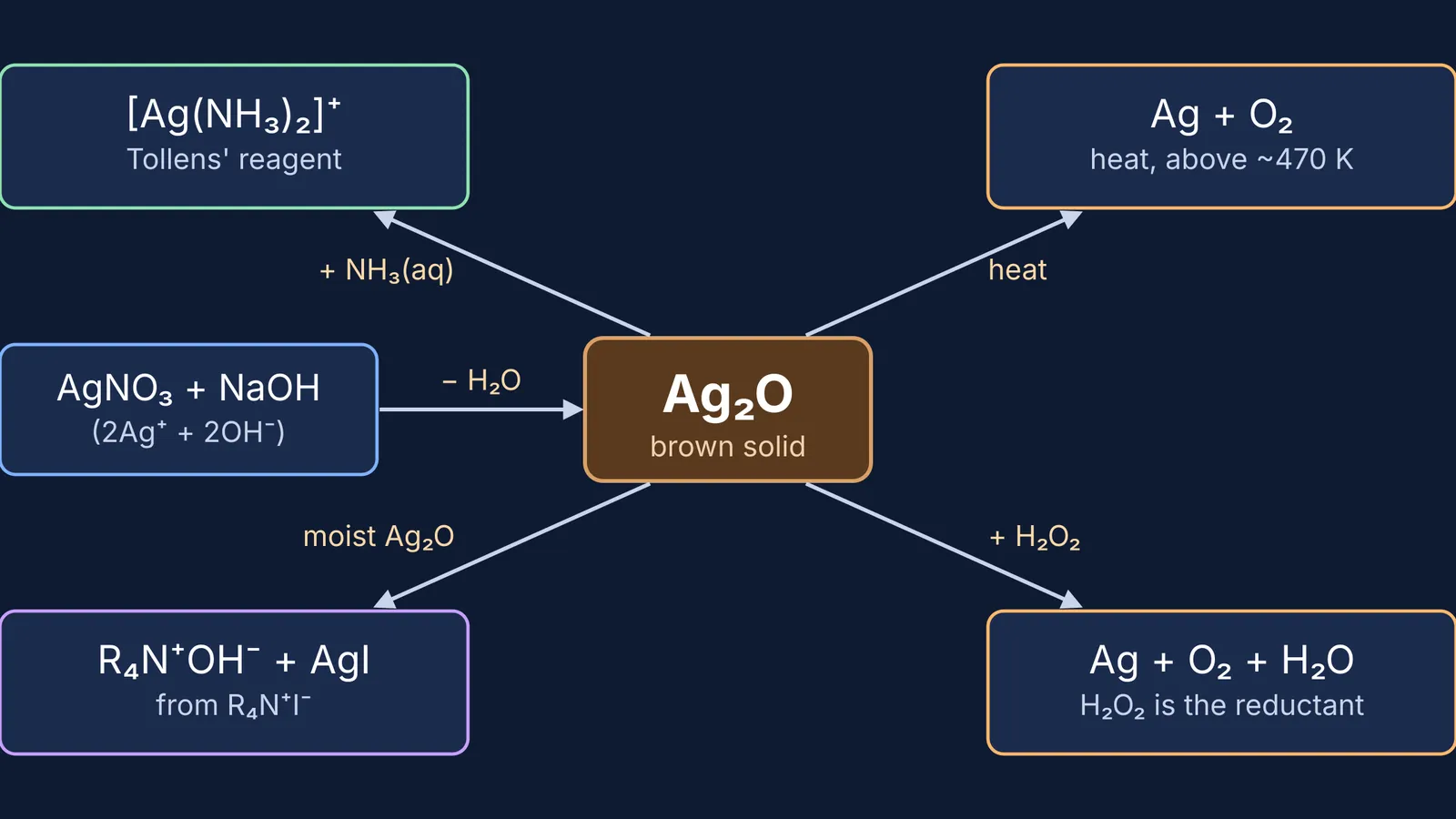
Add a few drops of sodium hydroxide to silver nitrate solution and a brown precipitate appears. That solid is silver oxide, Ag₂O, and it is the starting point for four reactions JEE and NEET keep returning to: Tollens' reagent, the moist-Ag₂O step before Hofmann elimination, its reduction by hydrogen peroxide, and its loss of oxygen on heating. JEE Advanced names silver oxide in its inorganic syllabus, so it is worth knowing as a compound in its own right, not only as a reagent in organic chemistry.
Why do you get Ag₂O and not AgOH?
The ionic equation is:
2Ag⁺ + 2OH⁻ → Ag₂O + H₂O
Check: 2 Ag, 2 O and 2 H on each side; charge 0 on both sides. In molecular form, 2AgNO₃ + 2NaOH → Ag₂O + 2NaNO₃ + H₂O.
You might expect silver hydroxide, by analogy with NaOH. But AgOH is not isolated as a stable compound. Any AgOH that forms loses water at once (2AgOH → Ag₂O + H₂O), so the brown solid you filter off is the oxide. When an organic textbook writes "AgOH" or "moist Ag₂O", it means Ag₂O in water, which behaves as a source of OH⁻. Do not write AgOH as a product you can bottle.
Ag₂O is a basic oxide, not an amphoteric one. It dissolves in acids to give silver salts (Ag₂O + 2HNO₃ → 2AgNO₃ + H₂O), and it does not dissolve in excess NaOH the way Zn(OH)₂ or Al(OH)₃ do. Its sparing solubility makes its water slightly alkaline. General properties are summarised on the silver oxide page on Wikipedia.
How does Ag₂O become Tollens' reagent?
Ag₂O dissolves in aqueous ammonia because Ag⁺ forms the linear complex ion diamminesilver(I):
Ag₂O + 4NH₃ + H₂O → 2[Ag(NH₃)₂]⁺ + 2OH⁻
Check: 2 Ag, 4 N, 14 H and 2 O on each side; charge 0 on the left and 2(+1) + 2(−1) = 0 on the right. This colourless, alkaline solution is Tollens' reagent. Keeping silver tied up as a complex stops Ag₂O from precipitating in the alkaline solution, so the silver stays available to be reduced. An aldehyde then reduces it to a silver mirror:
RCHO + 2[Ag(NH₃)₂]⁺ + 3OH⁻ → RCOO⁻ + 2Ag + 4NH₃ + 2H₂O
Charge: +2 − 3 = −1 on the left and −1 on the right. For which carbonyl compounds pass this test, see Tollens' and Fehling's tests, and for the history of the reagent, Bernhard Tollens and the silver mirror.
What does moist Ag₂O do in Hofmann elimination?
A quaternary ammonium iodide, R₄N⁺I⁻, cannot eliminate on heating because iodide is too weak a base. Moist silver oxide swaps the iodide for hydroxide:
2R₄N⁺I⁻ + Ag₂O + H₂O → 2R₄N⁺OH⁻ + 2AgI
Check: 2 Ag, 2 I and 2 O on each side, and the H from water ends up in the two OH⁻ ions. The driving force is the very low solubility of AgI, which falls out of solution and pulls the reaction to the right. Heating the quaternary ammonium hydroxide then gives the alkene, explained in Hofmann elimination: why the less substituted alkene wins.
The same idea turns an alkyl halide into an alcohol: moist Ag₂O supplies OH⁻ and removes the halide as AgX.
Why does H₂O₂ reduce Ag₂O to silver?
Hydrogen peroxide is usually an oxidising agent, but towards Ag₂O it is a reducing agent:
Ag₂O + H₂O₂ → 2Ag + H₂O + O₂
Check atoms: 2 Ag, 2 H and 3 O on each side. Now the electrons. Two Ag go from +1 to 0, gaining 2 electrons. The two oxygen atoms of H₂O₂ go from −1 to 0 in O₂, losing 2 electrons. Gain equals loss. The oxygen in Ag₂O stays at −2 and ends up in water.
The rule to remember: H₂O₂ acts as a reductant when it meets an oxidant stronger than itself, and Ag⁺ is a fairly strong oxidant. You see oxygen bubbling off and grey-black silver forming.
At what temperature does Ag₂O lose oxygen? A worked example
On heating, 2Ag₂O → 4Ag + O₂. You can estimate when this becomes favourable from formation data. Use standard values at 298 K (approximate, from common data tables): ΔfH°(Ag₂O) = −31.1 kJ mol⁻¹; S°(Ag₂O) = 121.3, S°(Ag) = 42.55 and S°(O₂) = 205.15 J K⁻¹ mol⁻¹.
Step 1: write the formation reaction. 2Ag(s) + ½O₂(g) → Ag₂O(s), with ΔH° = −31.1 kJ mol⁻¹.
Step 2: find ΔS°. ΔS° = 121.3 − (2 × 42.55) − (½ × 205.15) = 121.3 − 85.1 − 102.6 = −66.4 J K⁻¹ mol⁻¹. It is negative because a gas is used up.
Step 3: ΔG° at 298 K. ΔG° = ΔH° − TΔS° = −31.1 − 298 × (−0.0664) = −31.1 + 19.8 = −11.3 kJ mol⁻¹. Negative, so Ag₂O is stable at room temperature.
Step 4: find where ΔG° = 0. T = ΔH° ÷ ΔS° = (−31 100) ÷ (−66.4) ≈ 468 K, about 195 °C. Above this, ΔG° for formation is positive, so the reverse reaction, loss of O₂, is favoured.
Step 5: interpret honestly. This estimate assumes O₂ at 1 bar and treats ΔH° and ΔS° as constant, so call it approximate. In air, where O₂ is only about 0.21 bar, the same data give a slightly lower figure, near 430 K. In practice decomposition is slow until about 200 °C and becomes fast near 300 °C, because rate matters too.
Step 6: a mass check. Heating 2.32 g of Ag₂O (0.0100 mol, M = 231.74) to constant mass leaves 0.0200 mol of Ag, 2.16 g. The loss is 0.16 g, 6.9% of the starting mass.
This is why heating silver nitrate leaves silver metal and not an oxide: any Ag₂O formed is already above its decomposition temperature. That reaction is worked through in what KMnO₄, K₂Cr₂O₇ and AgNO₃ give on heating.
If ΔG° = ΔH° − TΔS° problems like this trip you up, the Fermi Problem Library has a step-by-step solver that explains the reasoning at each line.
Quick checklist
Ag⁺ + OH⁻ gives brown Ag₂O. AgOH is not isolated.
Ag₂O is basic, not amphoteric: it dissolves in acids and in ammonia, not in excess NaOH.
Ag₂O + 4NH₃ + H₂O → 2[Ag(NH₃)₂]⁺ + 2OH⁻ is Tollens' reagent. Make it fresh and never store it.
Moist Ag₂O swaps I⁻ for OH⁻ in R₄N⁺I⁻ because AgI precipitates.
Ag₂O + H₂O₂ → 2Ag + H₂O + O₂: here H₂O₂ is the reductant.
ΔG° of formation reaches zero near 470 K (estimate), so Ag₂O loses O₂ on heating, and AgNO₃ leaves Ag metal.


