

On this page
Press the front of your knee and you feel a hard, movable bone: the patella. It sits in an odd place, floating inside the tendon of the big muscle at the front of your thigh. That placement is the answer to why it is there.
What kind of bone is the kneecap?
The patella is the largest sesamoid bone in the human body, sitting in front of the knee joint within the tendon of the quadriceps femoris muscle, according to the StatPearls anatomy review by Cox and colleagues. A sesamoid bone is a bone embedded in a tendon rather than joined end to end with other bones.
The same review lists four jobs for it:
an attachment point for the quadriceps tendon above and the patellar ligament below
a longer moment arm for the patellar ligament, so the quadriceps straightens the knee more effectively
less friction, because the tendon rubs less against the femur
a bony shield for the deeper parts of the knee
If tendons and ligaments blur together for you, our explainer on the difference between a tendon and a ligament sorts them out.
How does the kneecap work like a pulley?
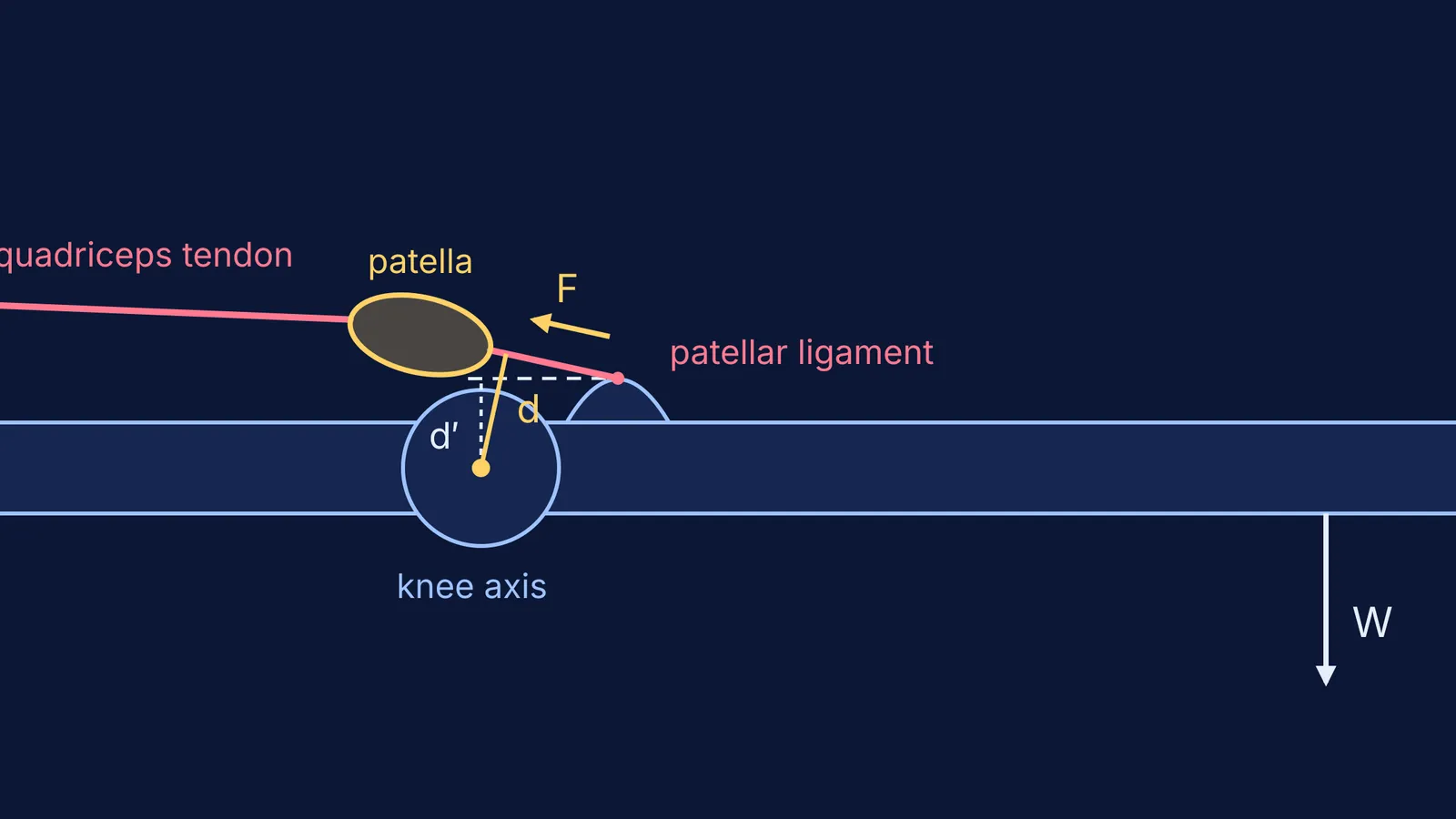
Muscles turn joints with torque, and torque is force times moment arm: τ = F × d, where d is the perpendicular distance from the joint's axis to the line along which the force pulls. A longer d means the same force gives more torque.
The quadriceps tendon wraps over the front of the knee. Without a patella it would lie against the rounded end of the femur, close to the axis, so d would be small. The patella is a thick block set into the tendon that pushes the line of pull forward, away from the axis, and, like a pulley, guides it around the joint. Researchers who measured moving knees with MRI wrote that "the patella creates a dynamic fulcrum" for the quadriceps (Im, Goltzer and Sheehan, Journal of Biomechanics, 2015).
In the diagram at the top, d is the moment arm with a patella and d′ is the shorter one along the dashed path the tendon would take without it.
How much does the kneecap add to your thigh's strength?
Three measured findings frame the answer.
In six cadaver knees, the peak moment arm of the patellar tendon was 4 to 6 cm, largest near 45 degrees of knee bend (Krevolin, Pandy and Pearce, Journal of Biomechanics, 2004).
In 40 healthy volunteers bending and straightening their knees inside an MRI scanner, the effective quadriceps moment arm rose from roughly 3.2 cm to between 4.5 and 4.7 cm as the knee straightened from 50 to 10 degrees (Im, Goltzer and Sheehan, 2015).
Herbert Kaufer reported in 1971 that the patella adds to the extension moment arm through the whole range of knee motion, more so as the knee straightens, and that full extension after the patella is removed may need as much as 30 per cent more quadriceps force, depending on how the gap is repaired (Kaufer, Journal of Bone and Joint Surgery, 1971).
Worked example: the kneecap's moment arm in numbers
Sit on a chair and hold one leg straight out, with a 5 kg bag hanging from your ankle 40 cm from the knee axis. Ignore the weight of the leg itself.
Load torque: W = 5 kg × 9.8 m/s² = 49 N, so τ = 49 N × 0.40 m = 19.6 N m.
With a patella: take d = 4.5 cm, inside the range the 2015 MRI study measured near full extension. The quadriceps must pull with F = 19.6 ÷ 0.045 ≈ 436 N.
Without a patella: take Kaufer's upper figure of 30 per cent more force for the same torque. That is what you get if the moment arm shrinks to 1 ÷ 1.3 of its value, about 3.5 cm. Now F = 19.6 ÷ 0.0346 ≈ 567 N.
Difference: up to about 130 N extra, roughly the weight of another 13 kg, just to hold the same bag still.
Even with a patella, the muscle pulls with about nine times the bag's weight. The knee is a third-class lever, with the effort between the pivot and the load, so it gives up force to gain speed and range. Our guide to the three classes of levers with examples walks through others. The patella wins back part of the force this design costs.
How can you practise moment-arm problems?
Rework the example with the bag at 30 cm, then with d = 4 cm, and predict before you calculate whether F goes up or down. If a step trips you up, the Fermi Problem Library has worked problems with a step-by-step solver that explains the reasoning rather than printing an answer. If the gap is the idea of torque itself, the Fermi Concept Library gives each concept in physics and biology its own lesson.


