

On this page
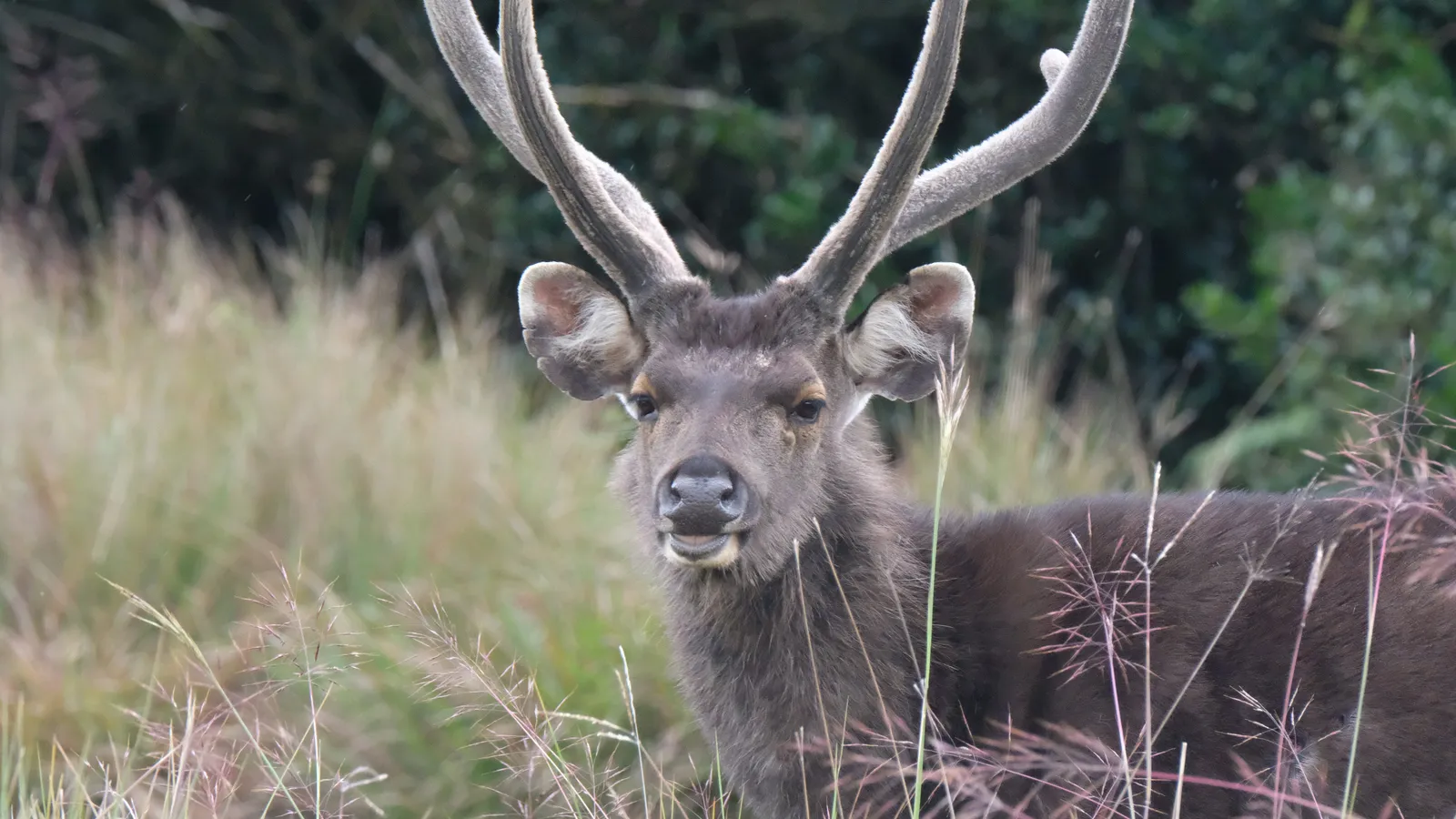
If you have walked through Kanha or Bandipur, you may have seen a chital stag with soft, furry antlers and another stag beside it with hard, polished ones. Antlers are bone that a deer grows, uses for one breeding cycle, drops and grows again. Horns stay on the animal for life.
What is the difference between antlers and horns?
A horn has two parts: a core of living bone attached to the skull, and a sheath of keratin over it, the same protein as your nails. A 2026 review of ruminant headgear by Piprek and colleagues in Biology says horns are not shed during an animal's lifetime. They grow from the base.
An antler is bare bone with no keratin covering. It grows from a permanent stump on the skull called the pedicle. While it grows, it is covered in velvet, a skin full of blood vessels and nerves. The same review notes that once the velvet is shed, the blood vessels go with it, and the antler bone dies.
The two belong to different families. The review counts 143 species of Bovidae (cattle, antelopes, goats), the family with true horns, and 55 species of Cervidae, the deer family, which carries antlers. In most deer only males grow antlers; reindeer are the one species where females have them too.
For a longer list of Indian examples, see our explainer on the difference between horns and antlers.
Why do deer shed their antlers every year?
Hormones, timed to the breeding season. Here is the cycle as the Piprek review describes it:
Growth: the antler grows from the pedicle, covered in velvet.
Hardening: testosterone rises, the antler mineralises and the velvet is rubbed off.
Rut: androgen levels peak while the antlers are hard and bare, the start of the rutting season and fights between males.
Casting: after the rut, testosterone falls and osteoclasts, cells that dissolve bone, form at the base of the antler. They eat through the joint with the pedicle until the antler drops.
Regrowth: a new antler starts from the same pedicle.
Regrowth is fast. Antlers are the fastest-growing tissue in animals, with growth rates that can exceed 2 cm a day, according to the same review. A 2025 study in iMeta says antlers can lengthen by up to about 2 cm a day, over 300 times faster than a human growth plate, which adds about 2 cm a year.
Why not keep the same set? The review explains how casting happens rather than why it evolved. Price and Allen, writing in Philosophical Transactions of the Royal Society B, called antlers the only mammalian appendages that can regenerate over and over, regrowing every year from a blastema (a mass of cells that rebuilds lost tissue).
Our post on whether bone is a living tissue explains what normally keeps bone alive.
Why don't chital and sambar shed at the same time?
In temperate deer, the Piprek review explains, longer days trigger antler growth, so a whole population moves through the cycle together. Near the tropics, day length barely changes across the year. That same review notes that in tropical chital (Axis axis) and sambar (Rusa unicolor), every stage of the antler cycle can be seen at any time of year.
Each stag seems to keep his own clock. Loudon and Curlewis studied free-ranging axis deer stags in southern England for the Journal of Reproduction and Fertility. They found little sign of a shared seasonal cycle in the herd. In four stags followed closely, testosterone and testis size rose and fell with each stag's own antler stage, highest in hard antler. This helps explain why one Indian meadow can hold a velvet stag, a hard-antlered stag and one with bare pedicles all at once. For more on chital behaviour, read why deer follow langurs.
Antlers vs horns: how do they compare?
Material: antlers are bone only; horns are a bone core with a keratin sheath.
Shed? Antlers are cast after each breeding cycle; horns are kept for life.
Growth: antlers regrow from the pedicle under velvet; horns grow from the base.
Alive when mature? A hard antler is dead bone; a horn's core stays living bone.
Who has them: antlers in most male deer, plus female reindeer; horns in many bovid males, and in some females, depending on species.
How can you remember the antler cycle for an exam?
Try this check without notes.
Draw a circle and write five stages around it: growth, hardening, rut, casting, regrowth.
Next to each stage, write whether testosterone is low, rising, high or falling.
Mark the point where the bone dies (velvet shed) and the cell that causes casting (osteoclast).
Explain aloud why a sambar herd in Kerala can show mixed stages but a temperate deer herd does not. If you can say "day length" and "each stag's own clock", you have it.
Stuck on step 2? The Fermi Concept Library has a lesson for every biology concept, so you can revisit testosterone, osteoclasts or bone tissue and see where each fits in the map.


