

On this page
Horns and antlers both grow from an animal's head, so people often treat the words as the same. Biologists don't. The difference comes down to two questions: what is it made of, and does it fall off? Answer those and you can sort almost any animal, from a blackbuck to a one-horned rhino.
What is the difference between horns and antlers?
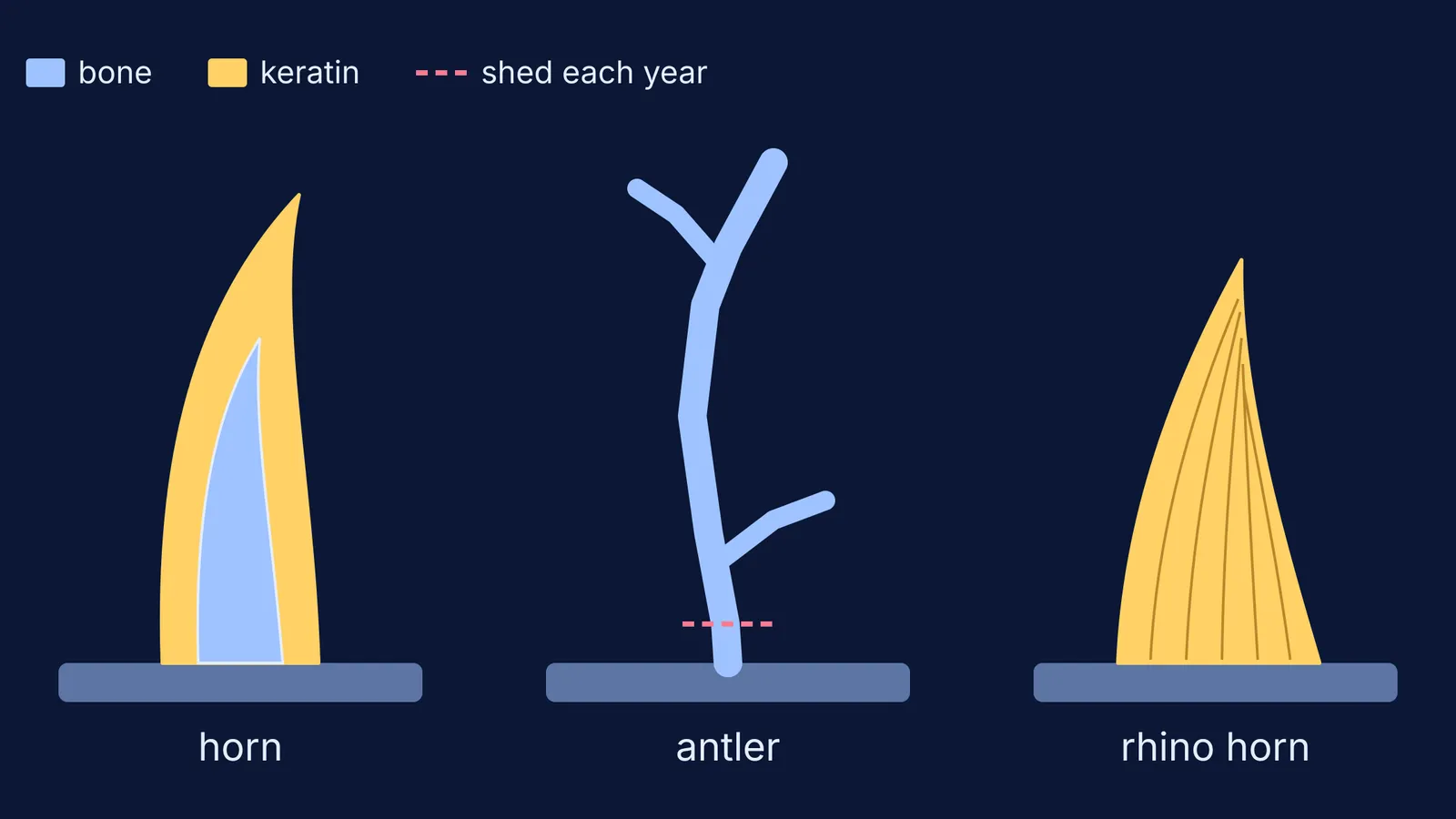
A true horn is a bony core covered by a sheath of keratin, and neither the core nor the sheath is ever shed, according to the Animal Diversity Web at the University of Michigan. True horns are typical of the cattle and antelope family (Bovidae). They are unbranched, and in many species they keep growing for the animal's whole life.
Keratin is the same tough protein that makes your hair and nails; we explain why those are made of dead cells in what hair and nails are made of.
Antlers are branched structures made of bone, and they are shed and regrown every year (Animal Diversity Web). They belong to the deer family (Cervidae) and are usually carried only by males; caribou are the exception, where females grow them too.
While an antler grows, it is wrapped in a soft, hairy skin called velvet, which carries the blood supply to the growing bone, explains the US Fish and Wildlife Service. Antlers can grow up to an inch a day, among the fastest-growing animal tissue on the planet (US Fish and Wildlife Service). The same page notes one more difference that is easy to forget: antlers grow from the tip, while horns grow from the base.
Why is rhino horn not a true horn?
Rhino horn breaks the pattern because it has no bone inside. A study by Tobin Hieronymus, Lawrence Witmer and Ryan Ridgely used CT scans and microscope sections of white rhinoceros horn (Journal of Morphology, 2006). As Ohio University's summary of the work puts it, rhino horns are made entirely of tiny keratin tubes set in a keratin matrix, without any bony core.
The team also found a denser centre reinforced with calcium and melanin. The softer outer layers wear away faster, so the horn keeps a sharp point, rather like a pencil sharpening itself.
India's own rhino follows the same rule. Every greater one-horned rhinoceros, male or female, has a single horn made of keratin, with an average length of 529 mm, according to the Animal Diversity Web species account. The same account says wild populations are now limited to northeastern India and parts of southern Nepal. You can read how Kaziranga brought the one-horned rhino back.
Which Indian animals have horns, antlers or rhino horn?
One example of each type is enough to anchor the idea:
Horn: blackbuck. Only males have horns, 50 to 61 cm long, ringed at the base and twisting up to about four turns (Animal Diversity Web). As an antelope, its horns are bone inside keratin and are never shed.
Antler: chital (spotted deer). Males carry antlers with three tines that can reach almost a metre (Animal Diversity Web). Like all deer antlers, they are bone, and they are dropped and regrown.
Keratin-only horn: greater one-horned rhinoceros. One horn, carried by both sexes, with no bone core (Animal Diversity Web).
How do you tell horns from antlers in a question?
Use this four-step check on diagrams, assertion-reason questions or real objects.
Is there bone inside? If not, it is a keratin-only structure like rhino horn.
Is it branched? Branched bone almost always means antler.
Does it fall off every year? Yes points to antler; no points to true horn.
Check for the known exception. The North American pronghorn has a branched horn sheath that it sheds every year, while the bony core stays (Animal Diversity Web).
Don't use "only males have them" as a test: male-only blackbuck horns and female caribou antlers show it tells you nothing.
Worked example. You see a hard, three-pointed object lying on a forest path. Step 2: it is branched. Step 1: the broken base is solid bone all through, with no outer sheath you could peel away. Step 3: it was lying loose with no sign of a carcass nearby, which fits a structure that falls off on its own. Your answer: an antler, very likely from a deer such as a chital. A blackbuck's horn, unbranched and ringed, with bone inside a sheath and never shed, would fail steps 2 and 3: a true horn.
If bone, keratin and cartilage still blur together, it helps to see them as separate ideas with their own lessons. The Fermi Concept Library covers every concept in biology, each with its own lesson and its place in the map, so you can move from keratin to bone structure in one sitting. For the next step on bone itself, read how compact and spongy bone differ.


